How the US Postal Service Works—and Why It's Broke
The USPS delivers to 167 million addresses daily without tax funding. Here's how its unique business model works, why mail volume collapse and mandatory costs have pushed it toward insolvency, and what that means for universal mail service.
A Government Agency That Funds Itself
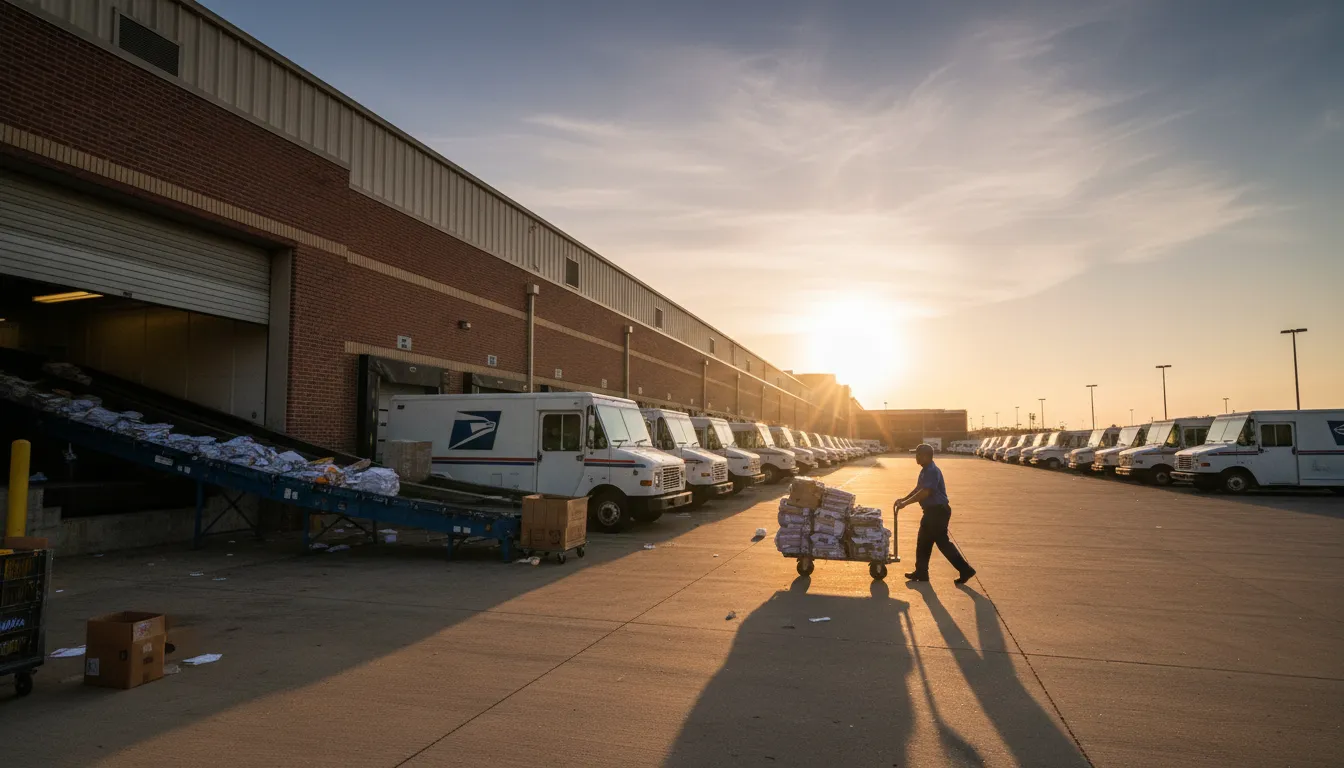
The United States Postal Service is one of the largest civilian employers on Earth, with more than 635,000 workers delivering mail and packages to roughly 167 million addresses every day. Yet unlike nearly every other federal agency, USPS receives no tax dollars for its day-to-day operations. It is expected to pay its own way through the sale of stamps, postage, and shipping services.
That self-funding mandate, combined with a legal obligation to serve every address in the country at uniform prices, creates a tension that has defined the Postal Service's finances for decades—and now threatens its survival.
The Universal Service Obligation
The roots of American mail delivery stretch back to 1775, when the Second Continental Congress established the first national postal agency. The U.S. Constitution itself grants Congress the power to "establish post offices and post roads," and lawmakers have long interpreted that clause as creating both a monopoly on letter delivery and a duty to serve everyone.
This duty is known as the universal service obligation (USO). It requires USPS to deliver mail to every residential and business address in the nation—from Manhattan high-rises to remote Alaskan villages—at the same price. A stamp costs the same whether a letter travels across the street or across the continent.
To support this costly mandate, federal law gives USPS a monopoly on delivering letters under 12.5 ounces. The Private Express Statutes prevent competitors like FedEx or UPS from carrying ordinary letter mail, protecting the revenue stream that historically subsidized deliveries to unprofitable rural routes.
Why the Model Is Breaking Down
The system worked when Americans sent mountains of mail. But First-Class Mail volume has fallen by more than half since its peak in the early 2000s. Bills moved online. Personal letters became emails and texts. Advertising shifted to digital channels. The decline accelerated sharply after the 2008 financial crisis and has never reversed.
USPS pivoted toward package delivery to compensate, processing about 23.5 million parcels daily. But the package market is fiercely competitive. Amazon—once a major USPS customer—surpassed the Postal Service as the largest domestic parcel carrier in 2025, delivering more than three-quarters of its own packages. A new contract signed in early 2026 cut Amazon's USPS volume by 20%, to roughly one billion parcels per year.
Meanwhile, UPS and FedEx each handle billions of packages annually. USPS must compete with these private carriers on price and speed while still serving every address, including those that private companies find unprofitable to reach.
The Retirement Cost Burden
Revenue decline alone doesn't explain USPS's $9 billion annual losses. A major contributor has been retirement obligations. The controversial 2006 Postal Accountability and Enhancement Act required USPS to pre-fund retiree health benefits decades into the future—a burden no other federal agency or private company faces. That requirement saddled the Postal Service with tens of billions in liabilities.
Congress partially addressed this in 2022 with the Postal Service Reform Act, which forgave roughly $57 billion in accumulated debt and ended the pre-funding mandate. But the relief wasn't enough. USPS still lost $9 billion in fiscal 2025, and in April 2026, it took the extraordinary step of halting employer pension contributions to conserve an estimated $2.5 billion in cash.
What Happens If the Money Runs Out
The Postmaster General has warned that without Congressional action, USPS could exhaust its cash reserves by early 2027. The Government Accountability Office has called the business model "unsustainable" and urged urgent reform.
The options are politically fraught. Congress could authorize higher stamp prices, allow USPS to borrow more, provide direct taxpayer funding, or scale back the universal service obligation. Each option has vocal opponents—rural lawmakers resist service cuts, fiscal hawks oppose subsidies, and consumer advocates fight price increases.
For now, USPS continues to add roughly 6,600 new delivery addresses to its network every day, expanding its obligations even as its revenue base shrinks. The agency that Benjamin Franklin once led as the first Postmaster General remains indispensable to American commerce and communication—but its financial model is running on borrowed time.