How Uranium Enrichment Works—and Why It Matters
Uranium enrichment is the process of increasing the concentration of uranium-235 in natural uranium using gas centrifuges, enabling both nuclear power generation and weapons production—making it one of the most strategically sensitive technologies on Earth.
The Core Problem: Too Little U-235
Natural uranium, as mined from the earth, is almost entirely composed of uranium-238—an isotope that cannot sustain a nuclear chain reaction on its own. Only about 0.7% of natural uranium is the fissile isotope uranium-235, the atom that can split and release enormous energy. To power a reactor or build a weapon, that proportion must be increased. That process is called uranium enrichment.
Turning Rock Into Gas
Enrichment begins long before any centrifuge spins. Mined uranium ore is processed into a concentrate called yellowcake, then chemically converted into uranium hexafluoride (UF₆), a compound that becomes a gas when gently heated. The gaseous form is essential because the entire separation method depends on the slight mass difference between UF₆ molecules containing U-235 and those containing U-238.
How Gas Centrifuges Separate Isotopes
The dominant enrichment technology today is the gas centrifuge, first developed in the early 1960s. A centrifuge is essentially a tall, narrow cylinder that spins at extraordinary speed—often exceeding 50,000 revolutions per minute.
When UF₆ gas is fed into the spinning rotor, centrifugal force pushes the slightly heavier U-238 molecules toward the outer wall, while the lighter U-235 molecules concentrate closer to the center. A scoop system draws off two streams: a depleted fraction (enriched in U-238) near the wall and an enriched fraction (with more U-235) from the center.
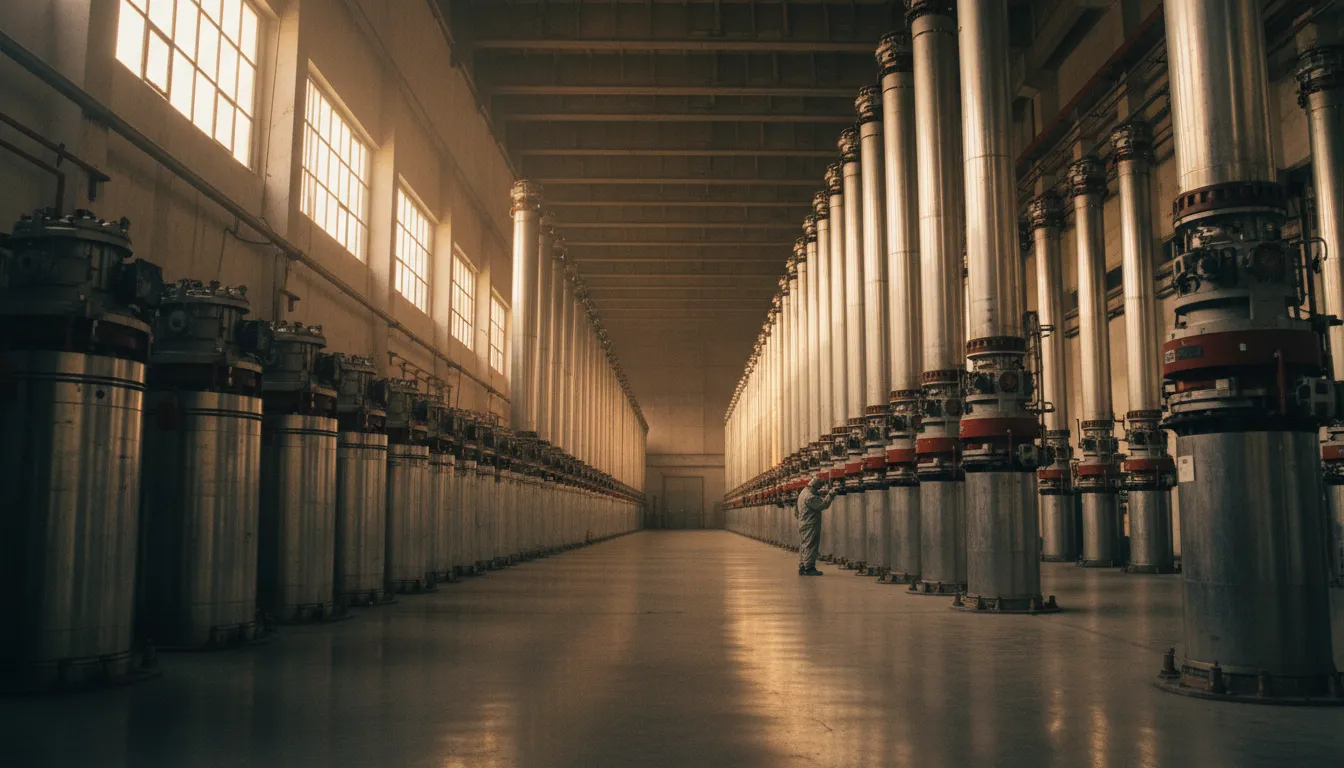
A single centrifuge achieves only a tiny increase in U-235 concentration. To reach useful levels, engineers connect thousands of centrifuges in series, called a cascade. Each stage feeds its enriched output into the next, gradually raising the U-235 proportion step by step.
Enrichment Levels: Fuel vs. Weapons
The degree of enrichment determines what the uranium can be used for:
- Low-enriched uranium (LEU) — 3–5% U-235. This is standard fuel for commercial nuclear power reactors and poses no direct proliferation risk.
- High-assay LEU (HALEU) — 5–20% U-235. Required by some advanced reactor designs now entering service.
- Highly enriched uranium (HEU) — 20% U-235 or above. Used in research reactors and naval propulsion. All HEU is considered weapons-usable.
- Weapons-grade uranium — approximately 90% U-235. Minimizes the critical mass needed for a nuclear weapon, making the device small enough to deliver by missile.
A critical nonproliferation fact: enriching uranium from natural levels to 20% represents roughly 90% of the total effort needed to reach weapons-grade material. The final sprint from 20% to 90% is comparatively fast, which is why international monitors treat the 20% threshold as a red line.
Why Centrifuges Changed the Game
Before centrifuges, the dominant method was gaseous diffusion, which forced UF₆ through thousands of porous membranes. Diffusion plants were enormous—the U.S. facility at Oak Ridge covered more than 40 hectares—and consumed staggering amounts of electricity. Gas centrifuges, according to the World Nuclear Association, use roughly 95% less energy than a comparably sized diffusion plant.
That efficiency made enrichment accessible to smaller states. The technology spread from Europe to Pakistan via the A.Q. Khan network in the 1970s and 1980s, and from there to Libya, Iran, and North Korea—a proliferation chain that reshaped global security.
Monitoring and Safeguards
The International Atomic Energy Agency (IAEA) inspects declared enrichment facilities worldwide. Inspectors install cameras, take environmental samples to detect undeclared isotopes, and verify that enriched material is not diverted. Gas centrifuge facilities are currently the only type of operating enrichment plant under IAEA safeguards, according to agency records.
Yet verification has limits. Centrifuge plants are modular and relatively compact, making covert facilities harder to detect than the sprawling diffusion plants of the Cold War era. Underground construction adds another layer of concealment.
Why It Still Matters
Uranium enrichment sits at the intersection of clean energy and existential risk. The same cascade that produces reactor fuel can, with reconfiguration and time, yield bomb material. As the world builds new reactors to meet climate goals and advanced designs demand higher-enriched fuel, the tension between peaceful use and proliferation risk will only intensify. Understanding how enrichment works is the first step toward understanding why it remains one of the most closely watched technologies on the planet.