How Friction Works—and Why It Still Puzzles Scientists
Friction governs nearly every physical interaction on Earth, yet scientists still struggle to fully explain it. From Leonardo da Vinci's first sketches to modern magnetic experiments, the science of friction remains surprisingly incomplete.
A Force Hiding in Plain Sight
Friction is one of the most familiar forces in daily life. It lets tires grip roads, fingers hold coffee cups, and brakes stop trains. Without it, walking would be impossible and every object on a slope would slide away. Yet despite centuries of study, friction remains one of the least understood forces in physics—a puzzle that still produces surprises in modern laboratories.
What Friction Actually Is
At its simplest, friction is the resistance one surface encounters when sliding against another. But zoom in to the atomic scale and the picture gets complicated fast. No surface is truly smooth. Even polished metal is covered in microscopic peaks and valleys called asperities. When two surfaces press together, only these tiny peaks make real contact—often less than one percent of the apparent surface area.
Pioneering work by physicists Frank Bowden and David Tabor in 1950 showed that this true contact area, not the visible area, determines how much friction occurs. As pressure increases, asperities deform and more peaks interlock, increasing resistance. At the atomic level, friction arises from electromagnetic interactions between surface atoms—bonds forming and breaking millions of times per second as surfaces slide.
The 300-Year-Old Law That (Mostly) Holds
The basic rules of friction were first sketched by Leonardo da Vinci around 1493, but his notebooks went unpublished. In 1699, French physicist Guillaume Amontons independently rediscovered them, and Charles-Augustin de Coulomb refined them in 1781. The resulting principles, known as Amontons' laws, state two things: friction force is proportional to the load pressing surfaces together, and it does not depend on the apparent area of contact.
These laws are remarkably useful. Engineers rely on them to design brakes, bearings, tires, and countless mechanical systems. But they are empirical rules—descriptions of what happens, not explanations of why. And they have known exceptions, particularly at very small scales or in unusual materials.
Why Friction Costs Trillions
The study of friction, wear, and lubrication—collectively called tribology—has enormous economic stakes. According to the Society of Tribologists and Lubrication Engineers, roughly 20 percent of global energy consumption is lost to friction and wear in transportation, manufacturing, and power generation. Reducing friction in engines, turbines, and industrial machinery by even a small percentage could save billions of dollars and cut carbon emissions significantly.
New Discoveries Still Upend Old Assumptions
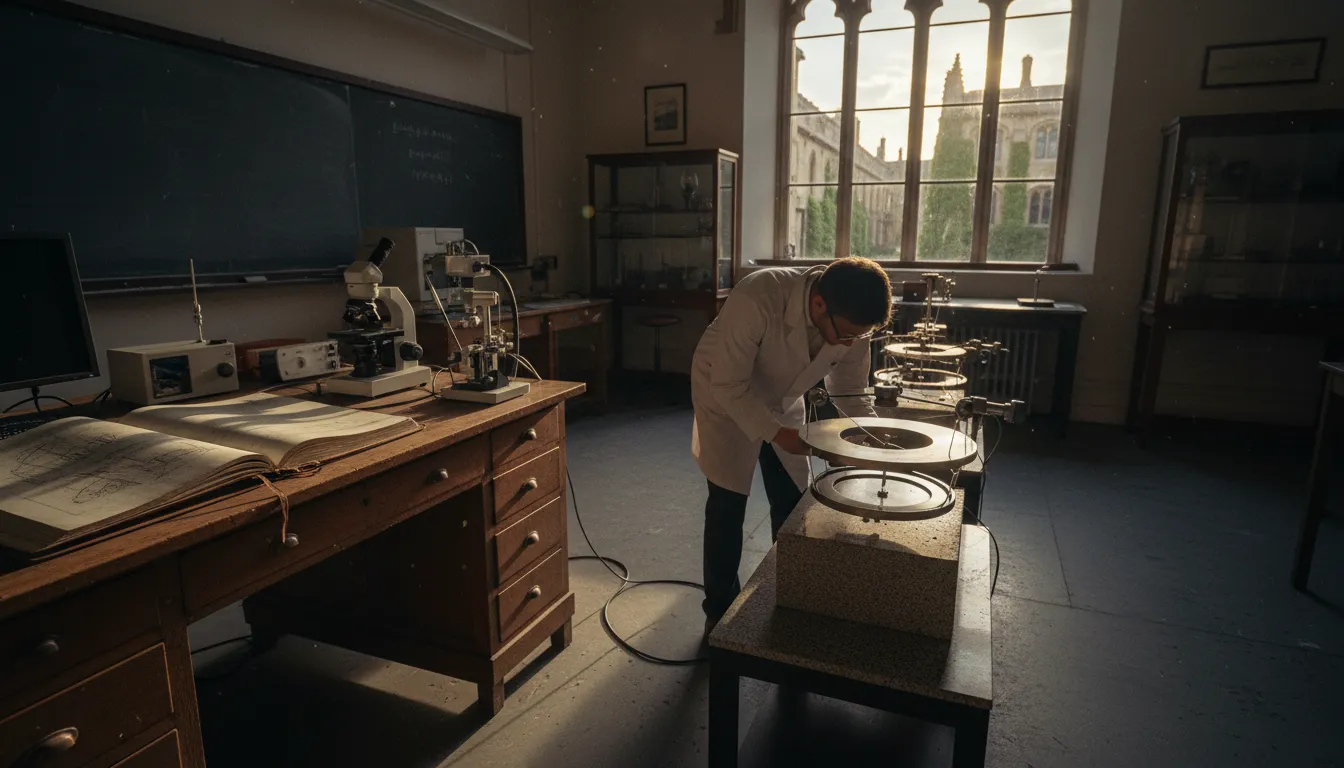
Despite its ancient history, friction research keeps producing surprises. In March 2026, a team at the University of Konstanz published a study in Nature Materials demonstrating friction without physical contact. They arranged two layers of freely rotating magnetic elements that never touched, yet produced measurable resistance to sliding driven entirely by magnetic interactions.
Most remarkably, the friction did not increase steadily with load as Amontons' law predicts. Instead, it peaked at intermediate distances where competing magnetic alignments created frustration—a state where the magnets cannot satisfy all their preferred orientations at once. The constant switching between incompatible states dissipated energy, producing a friction maximum that defies the classical linear relationship.
This discovery points toward tunable, wear-free frictional interfaces—systems where friction can be adjusted remotely using magnetic fields, with potential applications in adaptive dampers, precision instruments, and so-called frictional metamaterials.
Why Friction Still Matters
From the invention of the wheel to the design of next-generation nanomachines, friction sits at the heart of engineering progress. The field of tribology now draws on physics, chemistry, materials science, biology, and computer modeling. Every advance in understanding friction—whether at the atomic scale or through novel magnetic effects—opens paths to machines that last longer, waste less energy, and work in environments once considered impossible.
After more than five centuries of investigation, friction remains a force that is easy to feel but stubbornly difficult to fully explain. That gap between experience and understanding is exactly what keeps physicists reaching for answers.