What Are Supervolcano Calderas and How Do They Refill?
Supervolcano calderas are massive craters formed when colossal eruptions drain underground magma chambers, causing the surface to collapse. Scientists are now discovering how these giant reservoirs recharge with fresh magma over thousands of years.
The Biggest Eruptions Leave the Biggest Holes
A supervolcano is not a distinct type of volcano but a classification for any volcano that has produced an eruption rated 8 on the Volcanic Explosivity Index (VEI)—the highest level on the scale. Such eruptions eject more than 1,000 cubic kilometres of rock, ash, and lava in a single event, dwarfing anything in recorded human history. For perspective, the 1980 eruption of Mount St. Helens was a VEI 5—a supereruption is at least a thousand times larger.
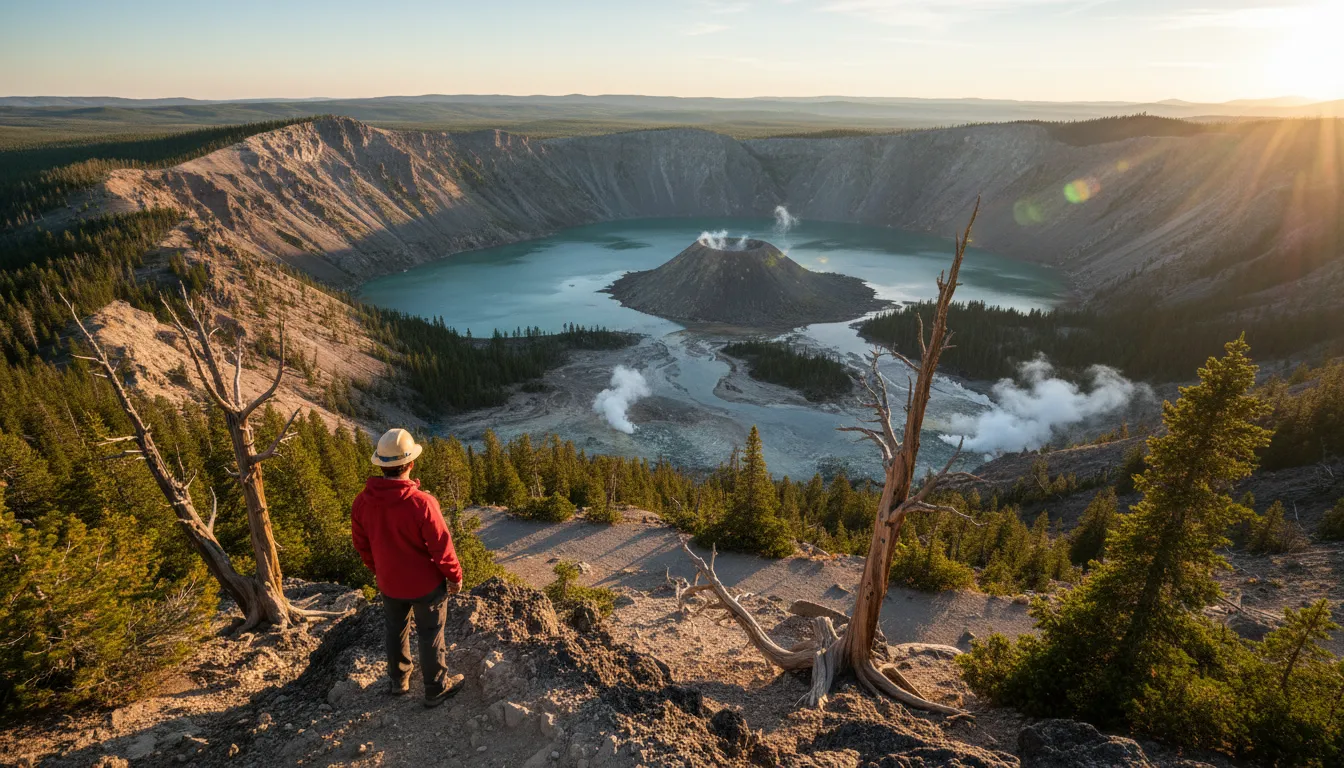
What these eruptions leave behind is equally dramatic: a caldera, a vast, bowl-shaped depression that forms when the emptied magma chamber can no longer support the rock above it. The surface simply collapses inward, creating craters that can stretch more than 50 kilometres across.
How a Caldera Forms
The process unfolds in stages. Deep beneath the Earth's crust, magma rising from the mantle accumulates in a reservoir, sometimes for hundreds of thousands of years. When pressure finally overcomes the strength of the overlying rock, the eruption begins—expelling enormous volumes of pyroclastic material and ash high into the stratosphere.
As the magma chamber rapidly empties, a structural crisis follows. The ceiling of the chamber, now unsupported, fractures along circular ring faults and drops like a piston into the void below. The result is a caldera—not the pointed cone most people picture when they think of a volcano, but a broad, sunken basin that may later fill with water to form a lake.
Earth's Known Supervolcanoes
Only a handful of volcanic systems have produced confirmed VEI-8 eruptions and remain geologically active:
- Yellowstone (Wyoming, USA) — last super-erupted roughly 630,000 years ago, creating the 70-km-wide Yellowstone Caldera. Beneath it sit two magma bodies: a shallower rhyolite reservoir 5–17 km deep and a deeper basalt body extending to 50 km, according to the U.S. Geological Survey.
- Toba (Sumatra, Indonesia) — erupted about 74,000 years ago in an event that may have triggered a global volcanic winter lasting years.
- Taupō (New Zealand) — produced the most recent super-eruption roughly 25,600 years ago, the Oruanui eruption.
- Kikai (Japan) — while its largest known eruption 7,300 years ago was VEI-7 rather than VEI-8, it was the most powerful eruption of the entire Holocene epoch.
How Magma Reservoirs Recharge
A long-standing question in volcanology has been what happens to these systems after they blow. Research published in March 2026 in Communications Earth & Environment by scientists at Kobe University offers a compelling answer. Studying Japan's Kikai caldera with seismic imaging, the team found that the magma reservoir beneath the volcano is actively refilling—not with leftover melt from the ancient eruption, but with newly injected magma rising from deeper in the Earth.
The researchers propose a general "magma re-injection model" that may apply to all giant calderas. Fresh, hot basaltic magma ascends from the mantle and pools beneath the caldera floor. Over millennia, this material differentiates and accumulates, gradually rebuilding the very reservoir that the previous eruption emptied. The same pattern appears consistent with observations at Yellowstone and Toba.
Should Anyone Worry?
The idea of a supervolcano "recharging" sounds alarming, but context matters. Studies estimate that VEI-8 eruptions have a return period of roughly 17,000 years, and the probability of one occurring in the next century is around 0.12 percent. No monitoring data from Yellowstone, Toba, or Kikai suggest an eruption is imminent.
If a super-eruption did occur, however, the consequences would be catastrophic. Nearby regions would be buried under metres of ash and pyroclastic debris. Globally, vast quantities of sulphur dioxide injected into the stratosphere would block sunlight, triggering a volcanic winter lasting 15 to 20 years—devastating agriculture, disrupting weather patterns, and pushing ecosystems into crisis.
For now, supervolcano calderas offer scientists a window into Earth's deep plumbing. Understanding how their magma reservoirs refill is not just academic curiosity—it is essential groundwork for assessing long-term volcanic risk on a planet that, deep beneath its surface, never stops churning.