What Is Auditory Beat Stimulation and How Does It Work?
Auditory beat stimulation uses precisely tuned sound frequencies to nudge brain activity into calmer states. Here is the science behind how binaural beats are constructed, how the brain responds, and what the evidence actually shows about anxiety and sleep.
Sound That Changes Your Brain
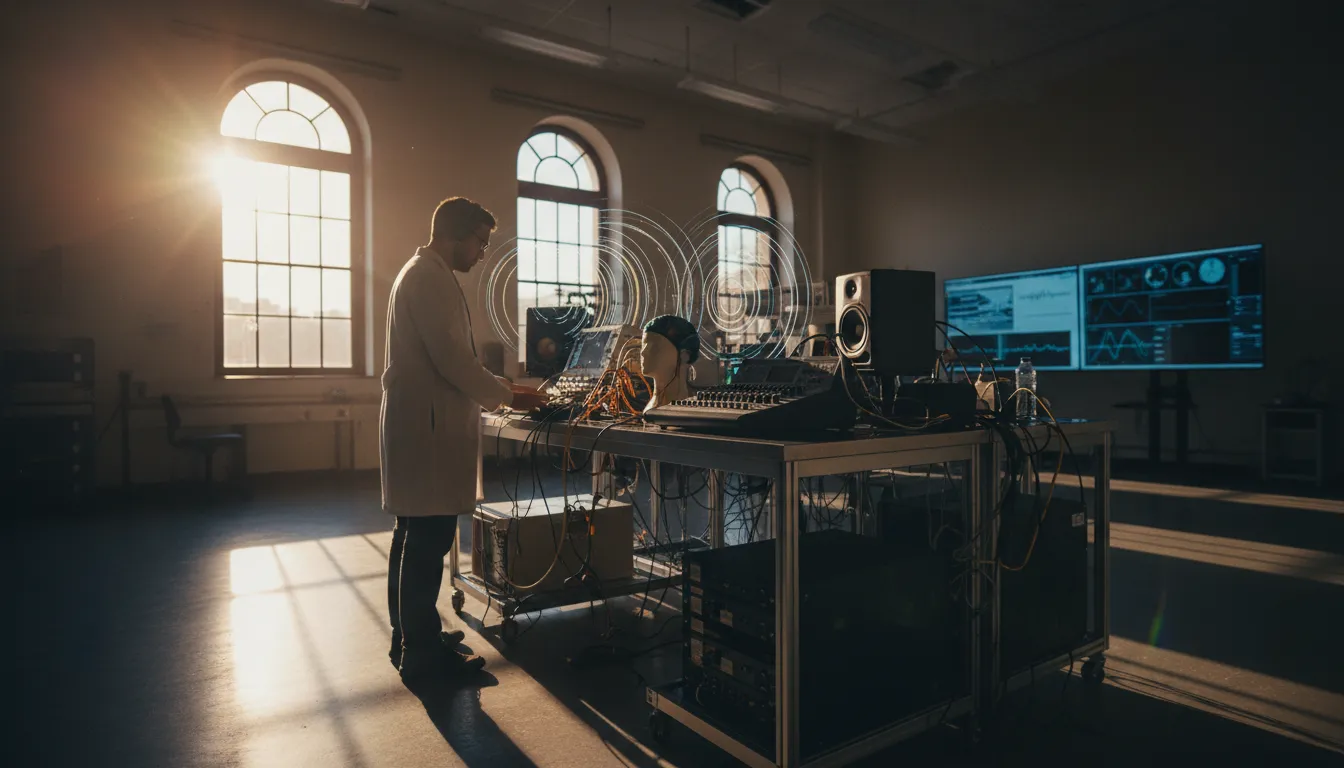
Put on a pair of headphones, play a specially crafted audio track, and within minutes your brain waves may begin to shift. That is the promise—and increasingly, the scientific rationale—behind auditory beat stimulation (ABS), a technique that uses precise sound frequencies to influence the brain's electrical activity. A 2026 clinical trial published in PLOS Mental Health found that just 24 minutes of music embedded with these beats significantly reduced anxiety in adults with clinically elevated anxiety levels. But what exactly is happening inside your skull?
What Is Auditory Beat Stimulation?
ABS is an umbrella term for several related techniques that deliver rhythmic audio pulses to the brain. The most studied form is binaural beats. When two tones of slightly different frequencies are played separately into each ear—say, 200 Hz in the left and 206 Hz in the right—the brain perceives a third "phantom" tone pulsing at the difference between them, in this case 6 Hz. That phantom beat does not exist in the audio itself; the brain constructs it.
Two other variants exist alongside binaural beats. Monaural beats are created by mixing two frequencies before they reach the ears, so headphones are not strictly required. Isochronic tones use a single tone that switches on and off at a set rate, producing a sharp, distinct pulse. Researchers often layer these techniques over music or ambient sound to make extended listening sessions more tolerable.
How the Brain Responds
The core proposed mechanism is neural entrainment, also called the frequency-following effect. When the brain detects a steady rhythmic stimulus, populations of neurons can begin firing in synchrony with it, gradually nudging the brain's dominant electrical frequency toward the beat's frequency. Human brain activity divides into several bands, each linked to a different mental state:
- Delta (0.5–4 Hz): Deep, dreamless sleep
- Theta (4–8 Hz): Light sleep, meditation, and creativity
- Alpha (8–13 Hz): Relaxed, calm wakefulness
- Beta (13–30 Hz): Active thinking and alertness
- Gamma (>30 Hz): High-level cognition and sensory integration
By delivering a beat in the theta or alpha range, ABS practitioners aim to coax the brain toward a relaxed or meditative state. The superior olivary complex in the brainstem—the first brain region to process input from both ears simultaneously—is where binaural beats are assembled before being propagated to higher brain areas involved in mood and cognition.
What the Research Shows
The 2026 trial from Toronto Metropolitan University and LUCID tested 144 adults with moderate trait anxiety who were already using medication. Participants were randomly assigned to listen for 12, 24, or 36 minutes. The 24-minute group showed the strongest overall reduction in both cognitive and physical anxiety symptoms, clearly outperforming the shorter session and matching the 36-minute group—suggesting a dose-response ceiling somewhere around 20–25 minutes.
Earlier work points in a similar direction. A 2019 analysis of 22 studies found that prolonged binaural beat exposure was reliably linked to reduced anxiety. Research also indicates that delta-frequency beats can lengthen the deepest stage of sleep, while theta-range beats lower heart rate and diastolic blood pressure in laboratory settings, according to studies reviewed in PMC and the Sleep Foundation.
The field carries important caveats, however. A systematic review in Frontiers in Human Neuroscience concluded that while binaural beats do appear to influence brain oscillatory activity, evidence for consistent psychological outcomes remains mixed. Many studies rely on small samples and subjective self-report measures. The entrainment mechanism itself, though plausible, has not been definitively confirmed in large-scale EEG trials.
How to Use ABS Safely
Binaural beats require headphones—the two tones must reach separate ears to create the phantom beat. Monaural beats and isochronic tones can be played through speakers. Tracks are widely available on streaming platforms and dedicated wellness apps. The 24-minute duration identified in the 2026 trial offers a practical starting point for anyone seeking anxiety relief.
Most adults can try ABS without risk. The main contraindication is epilepsy: rhythmic auditory stimulation could theoretically trigger seizures in susceptible individuals. People with pacemakers and pregnant women are generally advised to consult a doctor first. ABS is not a replacement for established treatments such as cognitive-behavioral therapy or prescribed medication—but as a low-cost, drug-free adjunct, the emerging evidence is promising enough that researchers are now exploring its use in formal clinical settings.
The Bottom Line
Auditory beat stimulation exploits the brain's natural tendency to synchronize its electrical activity with rhythmic input. While the science is not yet fully settled, a growing body of peer-reviewed research supports its ability to reduce anxiety and promote relaxation—particularly using theta and alpha frequencies. As larger and more rigorous clinical trials accumulate, ABS may earn a legitimate place in the toolkit for managing stress and sleep without a single pill.