How Ancient Egyptian Mummification Worked
Ancient Egyptians developed one of history's most sophisticated preservation techniques over thousands of years. Here is how the 70-day mummification process worked—and what modern chemistry is still revealing about it.
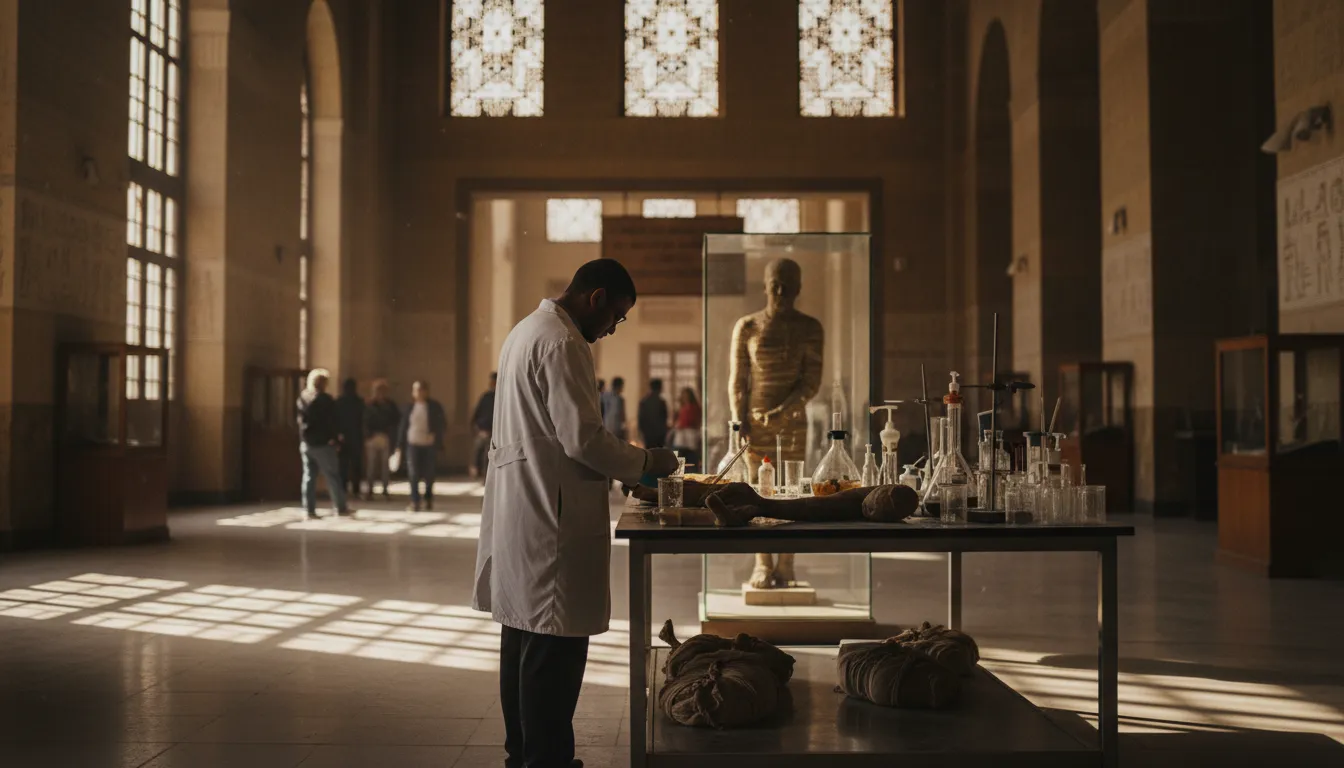
A Body Meant to Last Forever
More than 3,000 years ago, Egyptian embalmers were solving one of biology's most stubborn problems: how to stop a human body from decaying. Their answer—a 70-day ritual combining surgery, mineral salts, and precisely chosen resins—was so effective that mummies from the New Kingdom still survive in museum collections today. Modern chemical analysis continues to uncover just how sophisticated that ancient recipe really was.
Why Egyptians Mummified Their Dead
Mummification was not mere custom—it was a theological necessity. Ancient Egyptians believed that the soul, or ka, needed to return to the body after death to reach the afterlife. A decayed or unrecognizable body would leave the ka homeless, ending the person's existence entirely. Preserving the physical form was therefore an act of spiritual survival, not just reverence.
The practice evolved over roughly 3,000 years. The earliest intentional mummification appears around 2600 BCE during the Fourth and Fifth Dynasties. By the New Kingdom (circa 1550–1070 BCE), the technique had reached its peak complexity, reserved primarily for pharaohs and the wealthy—though simpler versions existed for those of lesser means.
The 70-Day Process, Step by Step
Specialized priests who served as embalmers carried out the process with detailed knowledge of anatomy and ritual. The key stages were:
- Brain removal: A hooked metal rod was inserted through the nasal cavity to perforate the ethmoid bone. The brain was liquefied and drained out through the nose—Egyptians considered it unimportant and discarded it.
- Organ removal: An incision on the left side of the abdomen allowed embalmers to remove the liver, lungs, stomach, and intestines. The heart was left in place, believed to be the seat of the soul. Each extracted organ was separately embalmed and stored in canopic jars—four containers topped with the animal-headed sons of the god Horus, each guardian protecting a specific organ for use in the afterlife.
- Natron drying: The body cavity was packed with natron, a naturally occurring crystalline salt harvested from dry lake beds in the Egyptian desert. Natron is a powerful desiccant: it draws moisture out of tissue, halting bacterial decomposition. The body was coated externally and left for 40 days. Without moisture, decay cannot proceed.
- Stuffing and anointing: Once dry, the body cavity was refilled with linen, sawdust, or herbs to restore shape. Embalmers then applied oils, resins, and ointments to the skin to prevent cracking and seal the surface.
- Wrapping: The body was wrapped in hundreds of yards of linen bandages, with protective amulets placed between layers. Warm resin was poured over the finished wrapping to bind and waterproof the whole structure.
The Chemistry Behind the Preservation
For decades, archaeologists assumed mummification relied mainly on natron and simple oils. Biomolecular analysis published in Nature in 2023 overturned that assumption. Residues in ancient embalming vessels from the Valley of the Kings revealed a far more complex pharmaceutical toolkit: beeswax, bitumen, Pistacia tree resin, juniper or cypress tar, elemi, dammar, and animal fats—many of them sourced from locations as distant as tropical Asia and the eastern Mediterranean.
The ingredients were not chosen at random. Many of the resins, including pine and juniper-derived compounds, have potent antimicrobial properties. Bitumen inhibits fungal and bacterial growth. Beeswax and hard resins physically sealed tissue against oxygen and moisture. One embalming vessel excavated at Saqqara was even inscribed: "to make his odour pleasant."
What the Smell of Mummies Reveals
Recent research from the University of Bristol, published in the Journal of the American Chemical Society, has added an unexpected new dimension: scent. Scientists used non-destructive volatile organic compound (VOC) sampling—trapping gases from the air around mummy specimens in small vials, then separating and identifying them with gas chromatography and mass spectrometry.
The mummies' aroma, often described by panelists as woody, spicy, and sweet, turned out to be a chemical fingerprint of the embalming recipe used. Earlier mummies showed simpler scent profiles dominated by animal fats and oils. Mummies from later periods bore more complex aromatic signatures reflecting costlier imported resins—direct evidence of how mummification techniques grew more elaborate over centuries as trade networks expanded.
Why It Still Matters
Mummification is not just ancient history. The VOC sampling technique now used on Egyptian mummies is the same non-invasive approach being explored for monitoring the condition of other fragile museum artifacts. The antimicrobial compounds ancient embalmers identified through trial and error over centuries are still studied by pharmacologists. And the sheer durability of these preserved bodies—tissue surviving millennia—continues to provide DNA, dietary, and disease data that rewrites our understanding of ancient life.


