Hormuz Paralyzed: Oil Tops $100 as Global Crisis Deepens
Iran's Revolutionary Guards have effectively shut the Strait of Hormuz since late February 2026, sending Brent crude above $100 a barrel and triggering the largest oil supply disruption in modern history, with a coordinated release of 400 million barrels from strategic reserves failing to reassure markets.
The Chokepoint That Stopped the World
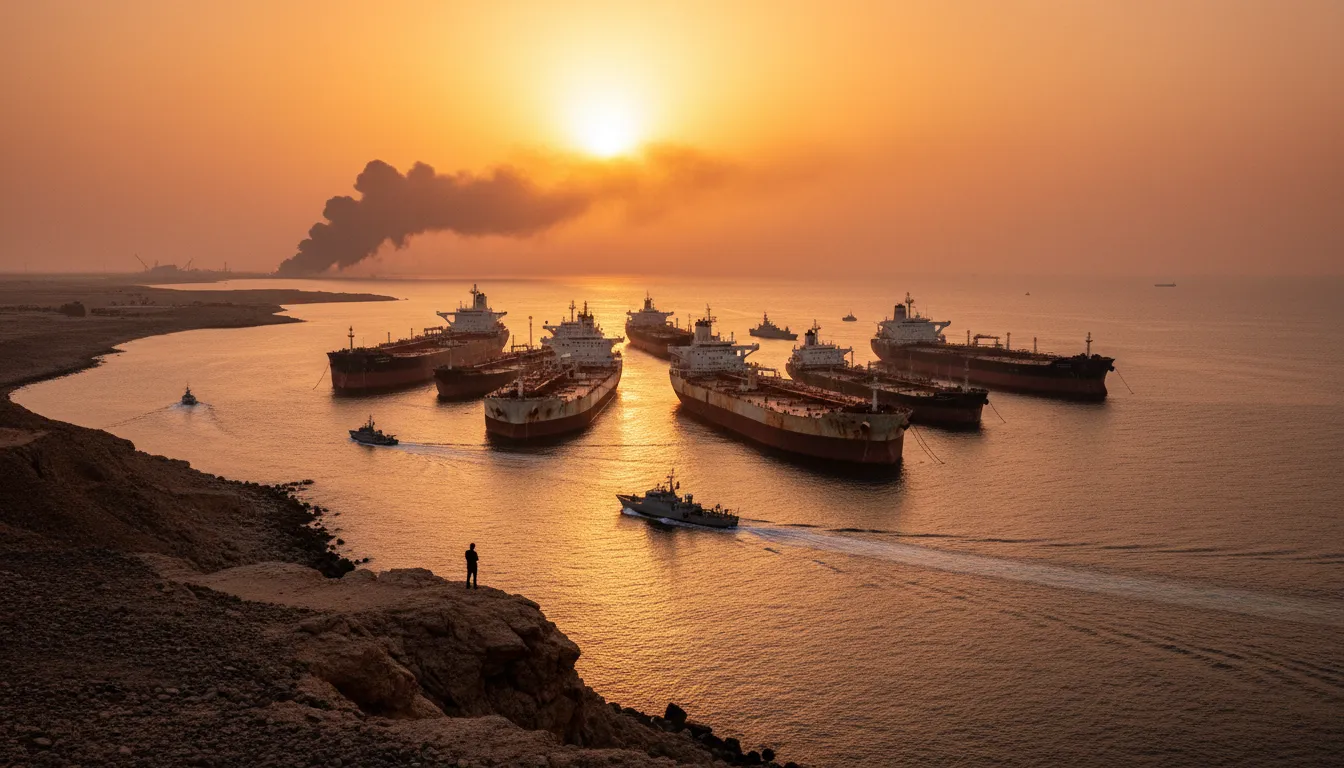
The Strait of Hormuz — the narrow waterway between Iran and the Arabian Peninsula through which nearly 20% of the world's oil supply flows daily — has been effectively paralyzed since late February 2026. Following joint U.S.-Israeli airstrikes on Iran that killed Supreme Leader Ali Khamenei, Iran's Islamic Revolutionary Guard Corps (IRGC) announced a sweeping closure of the strait to vessels from the United States, Israel, and their Western allies. Tanker traffic, which normally involves hundreds of ships per week, collapsed to near zero within days.
The disruption is already being described by analysts as the biggest oil supply shock in modern history — roughly twice the scale of the 1956 Suez Crisis. More than 150 tankers sat anchored on both sides of the strait, unwilling to risk passage as the IRGC issued stark warnings.
Oil Surges Past $100 — Iran Threatens $200
International benchmark Brent crude surged above $100 per barrel for the first time since August 2022, peaking at nearly $120 before settling around $103 on March 13, according to CNBC. West Texas Intermediate rose roughly 41% within days of the crisis erupting.
Iran made no effort to soothe markets. An IRGC spokesperson warned bluntly: "Expect oil at $200 per barrel." The Economist noted that if the strait remains closed through the end of March, a surge toward $150–$200 is plausible — a scenario analysts say would tip the global economy into recession.
Iran has selectively allowed some non-Western ships to pass — a Turkish vessel, two Indian-flagged gas carriers, and a Saudi tanker bound for India were permitted through — but the overall flow remains a fraction of normal, according to Al Jazeera.
Strategic Reserves: A Temporary Lifeline
In an emergency coordinated response, the International Energy Agency mobilized 400 million barrels from strategic reserves held by its 32 member nations. The United States alone authorized the release of 172 million barrels from its Strategic Petroleum Reserve.
Markets were unimpressed. Traders noted that the reserve release can buy time — weeks, not months — but cannot substitute for the roughly 17–20 million barrels per day that normally transit the strait. Al Jazeera quoted analysts warning that prices will only fall sustainably when tankers are physically able to move again.
Allies Rebuff Trump's Naval Coalition Push
President Trump has called on China, France, Japan, South Korea, the United Kingdom, and others to dispatch warships to escort tankers through the strait, warning that failure to act would be "very bad for the future of NATO." The response has been broadly lukewarm.
Japan's Prime Minister Sanae Takaichi said Tokyo has no current plans to deploy naval vessels, citing domestic constitutional restrictions on overseas military operations. The UK's Keir Starmer offered only mine-hunting drones and pledged Britain would "not be drawn into the wider war." Australia, Poland, Sweden, and Spain have all declined. As of March 17, no country has publicly committed forces.
A Global Economy Holding Its Breath
The downstream effects are spreading rapidly. Around 80% of Asia's oil imports transit Hormuz, and governments from India to Thailand are bracing for inflation shocks. Goldman Sachs raised its U.S. inflation forecast by 0.8 percentage points and increased its 2026 recession probability to 25%. Beyond oil, the closure threatens supplies of liquefied natural gas, fertilizers, aluminum, and steel — roughly one-third of global fertilizer trade moves through the strait.
A former White House energy adviser told Axios: "A prolonged closure of the Strait of Hormuz is a guaranteed global recession." For now, diplomacy has stalled, reserves are draining, and the world waits to see whether the most critical oil chokepoint in history will reopen — or tighten further.