Nvidia GTC 2026: Jensen Huang Bets Big on Physical AI
At its annual GTC conference in San Jose, Nvidia unveiled the Vera Rubin and Feynman GPU platforms, declared the autonomous vehicle revolution has begun, and signed landmark partnerships with AWS, Roche, and Eli Lilly that signal AI's shift from the cloud into the physical world.
The Physical AI Revolution Takes Center Stage
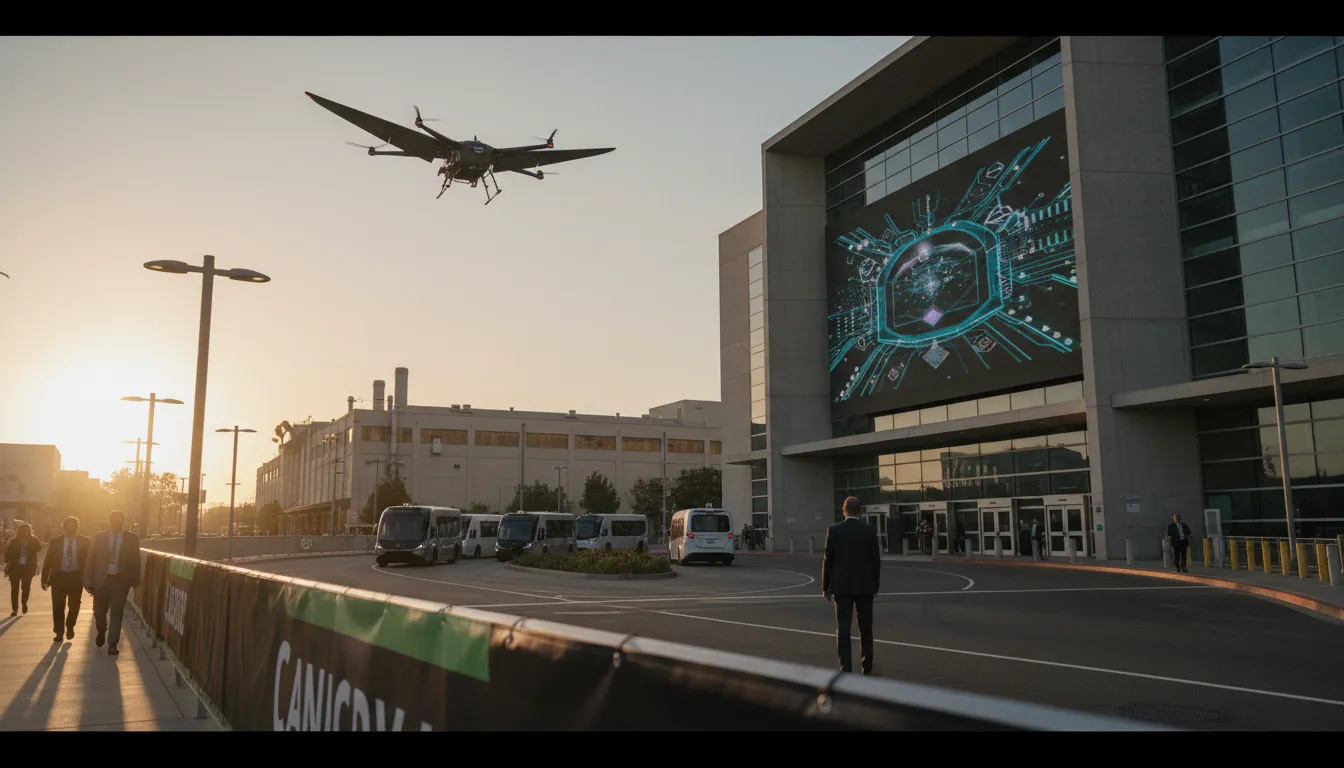
Jensen Huang used his keynote at Nvidia's annual GTC conference in San Jose — running March 16–19, 2026 — to declare that artificial intelligence is leaving the cloud and entering the physical world. "The ChatGPT moment for autonomous vehicles has arrived," Huang told thousands of developers and engineers, framing robotics and self-driving cars as the next frontier for Nvidia's dominance in AI computing. The company showcased over 110 robots on the conference floor, demonstrating everything from surgical assistants to factory automation systems, all trained using Nvidia's Omniverse simulation platform and Newton physics engine.
Vera Rubin and Feynman: The Next GPU Generations
Huang unveiled the Vera Rubin platform — a full-stack architecture comprising seven chips, five rack-scale systems, and a purpose-built supercomputer for agentic AI. Vera Rubin is slated for late 2026, with an Ultra variant following in 2027. Looking further ahead, Nvidia revealed the Feynman architecture, planned for 2028 on TSMC's advanced A16 1.6nm process, paired with a new CPU named Rosa — a nod to pioneering scientist Rosalind Franklin.
Huang told investors that Nvidia sees over $1 trillion in orders for Blackwell and Vera Rubin hardware through 2027, a figure that signals sustained capital commitment across the AI industry.
Cloud Giants Commit at Scale
One of the keynote's most striking announcements was an expanded partnership with Amazon Web Services. AWS will deploy over one million Nvidia GPUs globally — spanning Blackwell and Vera Rubin architectures — to serve the surging demand for agentic AI workloads across all cloud regions. Microsoft Azure also featured prominently, becoming the first hyperscale provider to power Vera Rubin NVL72 systems after deploying hundreds of thousands of liquid-cooled Grace Blackwell GPUs.
Pharma Embraces AI Supercomputing
Two pharmaceutical giants emerged as unlikely stars of the conference. Roche announced what it called the largest GPU footprint of any pharmaceutical company, deploying 2,176 new on-premise Blackwell GPUs across the United States and Europe, bringing its combined total above 3,500 Blackwell GPUs.
Eli Lilly went further, unveiling LillyPod — described as the most powerful AI supercomputer wholly owned and operated by a pharma company. Built on Nvidia's DGX SuperPOD platform with 1,016 Blackwell Ultra GPUs, the system delivers over nine exaflops of AI performance. Lilly says LillyPod can simulate billions of molecular hypotheses per year, compared with roughly 2,000 using traditional methods. In parallel, the two companies announced a $1 billion co-innovation lab in South San Francisco, where scientists and AI engineers will operate in continuous 24/7 experimentation loops connecting wet labs with computational infrastructure.
Autonomous Vehicles Reach an Inflection Point
Nvidia confirmed that BYD, Hyundai, Nissan, and Geely are building Level 4 autonomous vehicles on its Drive Hyperion platform. An integration with Uber means robotaxi-ready cars from these manufacturers could enter ride-hailing fleets directly. Nvidia also released its Alpamayo autonomous driving models openly on GitHub, lowering the barrier for the entire industry.
The Bigger Picture
GTC 2026 cemented a broader thesis: the age of physical AI — where intelligent systems perceive, reason, and act in the real world — is arriving in earnest. Whether through humanoid robots trained in simulation, surgical assistants learning from open datasets, or pharmaceutical companies replacing years of lab work with AI-simulated molecular screening, Nvidia's software-to-silicon stack is positioning itself as the operating system of this transformation. The company even announced plans for Space-1 Vera Rubin systems — taking accelerated computing into orbit with space-based data centers. For Huang, the message was unambiguous: the next decade of AI will unfold not just in the cloud, but in cars, hospitals, factories — and beyond.