China Bans Exports to 40 Japanese Defense Firms
Beijing placed 20 Japanese companies on an export control blacklist and 20 on a watchlist, cutting their access to rare earths and dual-use materials — escalating tensions over Japan's military buildup and Taiwan policy.
A Calculated Economic Strike
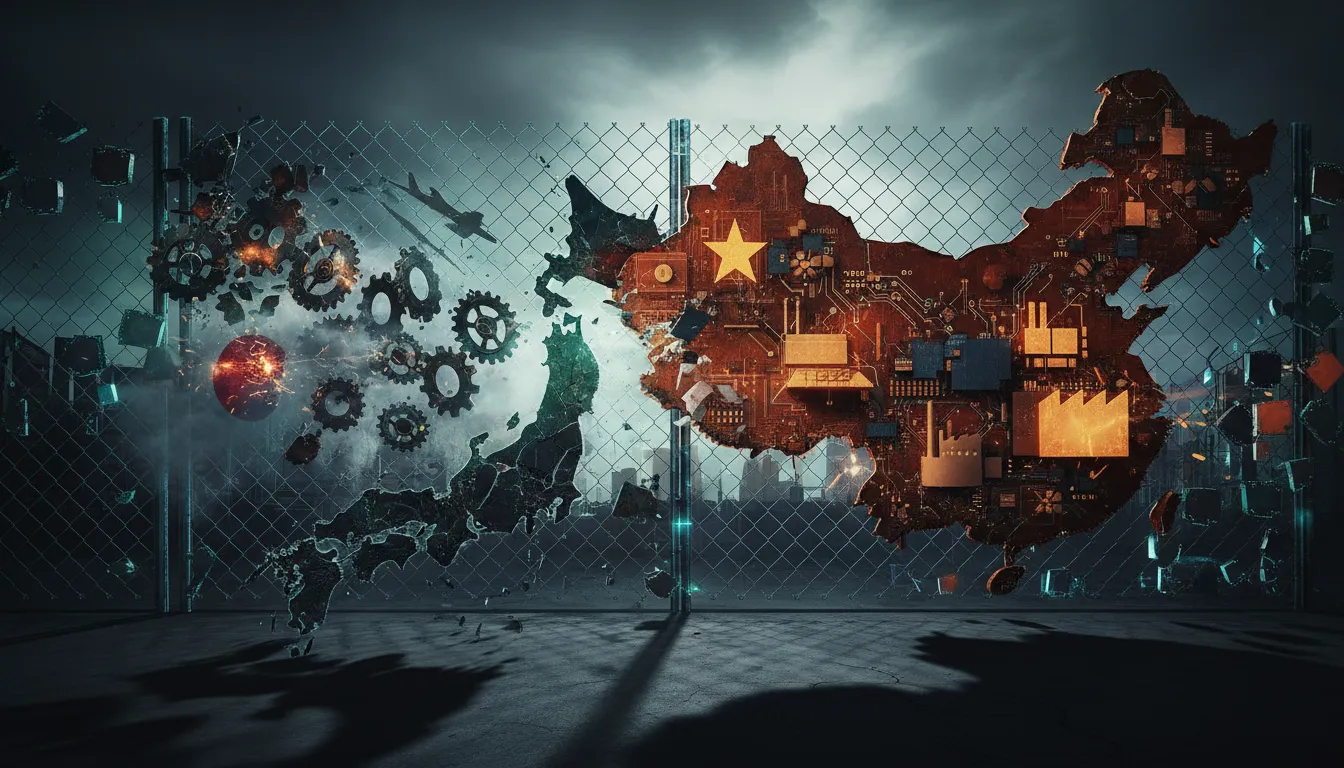
China's Commerce Ministry announced on February 24, 2026 that it was restricting dual-use exports to 40 Japanese entities — 20 placed on an outright blacklist and 20 added to a new watchlist requiring case-by-case export licensing. The move represents Beijing's most direct use of its export control arsenal against Tokyo, and the broadest economic retaliation since Japan began its historic military expansion.
The blacklisted companies are immediately barred from importing any Chinese goods that appear on Beijing's dual-use control list — roughly 1,100 items spanning materials, components, and technologies with both civilian and military applications. Companies on the watchlist face a different burden: Chinese exporters must file individual license applications, risk assessment reports, and written pledges that supplied items will not reach Japan's Self-Defense Forces.
Who Gets Hit
The full export ban targets major pillars of Japan's defense-industrial base. Units of Mitsubishi Heavy Industries — covering shipbuilding and aircraft engine production — are among the hardest hit. Kawasaki Heavy Industries, Fujitsu, and IHI Corporation also appear on the blacklist. The watchlist catches a broader sweep of companies including Subaru Corporation, Itochu Aviation, Mitsubishi Materials Corporation, and the Institute of Science Tokyo.
The critical materials in question include medium and heavy rare earths — dysprosium, samarium, gadolinium, terbium, yttrium, and lutetium — that play small but irreplaceable roles in jet engines, guided missiles, naval propulsion systems, and consumer electronics. China controls roughly 60% of global rare earth refining capacity, giving Beijing substantial leverage.
Taiwan as the Flashpoint
The restrictions did not emerge in a vacuum. Beijing has been escalating economic pressure on Tokyo since November 2025, when Japanese Prime Minister Sanae Takaichi stated publicly that a Chinese military attack on Taiwan could constitute an "existential threat" to Japan and might justify a Japanese military response — a significant departure from Japan's traditionally cautious Taiwan posture.
China's Commerce Ministry framed the February measures as "entirely legitimate, reasonable, and legal," aimed at curbing what it called Japan's "remilitarization and nuclear ambitions." Japan has been on a historic defense spending trajectory since 2022, doubling its defense budget toward the NATO target of 2% of GDP by 2027.
Tokyo's Furious Response
Japan's reaction was swift and unusually blunt. Deputy Chief Cabinet Secretary Kei Sato called the measures "absolutely unacceptable" and "deplorable." Tokyo lodged a formal diplomatic protest, summoning China's Deputy Chief of Mission Shi Yong and demanding the controls be immediately lifted. Japan's Foreign Ministry characterized the restrictions as contradicting international trade norms and warned of consequences for bilateral economic relations.
Supply Chain Fallout
Analysts warn the broader economic consequences could extend well beyond the targeted firms. Investment bank Nomura estimates that if China's rare earth restrictions persist for three months, Japan could absorb losses of approximately ¥660 billion — equivalent to roughly 0.11% of annual GDP. The automotive and aerospace sectors face the sharpest exposure, given their deep dependence on rare earth-based magnets and components.
Several affected companies have sought to downplay their direct China trade exposure, but the restrictions create compliance and sourcing headaches that ripple through complex global supply chains. Japan, the United States, and allied nations have accelerated rare earth diversification efforts since China imposed earlier export curbs in 2010 and 2023 — but full substitution of Chinese supply remains years away.
A New Phase in the Indo-Pacific Rivalry
The dual-use blacklist marks a qualitative shift in Sino-Japanese relations. Where previous tensions centered on territorial disputes in the East China Sea and historical grievances, Beijing is now deploying industrial policy as geopolitical leverage — mirroring tactics used against South Korea in 2017 and Australia in 2020. For Washington and its Indo-Pacific partners, the episode reinforces the urgency of building resilient, China-independent supply chains for critical defense materials.