China Targets Japan's Defense Giants With Export Ban
Beijing has imposed sweeping dual-use export controls on 40 Japanese companies, including Mitsubishi Heavy Industries and Kawasaki, citing Japan's military buildup — marking a sharp escalation in Sino-Japanese tensions.
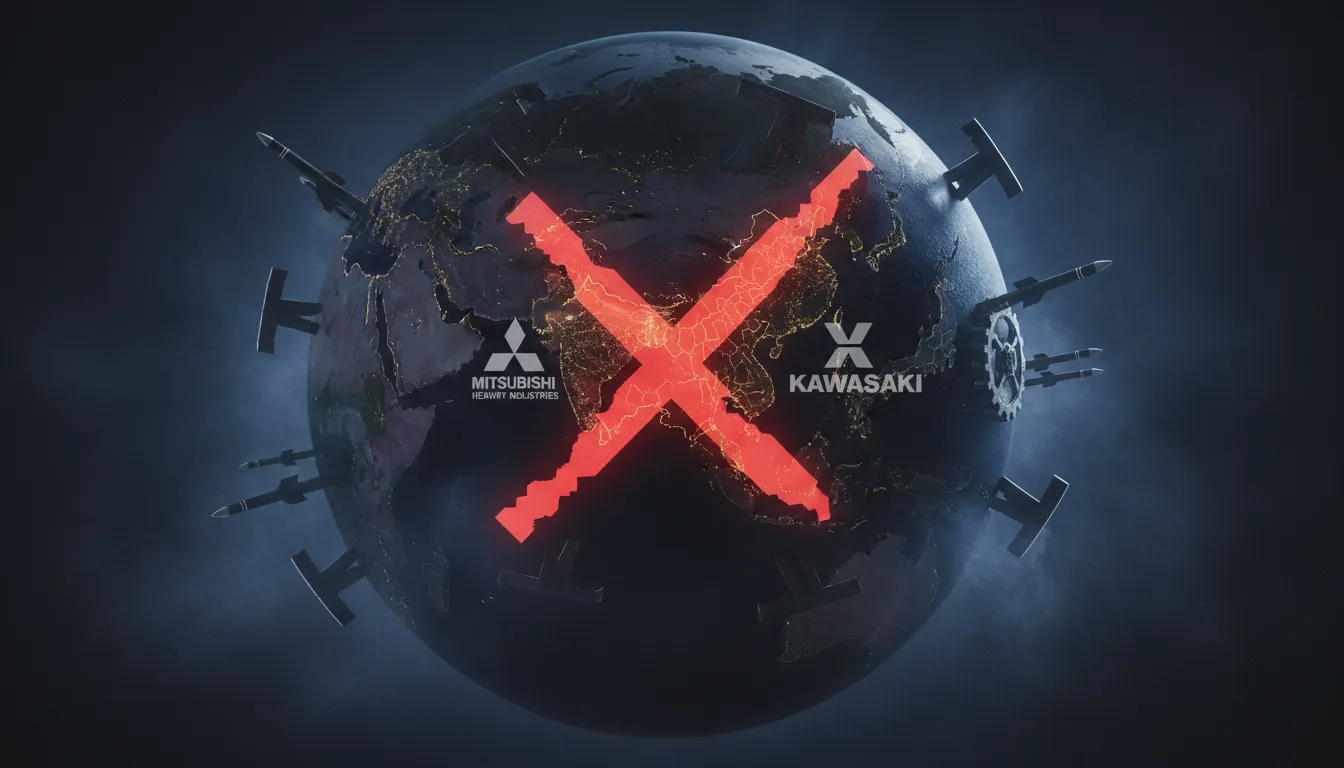
Beijing Cuts Off Japan's Defense Sector From Critical Supplies
China's Commerce Ministry on February 24 imposed sweeping export controls on 40 Japanese companies and institutions, banning the sale of dual-use goods — items with both civilian and military applications — to firms Beijing accuses of fueling Japan's military expansion. The move represents the most aggressive economic pressure China has applied on Tokyo in years, targeting the core of Japan's defense industrial base.
Who Is on the List
Twenty Japanese entities have been placed on a full export control list, cutting them off immediately from roughly 800 categories of dual-use goods from China, according to Nikkei Asia. These include rare metals such as tungsten, tellurium, and bismuth — materials critical to semiconductors, cutting tools, and aerospace components. Companies on the banned list include:
- Mitsubishi Heavy Industries — multiple subsidiaries spanning shipbuilding and aircraft engines
- Kawasaki Heavy Industries Aerospace Systems
- IHI Corporation (defense engines)
- Japan Marine United (naval shipbuilder)
- Fujitsu Defense & National Security
- NEC (telecommunications and computing)
- The National Defense Academy of Japan and JAXA, the national space agency
A further 20 companies — including Subaru, ENEOS, electronics maker TDK, and affiliates of trading giants Itochu, Sumitomo, and Mitsui — were added to a watchlist requiring special licensing before any Chinese dual-use exports can proceed, NPR reported.
Beijing's Justification
China's Commerce Ministry said the restrictions were "entirely legitimate, reasonable, and legal," framing them as a direct response to what it called Japan's "remilitarization." Chinese officials specifically cited remarks by Prime Minister Sanae Takaichi in November 2025, when she suggested Japan could intervene militarily if China used force against Taiwan. A Chinese Foreign Ministry spokesperson went further, accusing Tokyo of harbouring "nuclear ambitions" — a characterisation Tokyo flatly denied.
The February controls are not Beijing's first economic shot. China had already restricted rare earth exports to Japan in January 2026 and reportedly cut Chinese tourism to the country by roughly half, according to Asia Times.
Tokyo Protests, Markets React
Japan's government issued a formal diplomatic protest, calling the measures "absolutely unacceptable and extremely regrettable." Deputy Chief Cabinet Secretary Kei Sato said the controls "largely differ from international practices" and demanded they be reversed. Al Jazeera reported that Tokyo lodged its protest directly with China's Deputy Chief of Mission.
Markets in Tokyo registered sharp declines among targeted firms: Fujitsu fell nearly 9% and NEC dropped over 6% on the news, while Subaru shed 3.5%. Several affected companies sought to reassure investors by noting they currently conduct limited direct trade with China, though analysts warned the long-term supply chain implications are more serious.
A Deepening Strategic Rift
The export ban underscores a fundamental deterioration in Sino-Japanese relations driven by Japan's accelerating defence build-up. Tokyo has nearly doubled its defence budget in recent years and is developing long-range strike capabilities that China views as destabilising. For Beijing, the controls serve both as a punitive measure and a strategic signal — that economic interdependence can be weaponised in the event of geopolitical conflict over Taiwan.
Legal analysts note that Japan, unlike the United States and European Union, has not yet developed robust countermeasures to Chinese economic coercion, leaving Tokyo with limited retaliatory tools for now. How Japan responds — whether by accelerating supply chain diversification, deepening ties with the US and EU on critical minerals, or pursuing quiet diplomacy — will shape the trajectory of one of Asia's most consequential bilateral relationships.