Dukovany 5 and 6: Czech Republic Seeks Brussels' Approval for Twin Nuclear Reactors
The European Commission has launched a formal investigation into the Czech Republic's request for state aid to build two new nuclear reactors at Dukovany, a project worth 407 billion Czech crowns. This is the largest energy project in the Czech Republic's history.
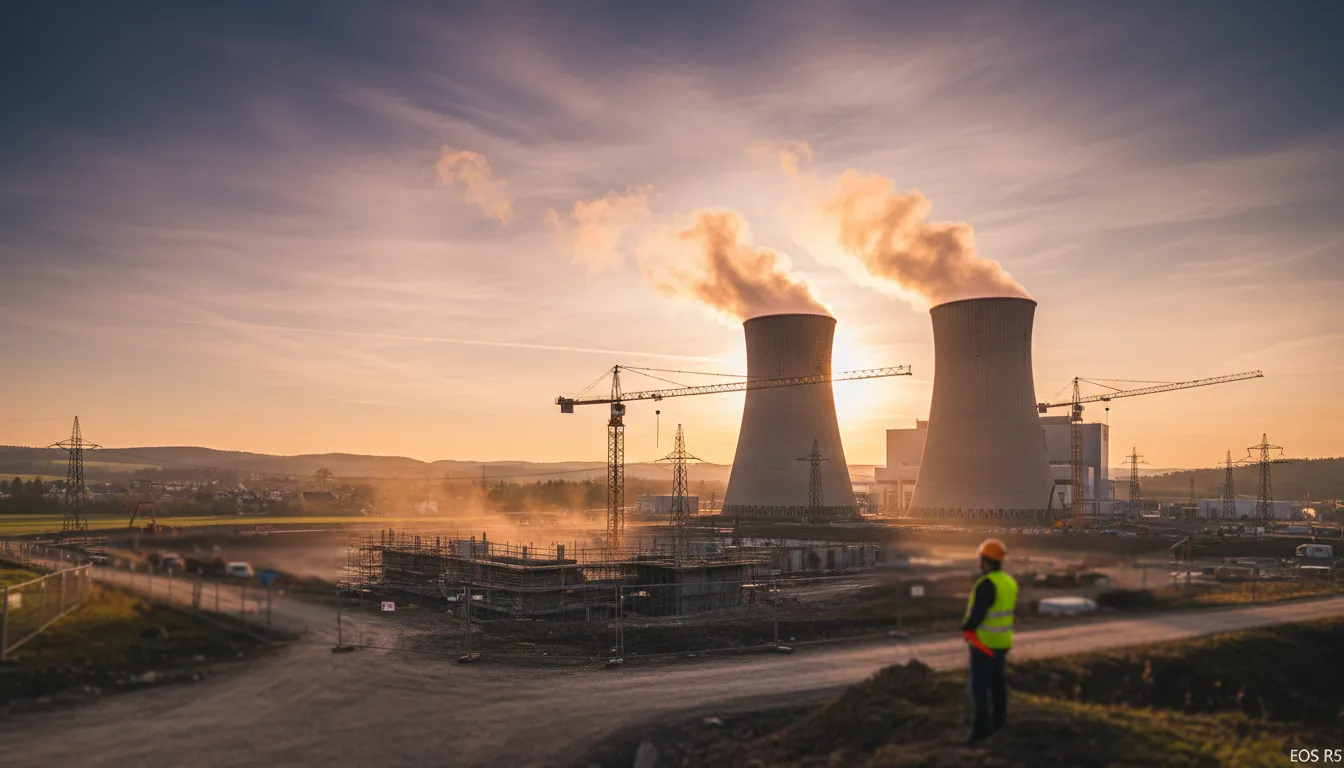
Unprecedented Move: Two Reactors at Once
The Czech Republic has taken a historic step in the energy sector. The government of Andrej Babiš has asked the European Commission for approval to finance two new nuclear reactors at the Dukovany power plant — simultaneously. While the fifth reactor (Dukovany 5) was preliminarily approved by the Commission in April 2024, the notification for the sixth reactor has taken the project to a whole new level. The total value of the contract reaches 407 billion Czech crowns.
On December 22, 2025, the European Commission announced the launch of a formal investigation. The aim is to verify whether the proposed Czech public support complies with EU competition rules. The proceedings may take up to eighteen months, so a decision is not expected until mid-2027 at the earliest.
Koreans at the Helm of the Czech Republic's Largest Project
The construction of both reactors will be carried out by the South Korean company Korea Hydro & Nuclear Power (KHNP), which won the tender and signed the contract on June 4, 2025 — after the Supreme Administrative Court overturned a preliminary injunction filed by French competitor EDF. KHNP operates 24 reactors in South Korea and covers over 31% of the country's electricity consumption.
The new reactors will be of the APR1000 type with a capacity of 1,200 MW each. Together with the existing four reactors (a total of 2,040 MW), the power plant's output will exceed 4,400 MW — more than double the current capacity. Construction is scheduled to begin in 2029, with the first reactor expected to begin trial operation in 2036 and the second in 2037.
How the State Will Pay for the Project
Czech support consists of three measures. The key instrument is a low-interest state loan estimated at 23 to 30 billion euros, which will cover construction costs. This is followed by a forty-year contract for difference ensuring stable revenues for the operator, and finally a protective mechanism protecting the investor from possible negative legislative changes.
The project is being implemented by Elektrárna Dukovany II (EDU II), which is 80% owned by the Czech state and 20% by the ČEZ Group. Preparatory expenses of 18.3 billion crowns have been earmarked for the state budget for 2026. Czech industrial sectors are expected to receive up to 60% of subcontracts, and the project also includes extensive modernization of transport infrastructure in Moravia.
Energy Security as the Main Argument
The government of Andrej Babiš presents nuclear expansion as the backbone of energy security. The Czech Republic is simultaneously closing coal-fired power plants and trying to get rid of its dependence on Russian natural gas. The new reactors are intended to ensure stable and emission-free electricity production for households and industry at a time when renewable sources alone are not sufficient to cover the base load of the grid.
While the Commission recognizes the strategic importance of the project, it raises doubts about the setting of risks and incentive mechanisms for the efficient behavior of the aid recipient. The Minister of Industry described the launch of the investigation as a "standard step" that occurs with all planned nuclear projects in the EU, and stressed that the project is not at risk.
If the Commission approves the support, the Czech Republic will be among the first EU countries to build multiple nuclear reactors in parallel — and will embark on a path to energy self-sufficiency, the results of which will be felt by future generations.