How Comets Break Apart—and What Scientists Learn
Comets are fragile relics of the early solar system. When they fragment, scientists gain rare access to pristine material billions of years old, revealing secrets about planetary formation and the origins of our cosmic neighborhood.
Dirty Snowballs on Borrowed Time
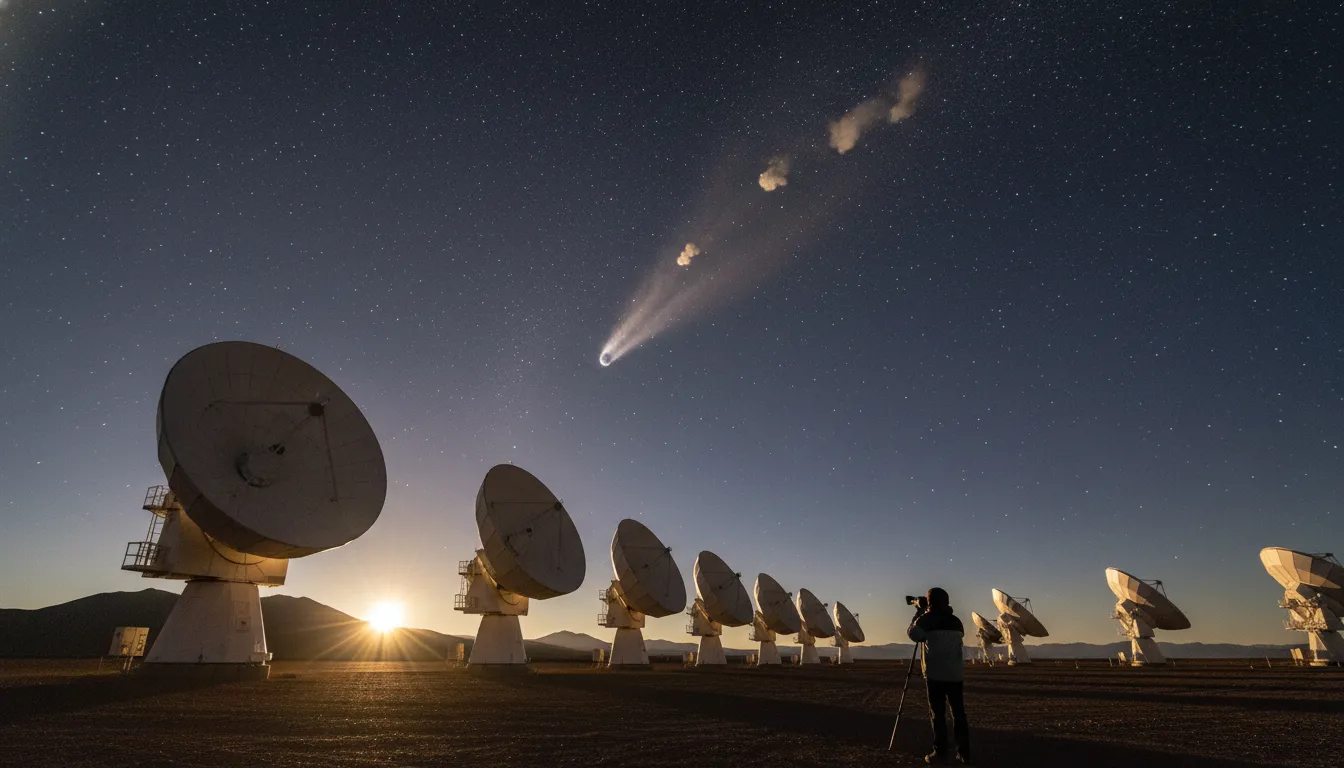
Comets are among the oldest and most fragile objects in the solar system. Formed roughly 4.6 billion years ago from leftover ice, dust, and rock, they spend most of their existence in the deep freeze of the outer solar system. But when a comet's orbit brings it closer to the Sun or a massive planet, its days as a single body may be numbered.
Comet fragmentation—the process by which a nucleus splits into pieces—is surprisingly common. Scientists estimate that most long-period comets eventually break apart, and studying these events offers a rare window into the primordial building blocks of planets.
What Holds a Comet Together—Barely
A comet's nucleus is not a solid rock. It is a loose, porous mix of water ice, frozen carbon dioxide, carbon monoxide, ammonia, dust, and organic compounds. Data from the European Space Agency's Rosetta mission to Comet 67P/Churyumov-Gerasimenko revealed that roughly 40% of the nucleus consisted of organic molecules, with an overall density lower than water—about 600 kg/m³.
Scientists often describe comets as "rubble piles": loosely bound aggregates held together by weak gravity and the cohesive strength of ice. Their tensile strength is extraordinarily low, making them vulnerable to forces that would barely register on a rocky asteroid.
Four Ways a Comet Falls Apart
Tidal Forces
When a comet passes too close to a massive body, the gravitational pull on the near side exceeds the pull on the far side. If that difference surpasses the comet's feeble internal strength, it tears apart. The most famous example is Comet Shoemaker-Levy 9, which in 1992 passed within Jupiter's Roche limit—the distance at which tidal forces overwhelm self-gravity—and shattered into at least 21 fragments. Two years later, those fragments plowed into Jupiter with the force of an estimated 300 million atomic bombs.
Thermal Stress
As a comet approaches the Sun, uneven heating causes ices to sublimate—turning directly from solid to gas. The resulting jets of gas and dust can crack a fragile nucleus the way rapid temperature changes crack glass. This thermal stress is among the most common triggers for breakup.
Rotational Spin-Up
Asymmetric outgassing acts like tiny rocket thrusters, gradually speeding up a comet's rotation. Once the centrifugal force at the equator exceeds the nucleus's weak cohesion, the comet flies apart. This mechanism can operate over many orbits before reaching a critical spin rate.
Internal Gas Pressure
Volatile ices trapped deep inside can build up pressure as the comet warms. When that pressure exceeds the strength of the overlying material, the nucleus explodes outward—like a cork bursting from a bottle. Intriguingly, many fragmentation events happen far from the Sun or any planet, suggesting internal pressure plays a bigger role than once assumed.
Why Breakups Matter to Science
A comet's surface is weathered by billions of years of cosmic radiation and solar heating. But when the nucleus splits, pristine interior material—unchanged since the solar system's formation—is suddenly exposed. Scientists can analyze the chemical fingerprints of this fresh material using spectrographs, revealing the original composition of the gas and dust cloud from which the planets formed.
In March 2026, NASA's Hubble Space Telescope released images of Comet C/2025 K1 (ATLAS) caught mid-fragmentation—one of the earliest stages of breakup ever observed. Researchers noted the comet had unusually low carbon levels, hinting at unexpected chemical diversity among objects in the distant Oort Cloud.
Fragmentation studies also help planetary defense scientists model how a comet would behave if it were ever on a collision course with Earth. Understanding whether an object is a solid body or a rubble pile fundamentally changes deflection strategies.
Cosmic Archaeology in Real Time
Every comet that breaks apart is a one-time experiment that cannot be repeated. Each event reveals something new about the internal structure, volatile reservoirs, and mechanical properties of these ancient travelers. As telescope technology improves, astronomers hope to catch more breakups in progress—turning fleeting cosmic accidents into lasting scientific discoveries.