How Corona Discharge Works—Trees Glow in Storms
Corona discharge causes treetops to glow with faint ultraviolet light during thunderstorms. Scientists recently filmed the phenomenon for the first time, confirming a century-old theory and revealing its surprising role in atmospheric chemistry.
An Invisible Light Show Above the Forest
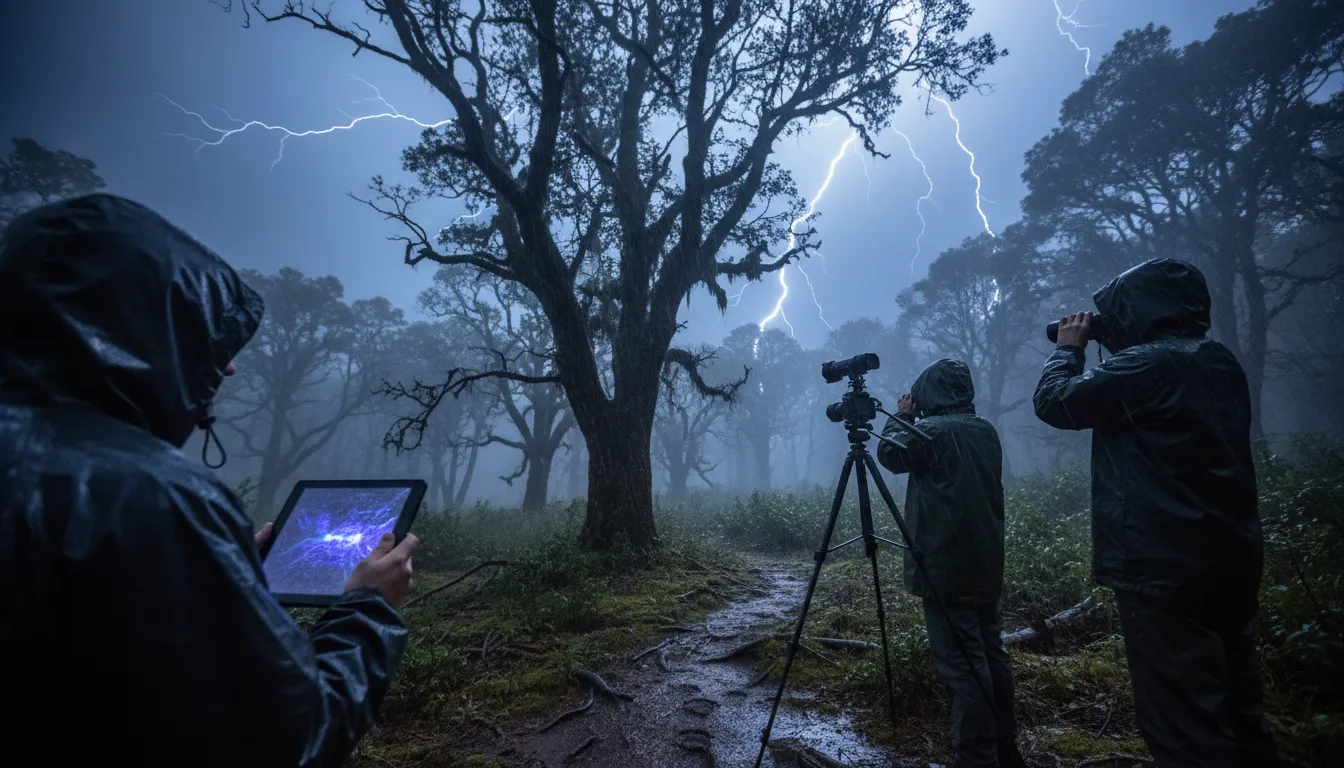
Every time a thunderstorm rolls over a forest, something extraordinary happens that no human eye can see. The tips of leaves and branches erupt in faint ultraviolet flashes—tiny electrical discharges called corona discharges—as the atmosphere's electric field forces charge through the trees. Scientists theorized about this phenomenon for nearly a century, but it was not until researchers from Pennsylvania State University drove a modified minivan into storms along the U.S. East Coast that anyone captured it on camera.
What Is Corona Discharge?
Corona discharge is a type of electrical breakdown that occurs when a strong electric field ionizes the air around a pointed or sharp object. Unlike lightning, which involves a massive, sudden flow of current between cloud and ground, corona discharge is a quiet, continuous leak of electricity. The current is tiny—roughly one microamp per discharge point—but the physics behind it shapes weather, damages vegetation, and may even clean the air.
The process starts with charge separation inside a thundercloud. The cloud's base typically carries a strong negative charge, which induces a corresponding positive charge on the ground below. Because opposite charges attract, the ground's positive charge migrates upward through anything conductive—including tree trunks and branches—and concentrates at the sharpest points: leaf tips, pine needles, and twig ends.
When the local electric field at those tips exceeds roughly 30,000 volts per centimeter, the surrounding air molecules begin to ionize. Electrons are stripped from nitrogen and oxygen atoms, creating a thin sheath of plasma. As the excited molecules relax back to their ground state, they release photons—predominantly in the blue and ultraviolet range—producing a faint glow.
Sailors Knew It First
Corona discharge is not a new discovery in principle. Sailors have observed its visible cousin, St. Elmo's fire, for centuries. Named after St. Erasmus, the patron saint of sailors, these eerie blue-violet glows on mast tips were once considered omens—sometimes good, sometimes bad. The same physics applies: a ship's tall metal mast concentrates charge just as a leaf tip does, but with enough intensity for the glow to be visible to the naked eye.
Aviators have encountered it too. During British Airways Flight 9 in 1982, passengers and crew watched glowing flashes dance across the windscreen as the plane flew through volcanic ash and electrically charged air. The Empire State Building displayed corona discharge shortly after its opening in 1931.
Filming the Invisible
What made the Penn State study groundbreaking was capturing corona discharge on wild trees in real storm conditions—something no one had managed before. Lead researcher Patrick McFarland and his team outfitted a 2013 Toyota Sienna with a weather station, an electric field detector, a laser rangefinder, and a roof-mounted periscope connected to a UV-sensitive camera tuned to wavelengths between 255 and 273 nanometers.
During summer field campaigns from Florida to Pennsylvania, the team recorded hundreds of corona events. In one 90-minute observation session in Pembroke, North Carolina, their camera captured 859 corona flashes on a sweetgum tree and 93 on a nearby loblolly pine. Individual flickers lasted from fractions of a second to about three seconds, often jumping between leaves.
"I believe you'd see this swath of glow on the top of every tree" during storms, McFarland said. "This just goes to show that there's still discovery science being done."
Why It Matters for the Atmosphere
The discovery has implications beyond visual spectacle. Corona discharges produce hydroxyl radicals—highly reactive molecules that break down hydrocarbons and other pollutants in the air. Forests already contribute to atmospheric chemistry through volatile organic compound emissions, but storm-driven corona discharge may add a previously unrecognized cleaning mechanism concentrated at the canopy level.
There are ecological consequences too. The discharges cause visible leaf-tip burning within seconds. Research dating back to the 1960s showed that electrical currents in trees can damage cell membranes and destroy chloroplasts—the organelles responsible for photosynthesis. Over many storm seasons, this cumulative damage could influence which tree species thrive in storm-prone regions and may have shaped leaf evolution over millennia.
A Common Phenomenon, Rarely Seen
The Penn State team confirmed identical corona activity across four separate storms and multiple tree species—sweetgum, loblolly pine, spruce, and maple—suggesting the phenomenon is universal wherever trees stand beneath thunderstorms. The reason it remained unfilmed for so long is simple: the UV wavelengths involved are blocked by Earth's ozone layer and invisible to our eyes. Without specialized equipment pointed at the right tree at the right moment, the light show stays hidden.
For anyone who has ever stood beneath a forest canopy during a thunderstorm, the implication is striking: every leaf tip above may have been quietly sparking with plasma, cleaning the air, and slowly burning itself in the process.