How Managed Aquifer Recharge Works—Banking Water Underground
Managed aquifer recharge is an increasingly vital water management strategy that deliberately channels stormwater, treated wastewater, and surface water into underground aquifers for storage and later use, helping cities worldwide fight drought and water scarcity.
What Is Managed Aquifer Recharge?
Beneath cities, farms, and deserts lie vast natural reservoirs called aquifers—layers of sand, gravel, and rock saturated with water. These underground stores supply roughly 37% of U.S. public water and drinking water for over 90% of rural populations, according to the U.S. Geological Survey. But decades of pumping have drained aquifers far faster than nature refills them.
Managed aquifer recharge (MAR) is the deliberate process of channeling water from the surface into these underground formations, essentially banking it for future use. Think of it as making deposits into a geological savings account—one shielded from evaporation, contamination, and the political fights that surround above-ground reservoirs.
How Water Gets Underground
Natural recharge happens slowly: rain falls, soaks into soil, and trickles through pore spaces down to the water table. MAR accelerates this process using engineered methods that fall into two broad categories.
Surface Spreading
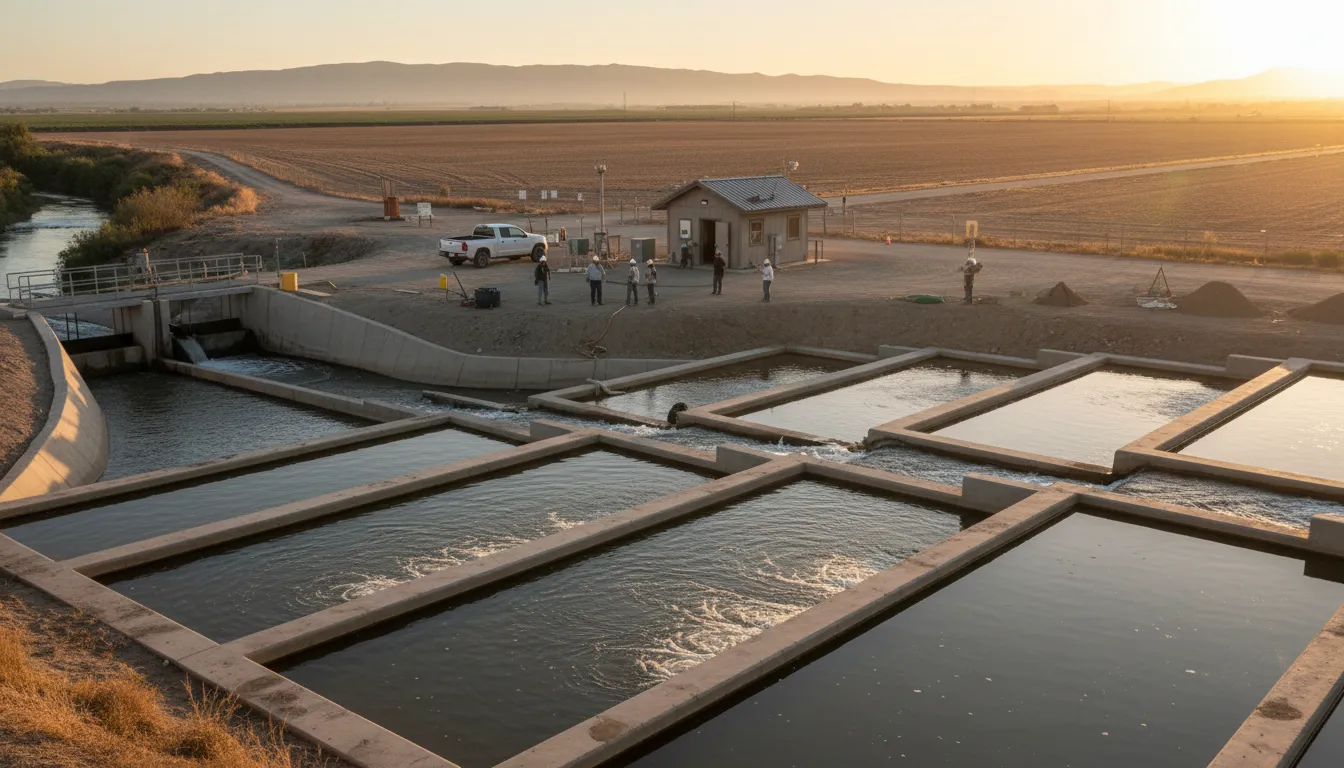
Spreading basins are the oldest and most common technique. Operators flood shallow, purpose-built basins—essentially large ponds—with stormwater or imported surface water. The water percolates downward through layers of sand and gravel, which act as a natural filter, removing sediment, bacteria, and some chemical contaminants before reaching the aquifer below. Basins are cycled through wetting and drying periods to prevent clogging and allow maintenance of the basin floor.
Los Angeles County has operated spreading grounds since 1917, siting them over coarse-grained sediments that drain quickly into the subsurface. These facilities help support groundwater supplies for over four million people.
Injection Wells
Where geology or geography makes surface spreading impractical—beneath dense urban areas or above deep aquifers—injection wells pump treated water directly underground. This method is more expensive but allows precise placement of water into specific aquifer zones. In coastal cities, injection wells serve a dual purpose: replenishing freshwater supplies while creating a hydraulic barrier against saltwater intrusion, where seawater creeps inland through depleted aquifers.
Where Does the Water Come From?
MAR draws from multiple sources:
- Stormwater runoff—rain that would otherwise flow to the ocean through storm drains
- Treated wastewater—recycled municipal water that undergoes advanced purification
- Imported surface water—river or canal water diverted during wet periods
- Rooftop rainwater—harvested in countries like Australia, India, and Germany
The U.S. Environmental Protection Agency notes that water quality is a critical consideration, since stormwater can carry chemical and microbial contaminants that could harm the receiving aquifer. Natural soil filtration removes many pollutants, but source water often requires pre-treatment—settling ponds, sand filters, or chemical conditioning—before recharge begins.
Why It Matters
Underground storage offers advantages that surface reservoirs cannot match. Aquifers lose almost no water to evaporation—a major concern in arid regions where open reservoirs can lose a metre or more per year. They require no dams, no massive land acquisitions, and no displacement of communities. And they already exist beneath most populated areas.
MAR also reduces flood risk. During heavy rains, capturing runoff for recharge keeps water out of streets and storm drains. In its 2025–26 storm season, Los Angeles County captured 120.3 billion gallons of stormwater—enough to supply roughly three million people for a year—compared to just 11.9 billion gallons the previous season.
A Global Practice
MAR is not a new idea, but it is expanding rapidly. Programs operate across dozens of countries: Israel uses treated wastewater to recharge the Coastal Aquifer, Namibia injects purified sewage into aquifers supplying Windhoek, and India has installed thousands of recharge wells alongside irrigation canals. Australia pioneered stormwater harvesting for aquifer injection in Adelaide.
As climate change intensifies the cycle of drought and deluge, MAR turns a problem—too much water arriving at the wrong time—into a solution. The challenge is building enough infrastructure to capture what falls from the sky before it reaches the sea.