How Tidally Locked Planets Work—Eternal Day Meets Night
Tidally locked planets keep one face permanently turned toward their star, creating a world split between scorching daylight and frozen darkness. Scientists now believe life could survive in the narrow twilight strip between the two extremes.
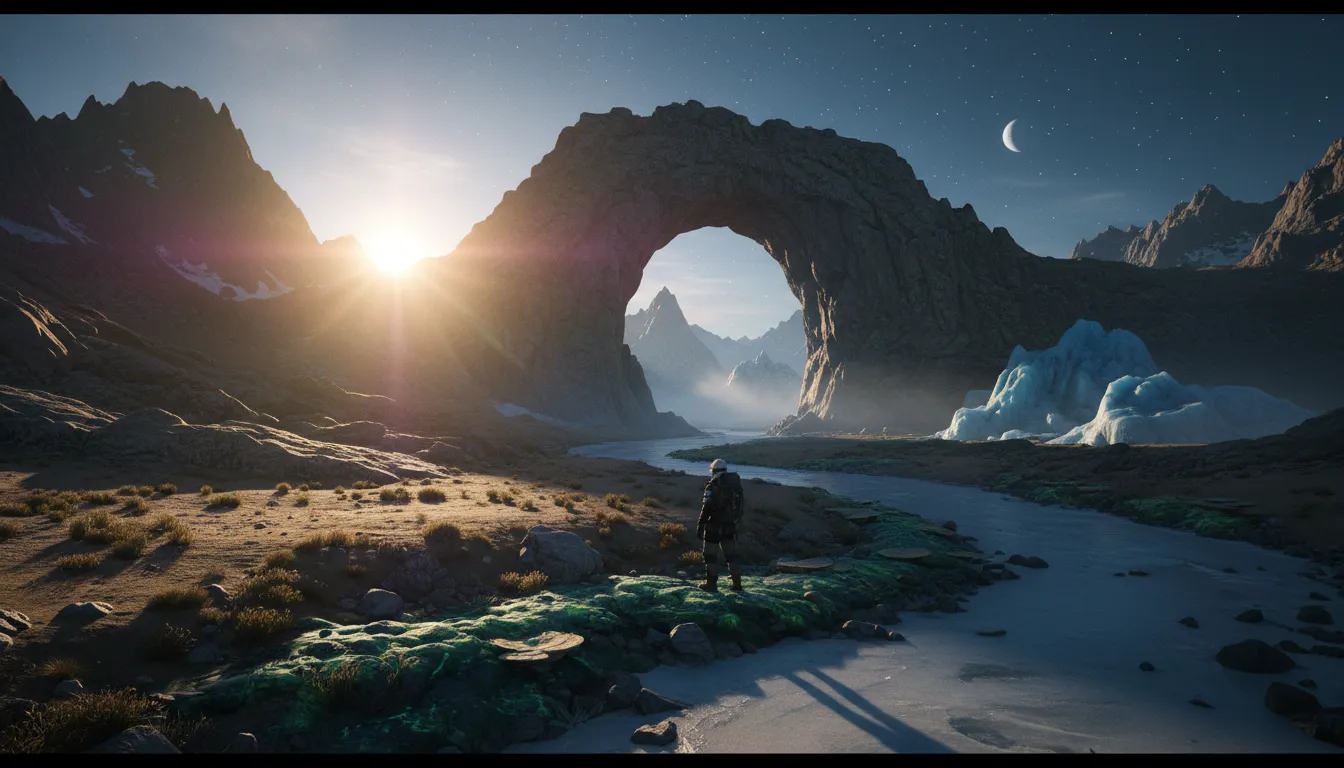
A World That Never Turns
Imagine a planet where the sun never sets on one hemisphere and never rises on the other. No sunrise, no sunset — just an eternal division between blazing light and freezing dark. This is the reality of a tidally locked planet, a world whose rotation has slowed until one face permanently points at its star, much like the Moon always shows the same side to Earth.
New observations from the James Webb Space Telescope have mapped the climates of two such worlds in the TRAPPIST-1 system, revealing temperature swings exceeding 500 °C between their day and night sides. The findings have reignited a fundamental question in astronomy: could anything actually live on a planet like this?
How Tidal Locking Happens
Tidal locking is driven by gravity. When a planet orbits close to its star, the star's gravitational pull raises slight bulges — tidal bulges — on the planet's near and far sides. Because rock and magma respond sluggishly, these bulges lag behind the gravitational force that creates them. The resulting misalignment generates a torque that gradually slows the planet's spin until its rotation period matches its orbital period. At that point, one hemisphere faces the star permanently.
The process can take millions to billions of years, depending on the planet's distance from its star, its internal rigidity, and its mass. According to NASA, every large moon in our solar system — including our own Moon — is already tidally locked to its parent planet. For planets orbiting stars, the effect is strongest around red dwarfs (M-dwarf stars), because their habitable zones sit close enough for tidal forces to dominate.
The Scorched Side, the Frozen Side
The consequences are dramatic. The permanent dayside receives unrelenting stellar radiation, potentially pushing surface temperatures above 200 °C. The permanent nightside, starved of any external heat, can plunge below −200 °C. Without an atmosphere to redistribute warmth, the contrast is stark — as Webb's TRAPPIST-1b observations confirmed, with a blistering dayside near 220 °C and a nightside too cold to detect any thermal glow.
If an atmosphere exists but is too thin, a catastrophic feedback loop can develop: gases on the nightside freeze and collapse onto the surface as ice, further thinning the atmosphere in a process scientists call atmospheric collapse. A thick enough atmosphere, however, can drive powerful winds from the hot side to the cold side, smoothing out the temperature extremes.
The Terminator Zone — Where Life Might Hide
Between the inferno and the ice lies a narrow strip of permanent twilight called the terminator zone. Research published by the University of California, Irvine, and highlighted by The Planetary Society, suggests this ribbon encircling the planet could maintain moderate temperatures and, crucially, liquid water — the essential ingredient for life as we know it.
The habitability of these zones depends on water availability. Planets with limited surface water and rocky terrain tend to develop more diverse microclimates along the terminator, increasing the odds of pockets where conditions are just right. Planets covered by global oceans, by contrast, rely on massive currents and evaporation cycles to ferry heat from day to night — a less stable arrangement.
Why It Matters for the Search for Life
The stakes are enormous. Red dwarfs make up roughly 75 percent of all stars in the Milky Way, and their habitable zones overlap precisely with the region where tidal locking occurs. That means the majority of potentially habitable rocky planets in the galaxy may be tidally locked. If the terminator-zone hypothesis holds, the number of worlds capable of supporting life could be far larger than once assumed.
A 2025 study in Nature Communications added another dimension: geothermal heating driven by tidal forces in a locked planet's mantle could warm mid-latitude regions independently of starlight, creating additional habitable patches. And a March 2026 analysis published by Astrobiology.com proposed that partial atmospheric collapse might paradoxically help sustain surface liquid water in some scenarios.
As Webb continues to probe TRAPPIST-1 and other red-dwarf systems, tidally locked worlds have moved from science-fiction curiosity to the front line of astrobiology. The question is no longer whether these split worlds exist — it is whether something is alive in the twilight.


