How Salmon Find Their Way Home—Thousands of Miles
Salmon navigate thousands of miles of open ocean and return to the exact stream where they were born using a dual navigation system: Earth's magnetic field as an open-water compass and smell to pinpoint their natal river.
A Journey That Defies the Odds
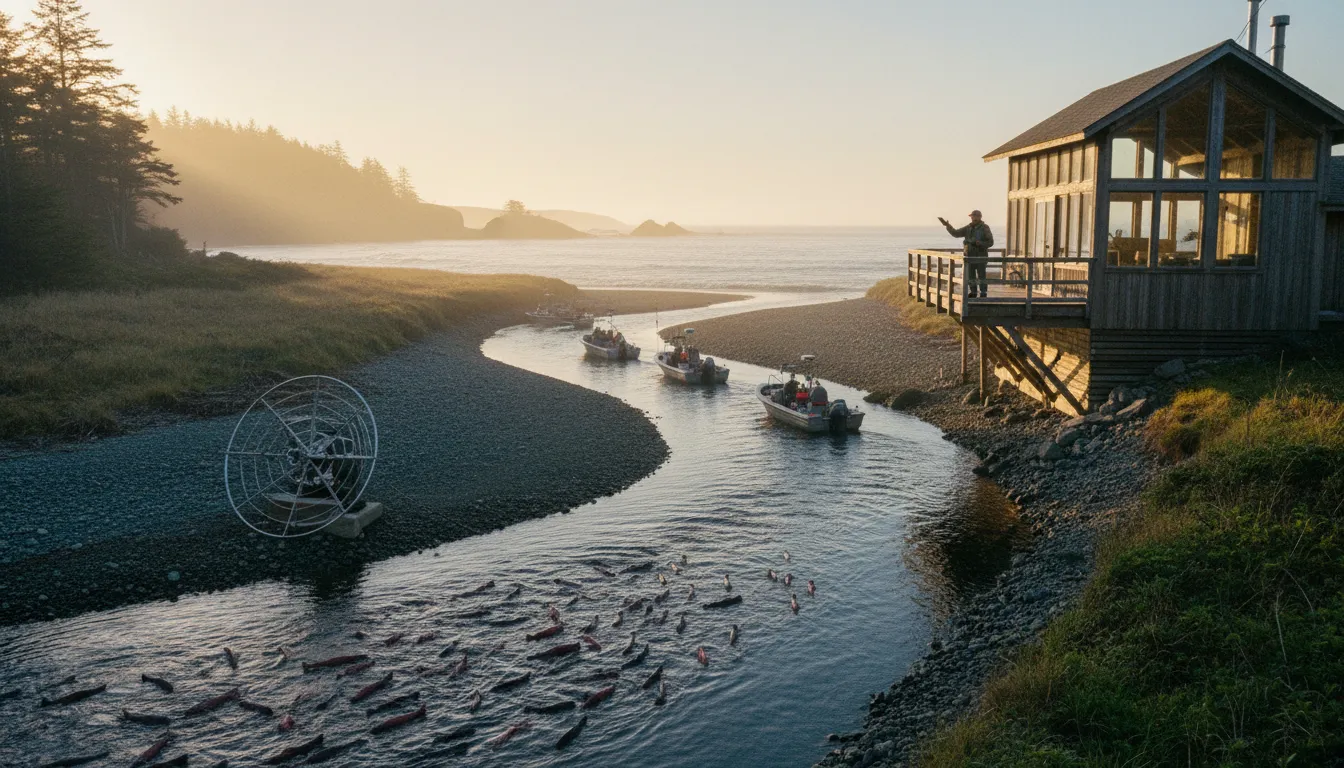
Every year, millions of salmon complete one of nature's most astonishing feats: after spending years roaming the open Pacific Ocean, they return to the exact freshwater stream where they hatched—sometimes traveling more than 900 miles upstream. The precision is extraordinary. Out of an ocean covering 60 million square miles, a single fish finds its way to one small creek. How?
Scientists have spent decades unraveling this mystery, and the answer involves two complementary navigation systems: an internal magnetic compass for the open sea and a chemical memory of home for the final stretch upriver.
The Magnetic Map
When young salmon leave their natal rivers and enter the ocean, they do something remarkable: they memorize the Earth's magnetic field at the river mouth. Researchers at Oregon State University discovered that salmon imprint on the specific magnetic signature—both intensity and inclination angle—of the location where they first reach saltwater.
Years later, when adults begin their spawning migration, they use these stored coordinates like a GPS waypoint. A landmark 2014 study published in the Journal of the Royal Society Interface found that geomagnetic imprinting accounted for up to 44% of the variation in migration routes of pink salmon. The mechanism relies on magnetite—tiny crystals of iron oxide found in the skulls and olfactory tissue of salmon—that act as a biological compass needle.
This magnetic map explains how salmon cross thousands of miles of featureless ocean. But it is not precise enough to locate one stream among hundreds along a coastline. For that, salmon switch to a second, far more intimate sense.
The Smell of Home
In the 1950s, biologist Arthur Hasler proposed that salmon recognize their home river by smell. He tested the idea by plugging the nostrils of returning coho salmon—and found that anosmic fish wandered into the wrong streams at far higher rates than controls. The olfactory hypothesis has since been confirmed by decades of research.
As juveniles transform into smolts—the developmental stage just before ocean migration—their brains undergo a burst of olfactory imprinting. They memorize a chemical fingerprint composed of amino acids, dissolved minerals, and even pheromones released by other salmon of the same population. According to the U.S. Geological Survey, returning adults essentially "smell their way" upstream, following an increasingly concentrated scent trail from river mouth to spawning gravel.
A One-Way Trip
All six species of Pacific salmon—Chinook, coho, sockeye, pink, chum, and cherry—are anadromous, hatching in freshwater, migrating to the ocean to feed and grow, then returning to freshwater to reproduce. They are also semelparous: they spawn once and die, usually within days. According to NOAA Fisheries, a Pacific salmon's entire life is a single loop from river to ocean and back.
Their death is not waste. Salmon carcasses deliver nitrogen, phosphorus, and carbon from the ocean deep into inland forests. Bears, eagles, and even trees depend on this annual nutrient pulse, making salmon a keystone species whose influence extends far beyond the water.
A System Under Stress
The homing instinct that has sustained salmon for millions of years now faces unprecedented threats. Dams block migration routes—in California's Central Valley, steelhead have lost access to over 80% of their historical spawning habitat. Climate change is warming rivers, reducing snowpack, and acidifying the ocean. The USGS identifies overfishing, habitat degradation, and migration barriers as the three forces that have driven more than half of U.S. salmon populations onto the Endangered Species Act list.
Yet there are signs of hope. Dam removals on the Elwha River in Washington and habitat restoration along California's Russian River have brought coho salmon back to streams where they had been absent for decades. These successes suggest that when humans remove the obstacles, salmon's ancient navigation system still works—guiding them home, one magnetic pulse and one molecule at a time.