How Meteor Showers Work—Cosmic Debris at 70 km/s
Meteor showers occur when Earth plows through trails of dust and rock left behind by comets. Here's the science behind these annual celestial displays, from comet debris streams to the radiant point illusion.
A Comet's Dusty Trail
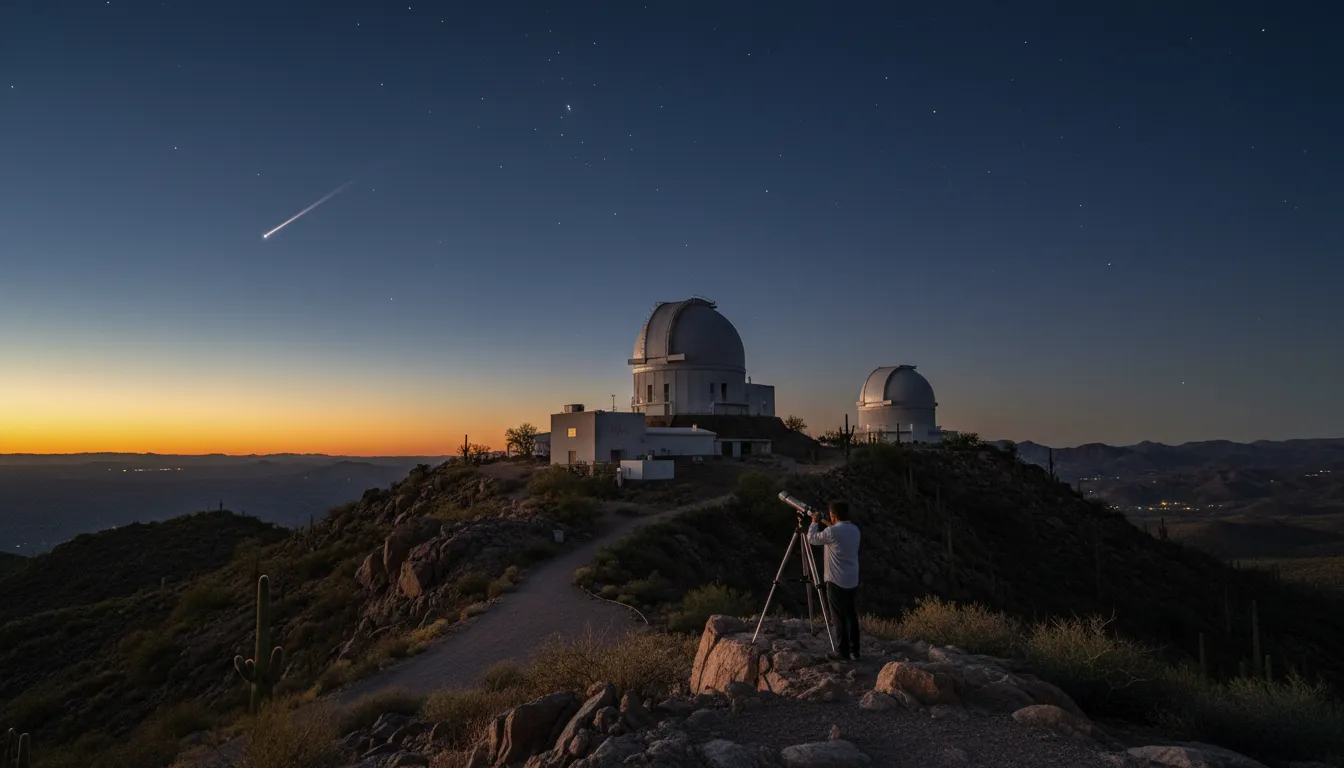
Every year, Earth passes through invisible rivers of debris hanging in space—the dusty remnants of comets that shed material on their journeys around the Sun. When these tiny particles slam into our atmosphere at speeds between 11 and 72 kilometers per second, they compress the air ahead of them so violently that it glows white-hot. The result is a streak of light lasting a fraction of a second: a meteor, commonly called a shooting star.
Most of the particles responsible are remarkably small. According to NASA, the vast majority are no larger than a grain of sand. They vaporize completely between 80 and 130 kilometers above the ground, never reaching Earth's surface.
How Comets Build Debris Streams
Comets are essentially dirty snowballs—mixtures of ice, rock, and dust orbiting the Sun on elongated paths. As a comet approaches the inner solar system, solar radiation heats its surface. The ice doesn't melt; it sublimates, turning directly from solid to gas. That escaping vapor drags dust, sand, and small pebbles along with it, ejecting material into space.
Over centuries of repeated orbits, a comet litters its entire orbital path with a broad tube of debris called a meteoroid stream. The stream gradually spreads under the influence of planetary gravity, solar radiation pressure, and collisions between particles. Some streams are narrow and dense; others are diffuse and wide. This is why some meteor showers, like the Geminids, reliably produce over 100 meteors per hour, while others yield only a modest handful.
The Radiant Point Illusion
During a meteor shower, all the streaks of light appear to fan outward from a single point in the sky called the radiant. This is a trick of perspective, much like the way parallel railway tracks seem to converge at a vanishing point on the horizon. The meteoroids actually enter the atmosphere on roughly parallel paths, but because we observe them from a single vantage point, they appear to diverge from one spot.
Meteor showers are named after the constellation that contains their radiant. The radiant drifts about one degree eastward per day, roughly tracking the ecliptic as Earth moves along its orbit.
Major Showers and Their Parent Comets
The International Astronomical Union recognizes over 900 suspected meteor showers, about 100 of which are well established. The biggest annual displays include:
- Quadrantids (January) — up to 110 meteors per hour, linked to asteroid 2003 EH1
- Perseids (August) — around 100 per hour, from Comet Swift-Tuttle
- Geminids (December) — the year's strongest, over 120 per hour, from asteroid 3200 Phaethon
- Lyrids (April) — a modest 15–20 per hour, but the oldest continuously recorded shower in history, first documented by Chinese astronomers in 687 BC
Notably, two of the strongest showers—the Quadrantids and Geminids—originate not from comets but from asteroids, challenging the traditional model and suggesting some parent bodies may be extinct comets that lost all their ice.
Why Some Years Are Better Than Others
Debris within a meteoroid stream is not evenly distributed. Dense clumps form where material was recently ejected or where gravitational interactions with Jupiter have concentrated particles. When Earth passes through a particularly dense filament, the result is an outburst—a sudden spike in meteor rates that can be ten times the normal peak. The Lyrids, for instance, occasionally surge to 100 meteors per hour, though predicting exactly when this will happen remains difficult.
Moonlight is the other major variable. A bright Moon washes out fainter meteors, dramatically reducing visible counts. Astronomers consider a shower favorable when the Moon is below the horizon during the predawn hours, when the radiant is highest and Earth's rotation turns observers directly into the oncoming stream of particles.
More Than a Light Show
Meteor showers are not just spectacles. Scientists use them to study cometary composition without sending a spacecraft. Each flash produces a momentary plasma whose spectrum reveals the chemical makeup of the particle—silicon, magnesium, iron, sodium. Radar networks track meteors invisible to the eye, building detailed maps of debris streams that refine orbital models of their parent comets. For a phenomenon recorded for nearly three millennia, meteor showers continue to teach us something new about the solar system's dusty highways.