What Is Teotihuacan—and Why Is It Still a Mystery?
Teotihuacan was the largest city in the pre-Columbian Americas, yet no one knows for certain who built it, what language its people spoke, or why it collapsed. Here's what archaeology has revealed — and what remains unsolved.
A Metropolis Before Its Time
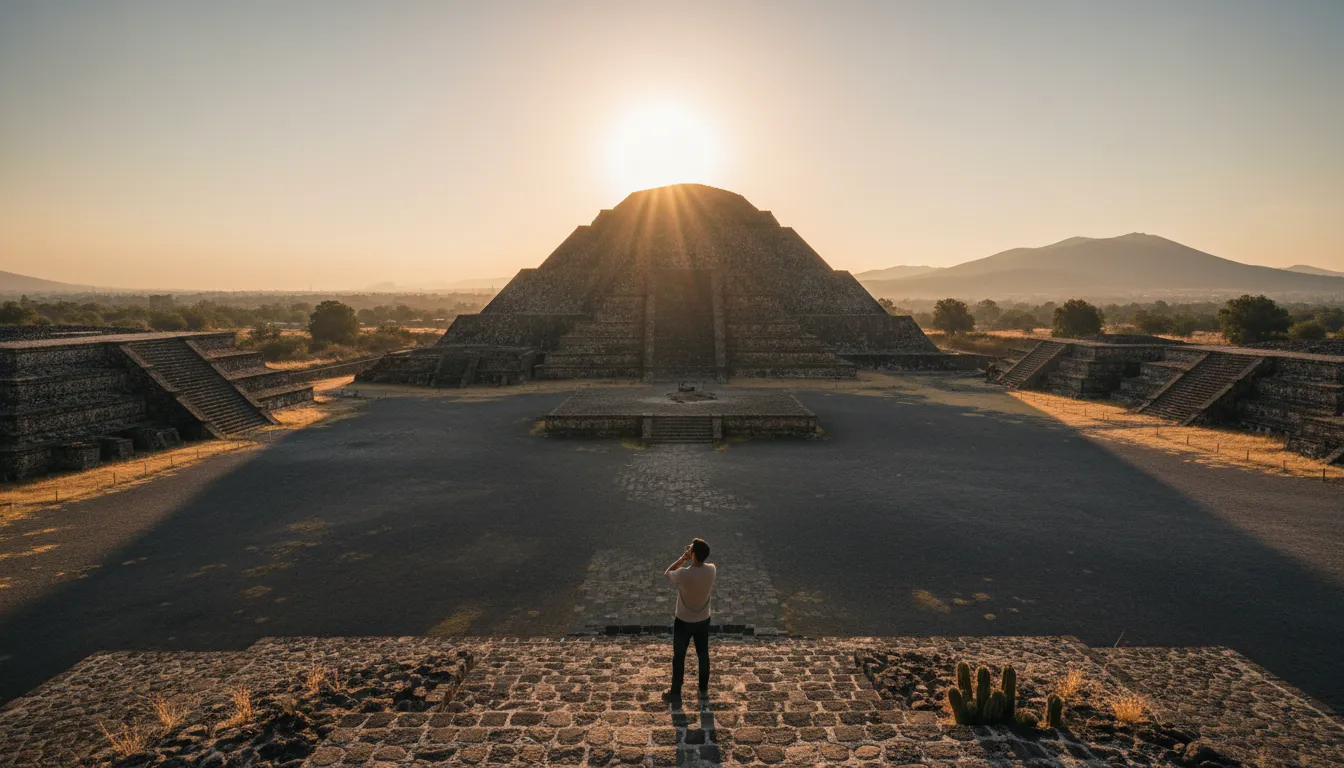
About 50 kilometers northeast of modern Mexico City lie the ruins of Teotihuacan, a city that at its peak around 400 CE housed an estimated 100,000 to 200,000 people — making it one of the largest cities on Earth at the time. Its colossal Pyramid of the Sun, standing 75 meters tall, and the slightly smaller Pyramid of the Moon dominated a carefully planned urban grid centered on a 2.4-kilometer ceremonial boulevard the Aztecs later called the Avenue of the Dead.
Yet for all its grandeur, Teotihuacan remains one of archaeology's deepest enigmas. Unlike the Maya or the Aztecs, the civilization that built this metropolis left behind no clearly deciphered written records, no king lists, and no accepted ethnic identity. Even the name "Teotihuacan" — roughly "the place where gods were born" — was assigned centuries later by the Aztecs, who found the city already in ruins and assumed only gods could have constructed it.
Who Built It?
The honest answer is: scholars still aren't sure. Several competing theories exist. Some researchers point to the Totonac people of eastern Mexico. Others suggest a multiethnic population — archaeological evidence shows that Teotihuacan hosted distinct neighborhoods of Maya, Zapotec, and Mixtec residents, each maintaining their own cultural practices within the larger urban fabric.
One leading hypothesis links the city's rapid early growth to the eruption of the Xitle volcano around the first century BCE, which may have driven refugees from the southern Valley of Mexico into the Teotihuacan basin. The area's abundant springs and fertile land could have attracted settlers who then coalesced into an increasingly organized urban center.
A 2025 breakthrough offered a tantalizing clue. Researchers Magnus Pharao Hansen and Christopher Helmke of the University of Copenhagen published a partial decipherment of Teotihuacan's writing system in the journal Current Anthropology, arguing that the script encoded proto-Corachol-Nahua — an early Uto-Aztecan language ancestral to Nahuatl, the language later spoken by the Aztecs. If confirmed, this would establish a direct linguistic link between Teotihuacan and later Nahuatl-speaking civilizations.
How Was the City Organized?
Teotihuacan was not a haphazard settlement. Its architects laid out the city on a precise grid oriented 15.5 degrees east of true north — a deliberate alignment whose purpose remains debated. The Pyramid of the Sun was erected around 200 CE over a natural cave system, and evidence suggests these caves held deep ritual significance. The Temple of the Feathered Serpent contained mass burials of sacrificial victims — warriors and captives interred with obsidian weapons and shell ornaments.
Residential compounds, called apartment complexes by archaeologists, housed extended families in multi-room units surrounding shared courtyards. Many walls were covered in vivid murals depicting gods, animals, and cosmological scenes — some of the finest pre-Columbian art ever discovered.
Why Did It Collapse?
Around 550 CE, Teotihuacan suffered a catastrophic decline. Crucially, the burn marks found on major structures are concentrated on palaces and elite residences, not ordinary homes. This pattern has led most modern archaeologists to reject the older theory of foreign invasion in favor of an internal uprising — the city's lower classes may have revolted against an increasingly extractive ruling elite.
Climate data strengthens this picture. Lake sediment cores from the region reveal severe droughts during the sixth century CE, possibly linked to the extreme weather events of 535–536 CE, when a volcanic eruption or comet impact dimmed sunlight worldwide. Crop failures would have intensified social tensions in a city dependent on agricultural surplus to feed its vast population.
What Archaeologists Are Still Finding
Far from a closed case, Teotihuacan continues to yield surprises. A tunnel beneath the Pyramid of the Moon, discovered using electrical resistivity tomography, runs from the Plaza de la Luna toward the pyramid's core. Researchers believe it may represent the underworld in Teotihuacan cosmology. A separate tunnel under the Temple of the Feathered Serpent, explored by archaeologist Sergio Gómez over two decades, contained thousands of ritual offerings — pyrite mirrors, jade figurines, and shells — but no royal tomb has yet been confirmed.
These ongoing discoveries, combined with the recent writing-system breakthrough, suggest that Teotihuacan's secrets are slowly yielding to modern science. But the city that the Aztecs believed was built by gods still guards many of its mysteries.