How Hospital Pharmacy Robots Work—and Why They Matter
Pharmacy robots now fill prescriptions, dispense medications, and deliver drugs across hospital floors with 99.98% accuracy—slashing the errors that kill thousands of patients every year.
A Silent Crisis in Every Hospital
Every day, hospitalized patients experience roughly one medication error during their stay. Across the United States alone, these mistakes—wrong drug, wrong dose, wrong patient—cause an estimated 7,000 to 9,000 deaths annually and cost the healthcare system around $21 billion per year, according to research published in peer-reviewed pharmacology journals. The solution increasingly found in modern hospitals is not more pharmacists, but robots.
What Pharmacy Robots Actually Do
Hospital pharmacy automation covers a range of interconnected technologies, from large robotic arms that retrieve and sort medications to smaller tabletop counting machines and autonomous delivery vehicles that navigate hallways. Their core job is to remove human hands—and human error—from as many steps of the medication dispensing process as possible.
The workflow typically begins when a physician enters a prescription into the hospital's electronic health record system. That order is automatically routed to the pharmacy's robotic system, which identifies the correct drug, retrieves it from storage, verifies it against the prescription using barcode or RFID scanning, packages it, and either places it in a labeled bin for collection or dispatches a delivery robot to bring it directly to the ward.
Chaotic Storage: The Counterintuitive Method That Works
Most modern pharmacy robots use what engineers call chaotic storage—a system that looks disorganized but is actually highly efficient. When a drug shipment arrives, the robot places each pack wherever there is available space on the shelves, recording the exact location in its database. Only the robot knows where every item is stored.
This approach allows the system to tessellate packages tightly together, dramatically increasing storage density compared to fixed-location shelving. When a prescription arrives, the robot calculates the shortest path to the item and retrieves it in seconds. The alternative, channel-fed dispensing, assigns each drug to a dedicated slot—simpler but far less space-efficient.
Automated Dispensing Cabinets at the Bedside
Beyond central pharmacy robots, hospitals deploy Automated Dispensing Cabinets (ADCs)—secure, nurse-accessible lockers placed directly on patient wards. Nurses authenticate with a fingerprint or PIN, and the cabinet unlocks only the specific drawer containing the medication ordered for a specific patient. ADCs act as a last checkpoint, preventing a nurse from accidentally grabbing the wrong drug from a shared medication room.
The first ADC was installed in October 1992 in the emergency department at the University of California San Francisco Medical Center, and the technology has proliferated rapidly. By the early 2010s, surveys showed that 97% of US hospital pharmacies had implemented some form of automation in their medication-use process.
The Numbers Behind the Safety Gains
The evidence for accuracy improvements is striking. Studies published in peer-reviewed pharmacy journals found that introducing robotic dispensing alongside ADCs produced a 53% reduction in administration errors, a 79% decrease in dosing errors, and a 93% drop in drug selection errors. Overall dispensing accuracy using these systems reaches approximately 99.98%—compared to a human accuracy rate typically estimated between 97% and 99%.
That fraction of a percent matters enormously at scale. A busy hospital pharmacy filling thousands of prescriptions daily means even a 1% human error rate translates into dozens of daily mistakes.
Beyond Dispensing: Robots That Roam the Halls
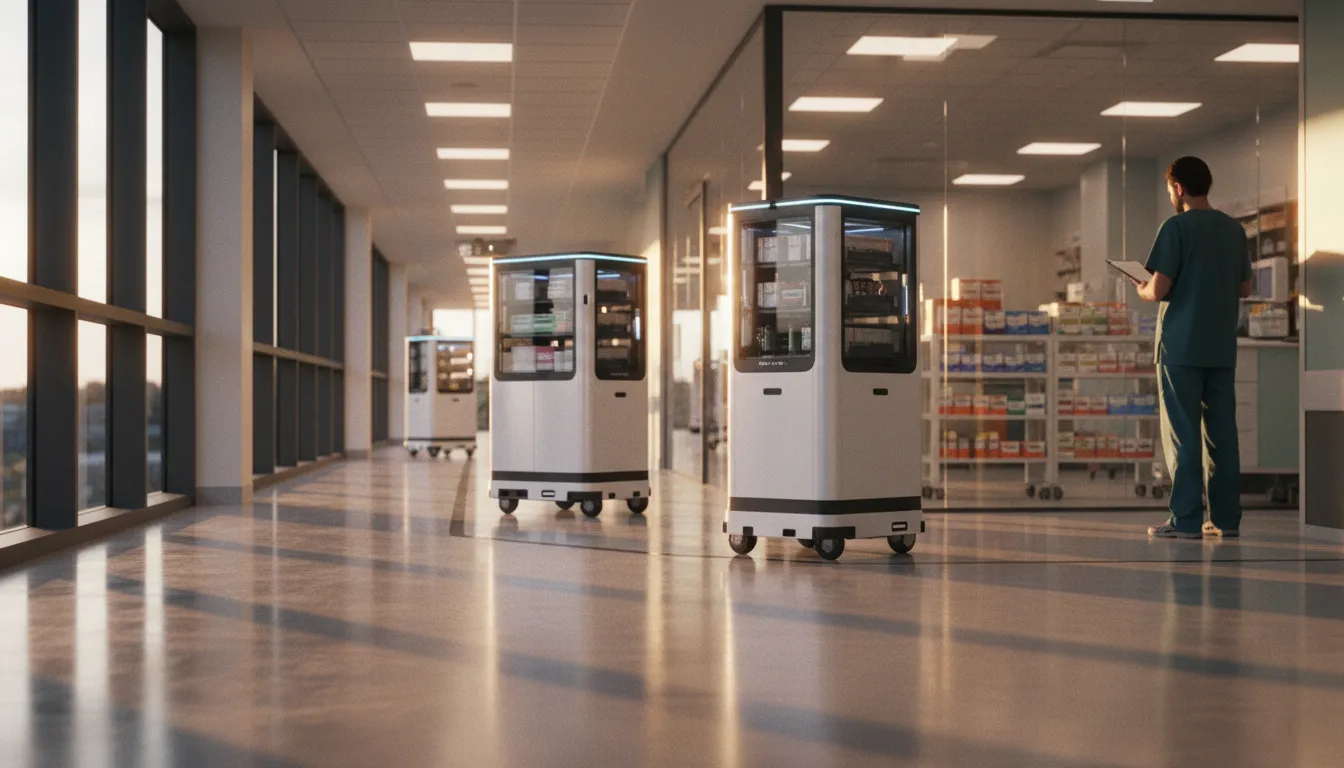
A newer generation of autonomous mobile robots now handles drug delivery between the central pharmacy and individual wards. These machines navigate hospital corridors using LIDAR sensors and pre-mapped floor plans, ride elevators, pass through automated doors, and alert staff when a delivery has arrived. Unlike human couriers, they do not tire, become distracted, or mix up delivery destinations.
Limitations and the Role of the Human Pharmacist
Pharmacy automation does not eliminate the need for pharmacists—it transforms their role. Clinical pharmacists freed from repetitive dispensing tasks can focus on reviewing complex medication regimens, counseling patients, and catching higher-level errors such as dangerous drug interactions that robots cannot assess. Mechanical failures, unusual medications that fall outside standard stock, and compounded or intravenous preparations still require skilled human hands.
Implementation also carries significant cost and complexity. Robotic systems require major capital investment, staff retraining, and careful integration with hospital IT infrastructure. Despite these hurdles, the combination of worsening pharmacist shortages and rising prescription volumes is pushing more institutions toward automation as a structural necessity rather than a luxury.
What Comes Next
Researchers and manufacturers are developing systems that combine pharmacy robotics with AI-driven clinical decision support—flagging potential allergies or interactions before a drug is even dispensed. As these technologies mature, the hospital pharmacy of the future may look less like a room full of people counting pills and more like a precision logistics hub where humans set the rules and machines execute them, one verified dose at a time.