How Ice Cores Work—and What They Reveal
Scientists drill deep into polar ice sheets to extract frozen cylinders that preserve hundreds of thousands of years of climate history, from ancient temperatures to greenhouse gas levels.
Frozen Time Capsules Beneath the Ice
Deep beneath the ice sheets of Greenland and Antarctica lies a remarkable archive of Earth's past. Scientists extract long cylinders of ice — called ice cores — that contain layer upon layer of compressed snowfall stretching back hundreds of thousands of years. Each layer acts as a time capsule, preserving traces of the atmosphere, temperature, volcanic eruptions, and even cosmic events from the moment that snow first fell.
Ice core science, a cornerstone of paleoclimatology, has transformed our understanding of how Earth's climate has shifted over deep time — and how today's changes compare to natural cycles.
How Scientists Drill Into the Past
Ice sheets form as seasonal snowfall accumulates year after year. The weight of newer snow compresses older layers beneath it, gradually turning them into dense ice. Because each season's snowfall has slightly different physical and chemical properties, annual layers remain distinguishable — much like tree rings.
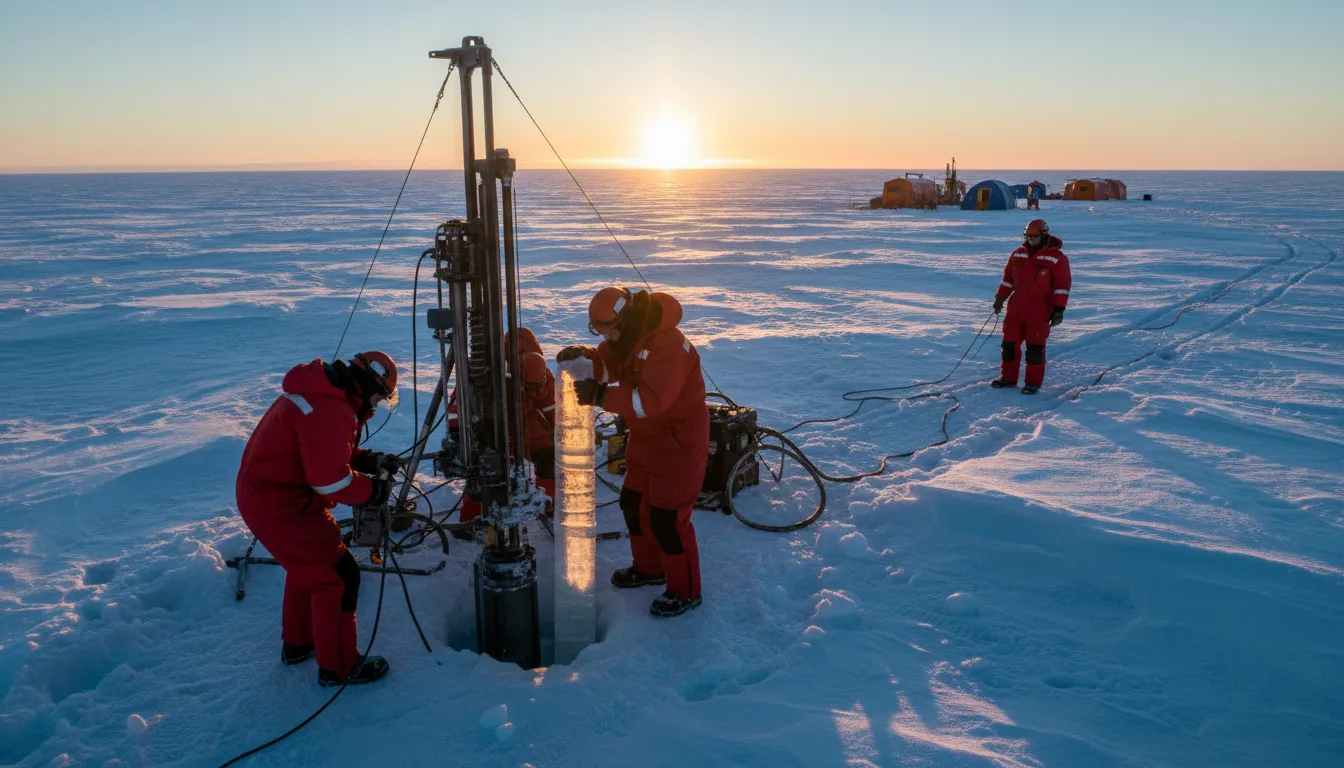
To access this record, researchers use specialized drills. Shallow cores can be extracted with hand-powered augers, but deep drilling requires motorized systems suspended on cables from the surface. These rigs cut cylindrical sections typically 10–13 centimeters in diameter and 2–6 meters long per run. The deepest cores reach over 3.2 kilometers below the surface and contain ice up to 800,000 years old, according to NASA.
Reading the Climate Record
Ice cores contain two main types of climate evidence: the ice itself and the tiny air bubbles trapped within it.
Temperature From Isotopes
Water molecules come in "light" and "heavy" varieties, depending on whether they contain the isotope oxygen-16 or oxygen-18. During colder periods, heavier water molecules are less likely to evaporate and travel to the poles, so ice formed in cold climates contains a higher ratio of oxygen-16. Scientists measure these stable isotope ratios using mass spectrometry to reconstruct temperature records stretching back millennia, as described by NOAA.
Atmosphere in a Bubble
As snow compacts into ice at depths of roughly 50–100 meters, air gets sealed inside tiny bubbles. These bubbles are miniature samples of the ancient atmosphere. By crushing or melting ice samples in a vacuum, researchers extract the trapped gases and measure concentrations of carbon dioxide, methane, and nitrous oxide. This technique has produced continuous records of greenhouse gas levels going back over 800,000 years — the longest direct measurements of atmospheric composition available anywhere.
What Else Ice Cores Preserve
Beyond temperature and gas data, ice cores capture a surprising range of signals:
- Volcanic eruptions leave layers of sulfuric acid and fine ash particles, allowing scientists to date past eruptions precisely.
- Dust and pollen reveal changes in wind patterns, vegetation, and aridity.
- Chemical anomalies — such as a platinum spike found in Greenland ice dating to 12,800 years ago — can point to volcanic episodes or even possible cosmic impacts, as recent research has explored.
- Sea salt and biological markers indicate changes in ocean conditions and sea ice extent.
Why Ice Cores Matter Today
Ice cores have provided some of the most compelling evidence linking greenhouse gases to global temperature. The records show that over the past 800,000 years, CO₂ levels and temperature have risen and fallen in lockstep during natural glacial cycles. Current atmospheric CO₂ — above 420 parts per million — far exceeds anything found in the ice core record, according to data compiled by the National Snow and Ice Data Center.
Major drilling projects continue to push the record deeper. The European Beyond EPICA project aims to recover Antarctic ice up to 1.5 million years old, which would span a critical period when Earth's glacial cycles shifted from 40,000-year to 100,000-year intervals. Understanding that transition could illuminate how sensitive the climate system is to orbital changes and CO₂ forcing.
From solving ancient mysteries buried in Greenland's ice to benchmarking modern climate change, ice cores remain one of the most powerful tools in Earth science — a frozen library written in isotopes, gas bubbles, and dust.