What Is the Younger Dryas and Why It Changed History
The Younger Dryas was a sudden 1,200-year cold snap 12,900 years ago that killed megafauna, ended the Clovis culture, and may have pushed humans toward agriculture. Scientists still debate what triggered it.
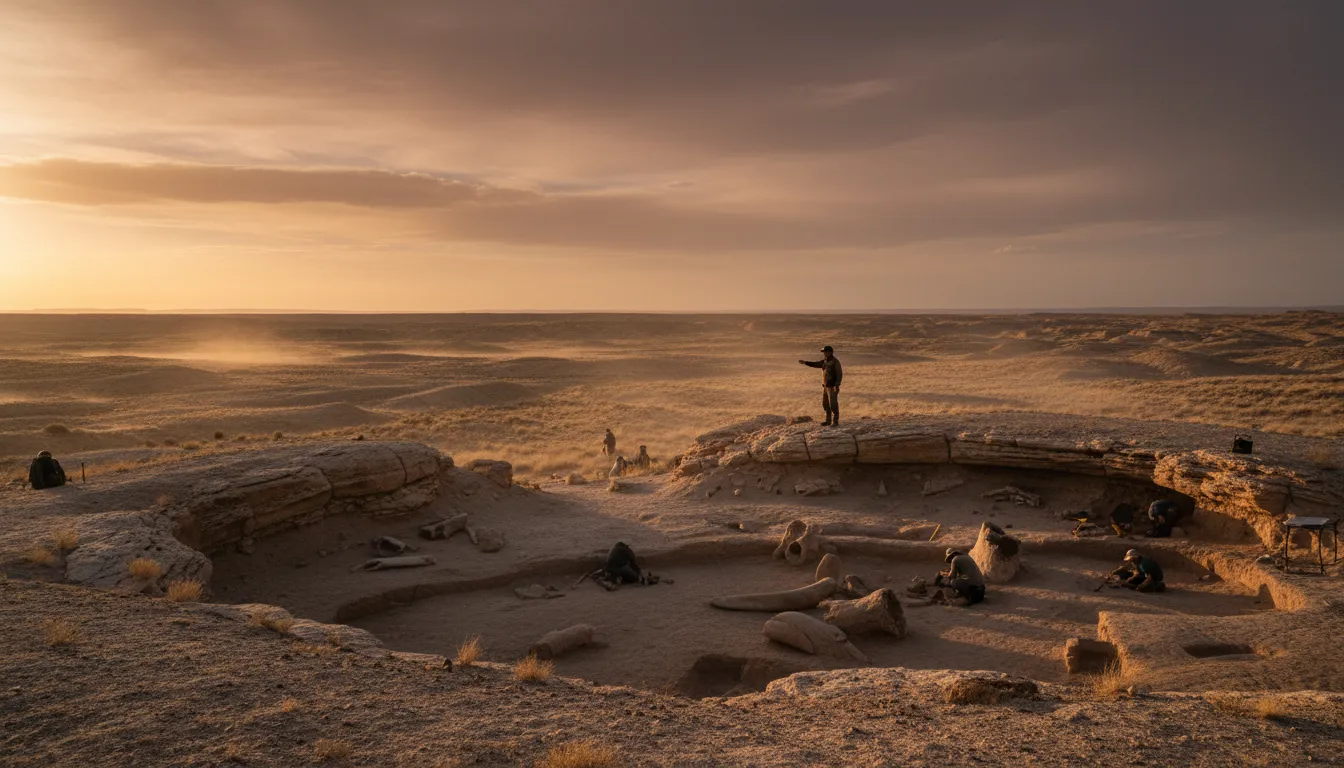
A Sudden Freeze at the Dawn of Civilization
Around 12,900 years ago, as Earth was warming out of the last Ice Age, temperatures abruptly plunged. In a matter of decades, Greenland cooled by as much as 10°C, Europe dropped 2–6°C, and North America chilled by roughly 3°C. This reversal, known as the Younger Dryas, lasted approximately 1,200 years before ending just as suddenly around 11,700 years ago. It remains one of the most dramatic climate shifts in the geological record—and one of the most debated.
What Caused the Big Freeze?
The leading scientific explanation centers on a massive freshwater flood into the North Atlantic. As the Laurentide Ice Sheet retreated across North America, it released enormous volumes of glacial meltwater. Lake Agassiz, a colossal meltwater lake covering much of present-day Manitoba and Ontario, likely drained eastward through the St. Lawrence River rather than southward into the Mississippi.
This deluge of cold freshwater disrupted the Atlantic Meridional Overturning Circulation (AMOC)—the ocean conveyor belt that carries warm tropical water northward and cold polar water south. When that circulation slowed or shut down, the Northern Hemisphere lost a critical heat source, and temperatures plummeted.
The Comet Controversy
A rival hypothesis has long proposed that a comet or asteroid impact triggered the cooling. Proponents pointed to a spike of platinum and microscopic glass beads found in sediment layers dating to roughly 12,800 years ago. However, research published in March 2026 found that the platinum signal in Greenland ice actually appeared about 45 years after the Younger Dryas began, and its chemical signature matches volcanic emissions rather than extraterrestrial material. A key paper supporting the impact theory using Baffin Bay sediment cores was also retracted in early 2026. Most climate scientists now consider the freshwater mechanism far more likely.
Why It Matters: Megafauna and Human History
The Younger Dryas coincided with a wave of mass extinctions across North America. Mammoths, mastodons, saber-toothed cats, giant ground sloths, and other megafauna vanished—33 genera of large mammals, representing roughly 75% of the continent's megafauna. Whether the cold itself, human hunting, or a combination killed them remains an active area of research.
Human cultures were reshaped as well. In North America, the Clovis culture—known for its distinctive stone tools—disappeared abruptly. In the Middle East, the Natufian people, who had begun settling in villages and harvesting wild grains, were forced back into nomadic patterns as drought and cold reduced food supplies.
The Birth of Agriculture
Paradoxically, this hardship may have sparked one of humanity's greatest leaps. As wild food sources dwindled in the Fertile Crescent, communities began experimenting with the deliberate cultivation of cereals and legumes. Many archaeologists view the Younger Dryas as a catalyst for the Neolithic Revolution—the transition from foraging to farming that eventually gave rise to cities, writing, and civilization itself.
Lessons for the Present
The Younger Dryas demonstrates that Earth's climate can shift with startling speed. The cooling began within decades, and its end was even faster—Greenland warmed by roughly 10°C in just 50 to 60 years. Scientists studying modern AMOC weakening watch these ancient records closely. While a full Younger Dryas–style shutdown is considered unlikely under current conditions, the event serves as a powerful reminder that the climate system has tipping points—and that crossing them can reshape entire ecosystems and human societies within a single lifetime.