How Living Seawalls Work—and Why Cities Need Them
Traditional seawalls destroy marine habitats with flat, featureless surfaces. Living seawalls use eco-engineered panels that mimic natural rock formations, boosting coastal biodiversity by up to 36% while still protecting against storms and rising seas.
The Problem With Concrete Coastlines
More than half the world's population lives within 60 kilometers of the coast, and that number keeps growing. To protect cities from waves, storms, and rising seas, engineers have lined shorelines with seawalls—vertical barriers of concrete, steel, or stone. Globally, these structures now stretch for tens of thousands of kilometers.
But standard seawalls come with a hidden cost. Their flat, smooth surfaces bear almost no resemblance to the craggy, textured rock pools and shorelines they replace. Research published in the journal BioScience found that seawalls support 23% lower biodiversity and 45% fewer organisms than natural shorelines. Without crevices, tide pools, or rough surfaces, marine plants and animals have nowhere to anchor, hide from predators, or shelter from heat and waves.
What Are Living Seawalls?
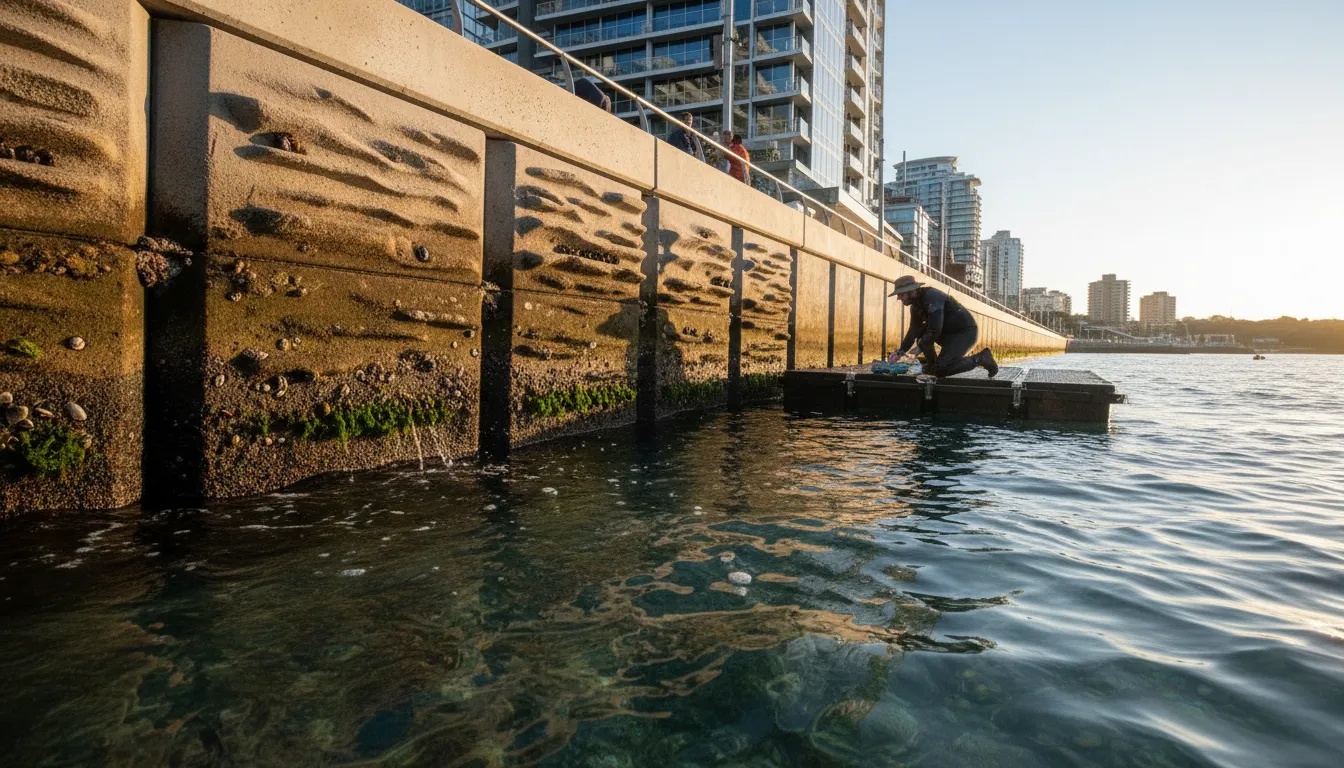
Living seawalls are a form of eco-engineering—the practice of designing infrastructure that deliberately supports ecosystems. Instead of replacing conventional seawalls entirely, living seawall projects retrofit existing structures with specially designed panels, tiles, or modules that mimic the complex surfaces found on natural rocky shores.
Each panel features ridges, crevices, pools, and varied textures modeled on habitats like mangrove roots, oyster reefs, and tidal rock platforms. These microhabitats give marine organisms—algae, barnacles, oysters, mussels, small fish, and crabs—places to colonize, feed, and reproduce.
The concept was pioneered by researchers at the Sydney Institute of Marine Science and Macquarie University, who installed the first panels beneath the Sydney Harbour Bridge in 2018. The project has since expanded to more than 35 sites across five continents, with over 2,500 panels deployed worldwide.
How the Panels Are Designed
Scientists use 3D scanning of natural reefs and rocky shores to capture the geometry that supports the greatest diversity of life. These scans inform molds and, increasingly, 3D-printed concrete forms. Miami-based startup Kind Designs, named one of Time magazine's Best Inventions of 2025, produces 3D-printed living seawall panels tailored to local species and tidal conditions.
There is no single universal design. The Australian Living Seawalls project alone has developed ten different habitat panel types, each targeting a different group of marine organisms—from water-retaining pools that keep species cool at low tide to deep crevices that shelter juvenile fish.
Do They Actually Work?
The evidence is strong. Peer-reviewed studies from Sydney Harbour show that living seawall panels support up to three times the biodiversity of flat surfaces of the same material and age. At McMahons Point, researchers recorded over 150 species using the panels, including invertebrates, seaweeds, and fish. A broader analysis by the Australian Museum found at least a 36% species increase compared to unmodified walls.
The benefits extend beyond headcount. Oysters and mussels that colonize the panels filter water, improving local water quality. At Rushcutters Bay in Sydney, filter-feeding organisms on living seawall panels measurably increased particle removal from the surrounding water. Research published in Frontiers in Marine Science also found that panels with protruding features reduced wave overtopping by up to 100% under certain conditions—meaning they can actually improve flood protection.
Where They're Spreading
Living seawalls have moved well beyond Australia. In South Florida, where sea-level rise threatens billions of dollars in property, cities are adopting eco-engineered seawalls as part of climate adaptation plans. Miami Beach's seawall program, budgeted at over $80 million, now incorporates living seawall technology. In Longboat Key, Florida, a retrofit project was completed in late 2025. Singapore, the United Kingdom, Gibraltar, and several European ports have also launched pilot installations.
Limits and Challenges
Living seawalls are not a silver bullet. They work best in intertidal zones—the band between high and low tide—where marine life is most active. In heavily polluted harbors, colonization may be slower. Cost remains a factor: eco-engineered panels add expense to standard construction, though advocates argue the ecosystem services they provide—water filtration, fish nursery habitat, carbon sequestration—offset the investment over time.
Still, as coastal cities spend trillions hardening their shorelines against climate change, living seawalls offer something rare: infrastructure that protects people and rebuilds the ecosystems that traditional engineering destroyed.