How PET Scans Work and Why They Detect Cancer Early
PET scans use radioactive sugar tracers and gamma-ray detection to map metabolic activity inside the body, revealing tumors long before symptoms appear. Here's the science behind one of medicine's most powerful diagnostic tools.
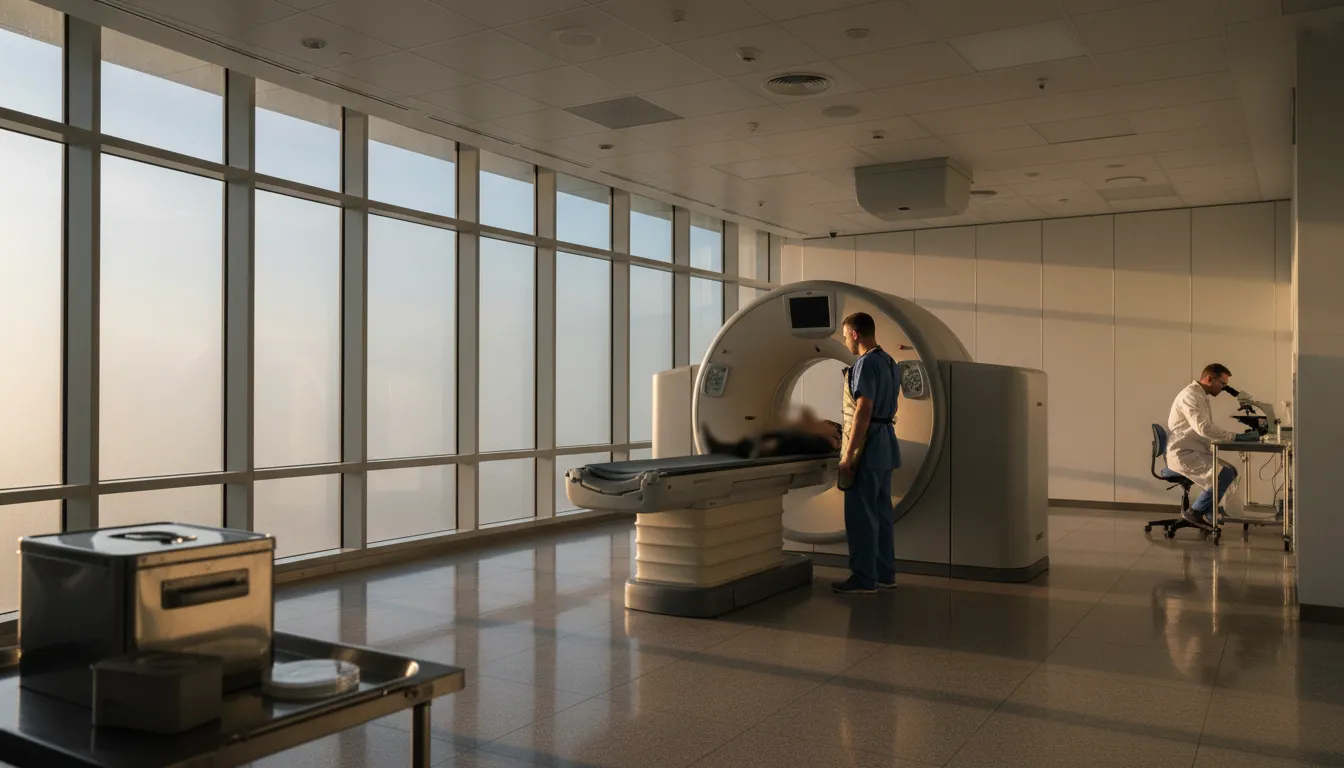
Seeing the Body From the Inside Out
Unlike X-rays or CT scans, which reveal anatomy — bones, organs, masses — a positron emission tomography (PET) scan shows something more fundamental: how the body's cells are actually behaving. By tracking a radioactive molecule as it moves through tissue, PET scans can detect cancer, measure brain activity, and evaluate heart disease with a precision no other imaging tool can match.
The Core Idea: Metabolism as a Map
Every cell in the body consumes energy, but cancer cells are especially hungry. Rapidly dividing tumor cells absorb glucose at far higher rates than healthy tissue — a metabolic quirk that PET scanning exploits directly.
Before the scan, a patient receives an injection of a radiotracer — most commonly fluorodeoxyglucose (FDG), a modified form of glucose tagged with the radioactive isotope fluorine-18. The body treats FDG just like ordinary sugar, routing it to the most metabolically active areas. Cancer cells gorge on it. After about an hour, those cells have accumulated enough FDG to show up vividly on a scan.
From Positrons to Pictures
Here is where the physics gets elegant. Fluorine-18 is unstable; as it decays, it releases a positron — the antimatter counterpart of an electron. Within a few millimeters of tissue, that positron collides with a nearby electron in a brief annihilation event. The collision converts both particles into two gamma-ray photons that shoot off in exactly opposite directions at the speed of light.
The PET scanner — a ring of specialized detector crystals surrounding the patient — catches both photons simultaneously. By recording thousands of these paired detections, a computer reconstructs a three-dimensional map of wherever FDG has accumulated. Tumors, which have absorbed the most tracer, appear as bright "hot spots" on the image.
PET/CT: The Power of Combination
A PET scan alone shows metabolic activity but lacks anatomical detail — you can see that something is abnormally active, but not precisely where it sits. Modern machines solve this by pairing PET with a CT (computed tomography) scanner in a single session. The CT provides a high-resolution structural map of organs and tissues; the PET overlays functional data onto that map. Doctors can pinpoint a tumor to the millimeter and assess whether it has spread to lymph nodes or distant organs — all from one visit, according to RadiologyInfo.org.
What Conditions PET Scans Diagnose
Cancer is the dominant use case, but PET's applications span several specialties:
- Oncology: Detecting, staging, and monitoring treatment response in lymphoma, lung cancer, colorectal cancer, melanoma, breast cancer, and esophageal cancer, among others.
- Neurology: Identifying abnormal brain metabolism linked to Alzheimer's disease, epilepsy, and other neurological disorders.
- Cardiology: Assessing areas of the heart muscle that have reduced blood flow but remain viable — critical information before bypass surgery.
According to the Mayo Clinic, PET images can detect cellular changes in organs and tissues earlier than CT or MRI scans, which only become useful once a tumor has grown large enough to physically distort surrounding tissue.
A Brief History
The physics underpinning PET — coincidence detection of positrons — was described as early as 1951. The first practical PET scanner was developed at Washington University in St. Louis in the mid-1970s, initially as a research tool in neurology and cardiology. Oncology applications followed in the 1990s, and the technology received a major boost in 1998 when U.S. health agencies approved Medicare reimbursement for PET scanning, opening it to routine clinical use, according to a review published in the Journal of Nuclear Medicine.
Safety and Radiation Dose
PET scans do involve exposure to ionizing radiation, but the dose is modest. A standard FDG injection delivers roughly 4.7 millisieverts (mSv) — comparable to about 18 months of natural background radiation, and well below levels associated with health risk. The radiotracer itself decays rapidly; fluorine-18 has a half-life of just under two hours, meaning it is effectively gone from the body within a day.
The Road Ahead
Researchers are constantly developing new radiotracers that target specific proteins expressed by particular tumors. A recent example: scientists engineered a tiny antibody fragment that homes in on the cancer protein EphA2, causing those tumors to glow on PET scans in animal studies. Such targeted tracers promise to make PET even more precise — detecting cancers that do not respond strongly to standard FDG and enabling treatments to be tailored in real time.
For now, the PET scan remains one of medicine's most powerful windows into the living body — translating the invisible chemistry of disease into images that save lives.