What Is Lonsdaleite—the Diamond Harder Than Diamond?
Lonsdaleite, or hexagonal diamond, is a rare carbon allotrope born from meteorite impacts. Scientists have now synthesized it in the lab, confirming it is harder than any other known material—with major implications for industry and technology.
A Diamond Born in Cosmic Catastrophe
Diamond has long held the title of the hardest natural substance on Earth. But deep inside the craters left by meteorite impacts, scientists have found traces of something even tougher: a strange cousin of diamond called lonsdaleite. Formed in the violence of cosmic collisions, this hexagonal diamond has tantalized researchers for decades with promises of extraordinary hardness — and now, for the first time, they have made it in the laboratory.
What Is Lonsdaleite?
Lonsdaleite is an allotrope of carbon — meaning it is made entirely of carbon atoms, just like ordinary diamond and graphite, but arranged in a completely different pattern. While regular diamond has a cubic crystal lattice, lonsdaleite has a hexagonal lattice. That subtle geometric difference gives the two materials dramatically different properties.
The name honors Dame Kathleen Lonsdale, a pioneering British crystallographer who determined the structure of benzene by X-ray diffraction in 1929 and was among the first women elected as a Fellow of the Royal Society. When scientists identified the mineral in 1967, naming it after her was a fitting tribute.
Where It Comes From
Lonsdaleite was first discovered in fragments of the Canyon Diablo meteorite, the iron meteorite responsible for Barringer Crater in Arizona. When a meteorite rich in graphite slams into Earth, the extreme heat and pressure of impact transform the graphite into diamond — but so rapidly that the carbon atoms lock into the hexagonal arrangement inherited from graphite, rather than settling into the cubic structure of conventional diamond.
The result is lonsdaleite: a diamond that remembers where it came from. Natural samples are vanishingly small — microscopic crystals scattered among ordinary diamond and other minerals — which made them extraordinarily difficult to study, and for years, some scientists questioned whether pure lonsdaleite even existed as a distinct material.
Why It Might Be Harder Than Diamond
In a conventional diamond, the bonds between carbon atoms are all arranged in a geometry chemists call the staggered conformation. In lonsdaleite, the bonds between layers adopt an eclipsed conformation, creating the defining hexagonal symmetry. According to computational simulations, this arrangement produces atomic bonds strong enough to make lonsdaleite up to 58% harder than cubic diamond.
For decades, however, those predictions remained theoretical. Natural specimens — tiny, impure, and mixed with other minerals — performed far below the theoretical ceiling. The real properties of pure lonsdaleite remained unknown.
The Breakthrough: Making It in the Lab
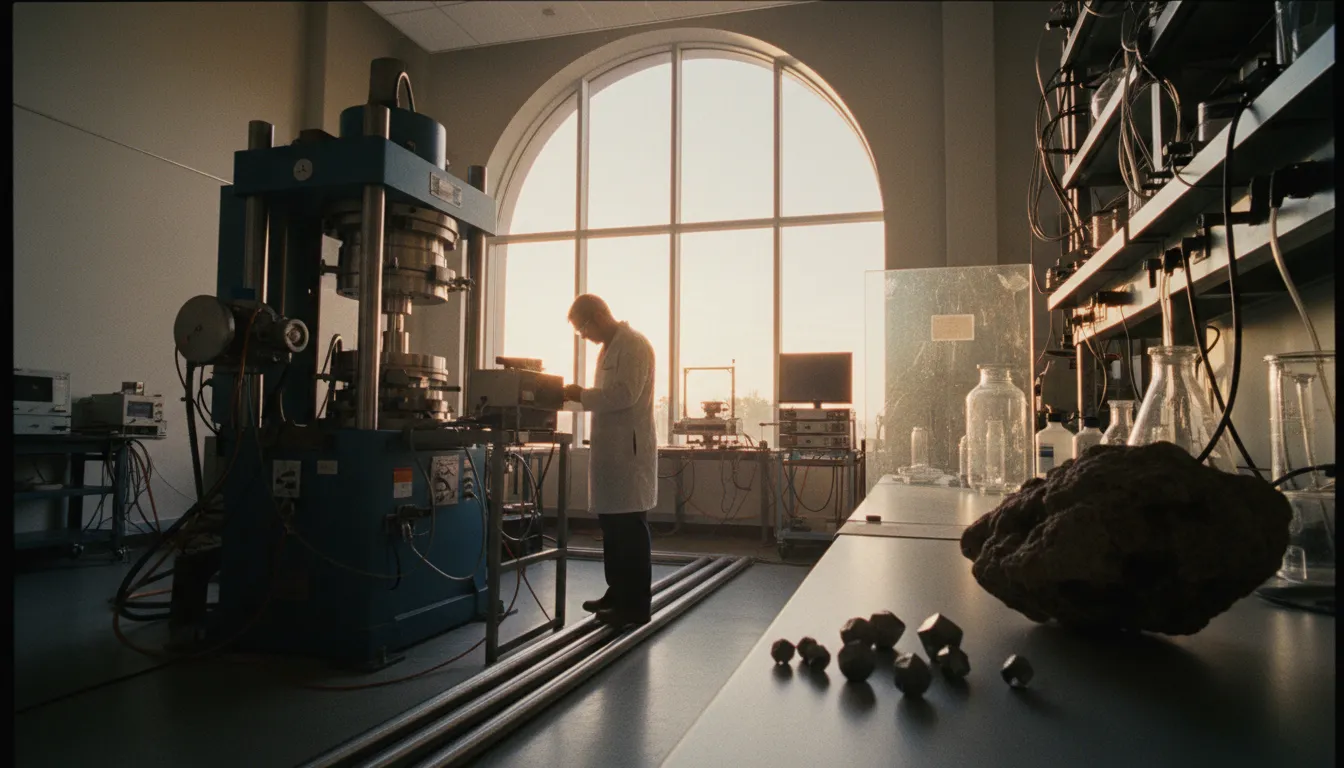
In 2025 and early 2026, Chinese researchers reported a landmark achievement: the first synthesis of bulk, millimeter-sized lonsdaleite crystals from ultrapure graphite. By compressing highly organized graphite at pressures of 20 gigapascals — roughly 200,000 times Earth's atmospheric pressure — and temperatures between 1,300 and 1,900 degrees Celsius for ten hours, the team produced samples large enough and pure enough to measure directly.
According to Phys.org and Live Science, hardness tests clocked the new material at 114 gigapascals — slightly exceeding the hardness of the best natural cubic diamond. The team also found lonsdaleite resists oxidation far better than ordinary diamond, an important property for industrial applications.
Nature magazine described the work as resolving a long-standing debate: hexagonal diamond is real, it is distinct, and it is the hardest bulk material ever measured in a laboratory.
What It Could Be Used For
The industrial implications are significant. Diamond already underpins a vast range of cutting, drilling, and grinding tools. A material that outperforms it in hardness and thermal stability could transform several industries:
- Cutting tools and abrasives — harder drill bits and saw blades for mining, manufacturing, and semiconductor fabrication
- Electronics — lonsdaleite's electrical insulation and thermal conductivity make it a candidate for next-generation transistors and high-power devices
- Optics — its high refractive index and transparency suit it for lenses and windows in extreme environments
- Quantum technologies — carbon-based materials are already studied for quantum computing; lonsdaleite's unique properties add a new candidate
A Material Still Finding Its Place
Laboratory synthesis of lonsdaleite remains challenging and expensive. Current samples are small and produced in tiny quantities. Before it can reach factory floors or electronics labs, researchers need to scale up production and drive down costs — challenges that familiar in the history of materials like synthetic diamond itself, which took decades to move from laboratory curiosity to industrial workhorse.
What is clear is that lonsdaleite is no longer just a meteorite oddity. It is a real material with measurable, extraordinary properties — a diamond harder than diamond, waiting for the world to find a use for it.