How Landslides Form—and Why They're So Deadly
Landslides kill thousands of people every year and cause billions in damage, yet many people don't understand what triggers them. Here's the science behind one of Earth's most lethal geological hazards.
A Hidden Geological Threat
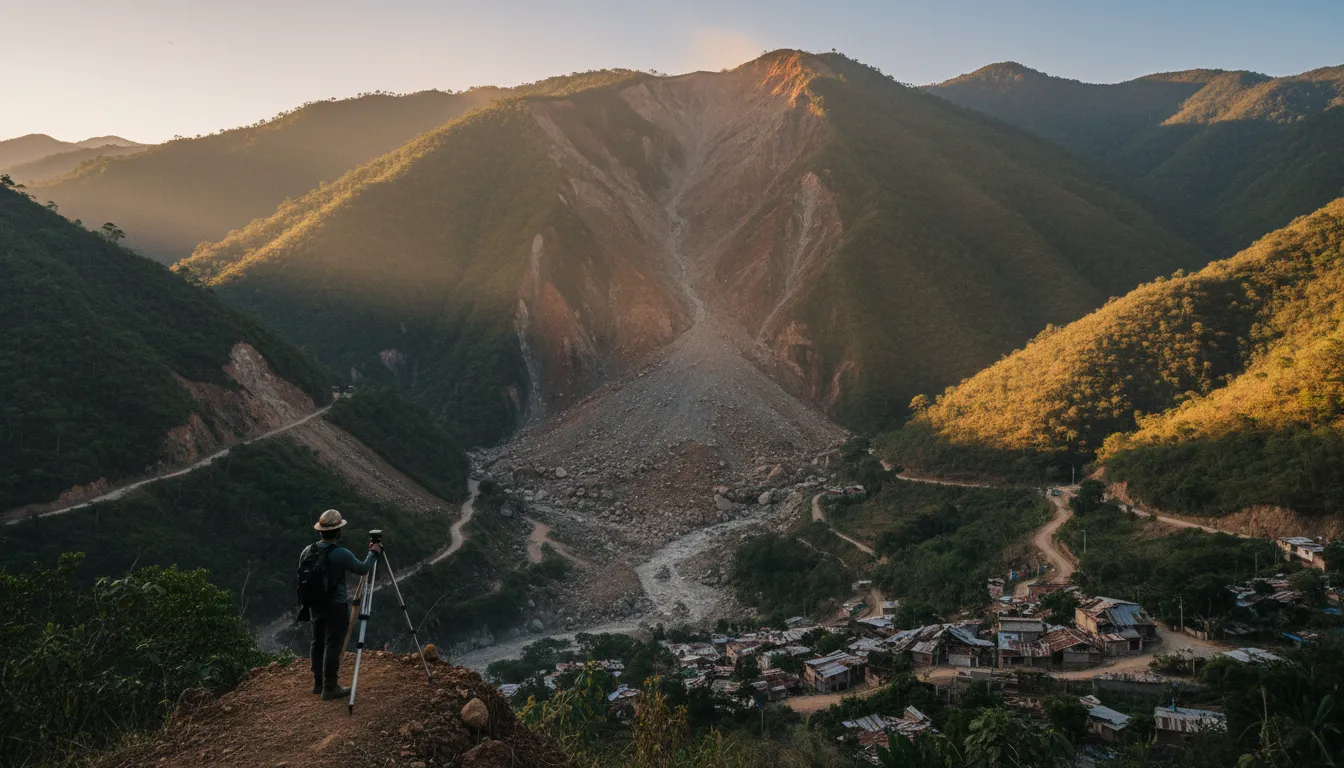
When a hillside suddenly gives way—burying roads, villages, and mining camps in seconds—the cause is almost always the same basic physics: gravity overpowering the ground's ability to hold itself together. Landslides, also called mass wasting events, are among the deadliest and most widespread natural hazards on Earth, yet they receive far less public attention than hurricanes or earthquakes.
Between 2004 and 2016, landslides killed nearly 56,000 people across 4,862 documented events worldwide, according to research published in the journal Natural Hazards and Earth System Sciences. They account for roughly 17 percent of all deaths caused by natural hazards globally—a figure that climate scientists warn is rising as extreme rainfall events become more common.
What Exactly Is a Landslide?
The U.S. Geological Survey (USGS) defines a landslide as the movement of a mass of rock, debris, or earth down a slope. The term covers five distinct types of slope movement: falls, topples, slides, spreads, and flows. Each behaves differently, but all share the same underlying cause: the force pulling material downhill exceeds the material's internal resistance.
Two of the most destructive subtypes are debris flows and rockfalls. A debris flow is a fast-moving slurry of loose soil, rock, organic matter, air, and water that can race downhill at speeds exceeding 50 km/h. Rockfalls involve boulders detaching from steep cliffs and descending in free-fall, bouncing and rolling with enormous kinetic energy. Both can strike with little or no warning.
What Causes a Slope to Fail?
Almost every landslide has multiple causes, the USGS notes. Geologists think in terms of two competing forces: shear stress (forces trying to move material down the slope) versus shear strength (the internal friction and cohesion holding the material in place). When stress exceeds strength, the slope fails.
Water: The Primary Trigger
Saturation of a slope by water is the single most common trigger. Heavy rainfall, rapid snowmelt, or a rise in the groundwater table all add weight to a slope and simultaneously reduce friction by lubricating the spaces between soil particles. This is why landslides cluster during and after intense storms, and why deforested hillsides—where tree roots no longer bind the soil—are especially vulnerable.
Earthquakes and Volcanic Activity
Seismic shaking is the second major trigger. The 1920 Haiyuan earthquake in China set off an estimated 675 large landslides, contributing to a death toll that some estimates place above 200,000. Volcanic eruptions destabilize slopes through both ground shaking and the rapid deposition of loose pyroclastic material.
Human Activity
Mining operations, road construction, deforestation, and urban expansion on hillsides all steepen slopes and remove stabilizing vegetation, dramatically increasing landslide risk. Research from the University of Southern California found that landslides are disproportionately deadly in developing countries partly because mining and informal settlement often occur on geologically unstable terrain, with debris flows killing an average of 23 people per event in developing nations compared to 6 in wealthier countries.
Why They Kill So Efficiently
What makes landslides exceptionally lethal is their combination of speed, mass, and unpredictability. Rockfalls are the fastest type of landslide and can reach speeds of 300 km/h on steep terrain. Large debris flows can travel many kilometres from their source, overwhelming valleys and riverbeds far from the original failure point. The 1970 Yungay landslide in Peru—triggered by an offshore earthquake—buried an entire town of 22,000 people under tens of metres of ice, rock, and mud in a matter of minutes.
Unlike floods or storms, landslides often strike in the dark, during or immediately after heavy rain, when residents are asleep and evacuation is impossible.
Prediction and Early Warning
Scientists and engineers have developed increasingly sophisticated tools to anticipate slope failures. Rainfall-threshold systems monitor real-time precipitation and issue alerts when cumulative rainfall exceeds empirical limits known to trigger slides in a given region. Ground-based sensors—inclinometers, extensometers, and pore-water pressure gauges—detect the subtle creep and swelling that often precede collapse.
More recently, researchers at Loughborough University have developed low-cost acoustic emission monitors that "listen" for the sounds of soil grains grinding past each other deep within a slope—a sign that failure may be imminent. Combined with satellite-based radar systems that can detect millimetre-scale ground deformation from space, these technologies are transforming landslide science from reactive to predictive.
Yet the biggest barrier remains not technology but governance: the communities most exposed to landslide risk are often those least able to fund monitoring infrastructure or enforce land-use regulations that keep people off unstable slopes.
A Growing Risk
Climate change is intensifying the landslide threat. More frequent and more intense rainfall events load hillsides with water faster than soils can drain, while permafrost thaw in mountain regions destabilises slopes that were frozen solid for millennia. The British Geological Survey warns that as global temperatures rise, many regions will experience a significant uptick in landslide frequency and severity—making the science of slope stability not just an academic exercise, but an urgent matter of public safety.