What Is Physical AI and How Does It Work?
Physical AI is the next frontier of artificial intelligence—systems that don't just process text but physically perceive, reason about, and act in the real world. From warehouse robots to autonomous vehicles, here's how it works and why it matters.
Beyond the Chatbot: AI That Moves
For the past few years, the artificial intelligence revolution has lived almost entirely inside screens—summarizing documents, generating images, writing code. But a new phase is accelerating: physical AI, where intelligent systems leave the digital realm and act in the real world. It is arguably the most consequential shift in robotics since the assembly line.
At its core, physical AI refers to machines that can perceive their environment through sensors, reason about what they observe, and then act on that reasoning—autonomously adjusting to unpredictable conditions rather than following rigid, pre-programmed instructions. Think of a warehouse robot that reroutes itself around a spilled box, or a humanoid assistant that learns to pour coffee by watching a person do it once.
How Physical AI Works
Physical AI systems are built on three tightly integrated layers: perception, reasoning, and action.
Perception
The system gathers data from the physical world via cameras, lidar, radar, microphones, inertial sensors, and temperature gauges. Unlike a traditional robot reading a barcode, a physical AI system builds a rich, real-time model of its surroundings—detecting objects, estimating distances, and tracking movement simultaneously.
Reasoning
Raw sensor data feeds into vision-language-action (VLA) models—a new class of AI that connects perception, language understanding, and decision-making in a single framework. According to ARM's technical analysis, VLA models allow a robot to interpret a verbal instruction like "pick up the red mug" and translate it directly into motor commands—bridging the gap between language AI and physical movement.
Action
Commands pass to actuators—robotic arms, wheels, joints, grippers—which interact with the physical environment. The key advance over older robotics is that the system continuously closes the feedback loop: it observes the result of each action, compares it to its goal, and adjusts in real time.
Training in Simulation, Deploying in Reality
One of the biggest challenges in physical AI is data. Training a robot by having it physically fail thousands of times is slow and expensive. The solution is high-fidelity simulation. Platforms like NVIDIA's Omniverse can render photorealistic virtual environments—complete with realistic physics—where AI systems train at massive scale before touching the real world. According to IBM, this approach of sim-to-real transfer has become a cornerstone of modern physical AI development.
Robots also learn through reinforcement learning (discovering strategies by trial and error) and imitation learning (copying human demonstrations), allowing them to acquire nuanced motor skills without explicit programming of every possible scenario.
Real-World Applications
Physical AI is already reshaping several industries:
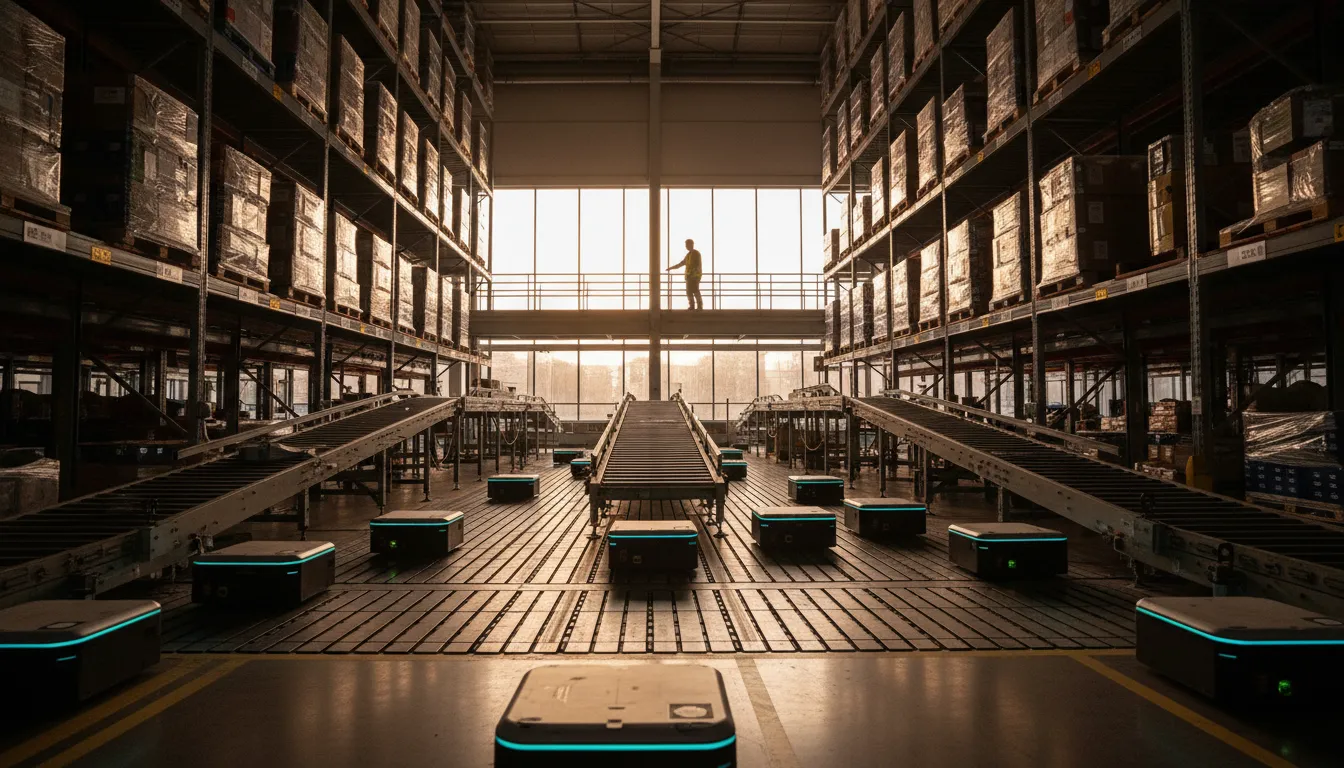
- Warehousing and logistics: Amazon has deployed over one million robots in its fulfillment centers, reporting a 25% efficiency boost. These systems navigate dynamic environments alongside human workers.
- Autonomous vehicles: Self-driving cars and trucks are among the most complex physical AI deployments, requiring the fusion of perception, planning, and real-time control at highway speeds.
- Healthcare: Surgical robots guided by AI can operate with sub-millimeter precision; autonomous systems deliver medications in hospital corridors.
- Manufacturing: Humanoid robots are being tested on factory floors—moving through spaces designed for people without costly infrastructure redesigns.
According to Deloitte's Tech Trends research, 58% of companies are already using physical AI to some degree, with adoption projected to reach 80% within two years.
The Hard Challenges
Physical AI faces obstacles that purely digital AI does not. When a chatbot makes a mistake, you get a bad answer. When a physical AI system makes a mistake, it can damage property—or injure people. SemiEngineering reports that integrating large language models into robotic systems introduces new safety risks, because the AI's reasoning can be unpredictable in ways that are difficult to test exhaustively in the physical world.
Other barriers include the sheer cost of hardware, the difficulty of integrating with legacy industrial systems, and the environmental fragility of electronics exposed to dust, vibration, and temperature extremes. AI perception models also still struggle with edge cases—unusual lighting, cluttered scenes, or novel objects never seen during training.
Why It Matters
Physical AI represents the moment when the intelligence that has transformed software begins to transform the material world. The global market for physical AI systems was estimated at roughly $5 billion in 2025, with analysts projecting growth to between $68 billion and $84 billion by the mid-2030s. Whether in factory automation, elder care, disaster response, or agriculture, the systems being built today will define how work—and daily life—is organized in the coming decades.