How Power Grids Work—and Why They Fail
Power grids are among civilization's most complex engineered systems, constantly balancing electricity supply and demand in real time. Understanding how they work—and why they sometimes collapse catastrophically—reveals the fragile engineering that underpins modern life.
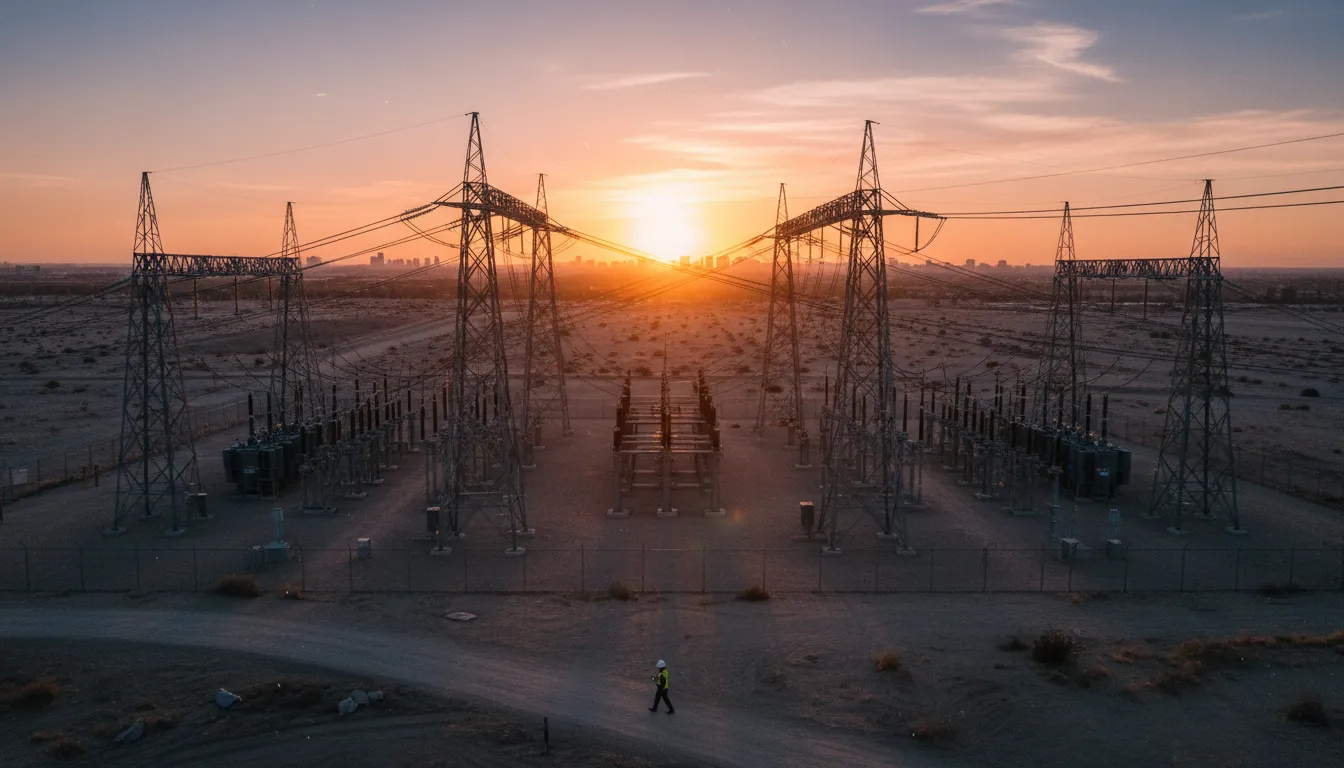
The Invisible Infrastructure of Modern Life
Every time you flip a light switch, you tap into one of the most sophisticated machines ever built. The electrical grid — a vast web of power plants, transmission lines, and substations — delivers electricity to homes, hospitals, and factories with a reliability so consistent that most people never think about it. Until it fails.
When a power grid collapses, the consequences can be immediate and severe: hospitals lose power, water treatment stops, food spoils, and communications go dark. Understanding how grids work — and why they sometimes fail catastrophically — is essential for appreciating a system the modern world cannot survive without.
Three Layers: Generation, Transmission, Distribution
Every national grid operates on the same fundamental architecture, with three distinct layers working in sequence.
Generation is where electricity is produced — in coal or gas power plants, nuclear reactors, wind farms, or solar arrays. Generators convert mechanical energy (from spinning turbines) or direct sunlight into alternating current (AC) electricity.
Transmission moves that electricity over long distances. Because electricity loses energy to resistance as it travels, the voltage is stepped up dramatically — often to 115,000 to 765,000 volts — using transformers at substations. High voltage means lower current, which means less energy wasted as heat along thousands of kilometers of wire. The tall steel towers carrying thick cables across landscapes are the transmission layer in action.
Distribution is the final step. Near homes and businesses, step-down transformers reduce voltage to safe, usable levels — 240 volts in Europe, 120 volts in North America — and deliver it through the wires in your walls.
The Frequency Problem: A Grid Must Never Go Out of Balance
Perhaps the most counterintuitive aspect of electrical grids is that supply and demand must be matched continuously and in real time. Unlike water or gas, electricity cannot be easily stored in bulk. Every watt generated must be consumed almost instantly.
The key signal of this balance is grid frequency. In Europe and most of the world, grids operate at 50 hertz (Hz) — generators spin 50 times per second. In North America, the standard is 60 Hz. When supply equals demand, frequency stays stable. If demand suddenly surges or generation drops, generators are forced to slow down, pulling frequency below the standard. If generation outpaces demand, frequency rises.
Grid operators tolerate only tiny deviations — typically within 0.5 Hz of the standard. Beyond that, protective relays automatically disconnect equipment to prevent damage. It is this very protection mechanism that can trigger a catastrophic cascade.
How Cascading Failures Bring Down an Entire Grid
Large-scale blackouts almost never have a single cause. They are the product of cascading failures — a chain reaction in which one problem overloads adjacent components, which then fail and overload others, spreading collapse across the network within minutes or even seconds.
According to research published in Nature Communications, transients — rapid, dynamic swings in electrical flow — play a crucial role in how failures propagate. A study of the 2006 European blackout found that 33 high-voltage transmission lines tripped in just 80 seconds, with 30 of them failing in the first 19 seconds. What began as a single line contact with a tree triggered a continent-wide failure affecting 15 million people.
Research from IEEE Spectrum shows that only about 10 percent of transmission lines are truly vulnerable to the kind of primary failure that can start a cascade — but those lines are often clustered near densely populated areas, maximizing the impact of any failure.
Why Island Grids Are Especially Vulnerable
Interconnected grids are inherently more resilient. When one region loses a generator, neighboring regions can supply backup power through shared transmission lines. Large grids like those of continental Europe or North America benefit enormously from this redundancy.
Island grids — those on isolated landmasses with no cross-border connections — lack this lifeline. A single power plant failure, a fuel shortage, or a storm-damaged transmission line can push the entire system into imbalance with no outside source to compensate. This structural vulnerability is why island nations face a disproportionate risk of total nationwide blackouts.
The Grid of the Future
As renewable energy sources like solar and wind expand, grids face new stability challenges. Unlike gas or nuclear plants, solar and wind generation fluctuates with weather, making real-time balancing harder. Grid operators are investing in battery storage systems, smart grid technologies, and demand-response programs — where large consumers agree to reduce usage during peak stress — to keep frequency stable in a cleaner energy future.
The electrical grid may be invisible in daily life, but it remains one of humanity's greatest — and most fragile — engineering achievements. Keeping it running requires a constant, invisible balancing act that never stops.