How Superconductors Work—and Why We Want Them Warmer
Superconductors carry electricity with zero resistance, enabling MRI machines, maglev trains, and quantum computers. Scientists are racing to make them work at higher temperatures, a breakthrough that could transform energy and technology.
Zero Resistance, Infinite Potential
Every wire in your home wastes energy. As electricity flows through copper or aluminum, electrons collide with atoms, generating heat and losing power. The U.S. Department of Energy estimates that roughly 5% of electricity generated in America is lost during transmission and distribution. Superconductors eliminate that problem entirely. Below a specific critical temperature, certain materials conduct electricity with absolutely zero resistance—current flows forever without any energy loss.
Since their discovery in 1911, superconductors have promised a revolution in energy, medicine, and transportation. The catch: they only work when extremely cold. That limitation has fueled one of physics' longest-running quests—finding a superconductor that works at room temperature.
How Superconductivity Works
In a normal conductor, electrons move independently, constantly bumping into the atomic lattice and losing energy as heat. In a superconductor cooled below its critical temperature, something remarkable happens: electrons pair up into what physicists call Cooper pairs.
These paired electrons are bound together by tiny vibrations in the crystal lattice called phonons. Unlike lone electrons, Cooper pairs move through the material in a coordinated quantum state, gliding past atoms without scattering. The result is a superfluid of charge carriers that meets no resistance whatsoever.
Superconductors also exhibit the Meissner effect—they actively expel magnetic fields from their interior. Surface currents spring up and generate an opposing field, which is why a magnet placed above a superconductor floats in midair. This isn't just a party trick; it's the principle behind magnetic levitation technology.
Where Superconductors Already Work
Despite the need for extreme cooling, superconductors power several critical technologies:
- MRI machines: The powerful, stable magnetic fields inside every hospital MRI scanner are generated by superconducting coils made of niobium-titanium, cooled by liquid helium to about 4 Kelvin (−269°C). This represents a multi-billion-dollar global market.
- Maglev trains: Japan's SCMaglev uses superconducting electromagnets to levitate and propel trains at speeds exceeding 600 km/h—far beyond what conventional rail can achieve.
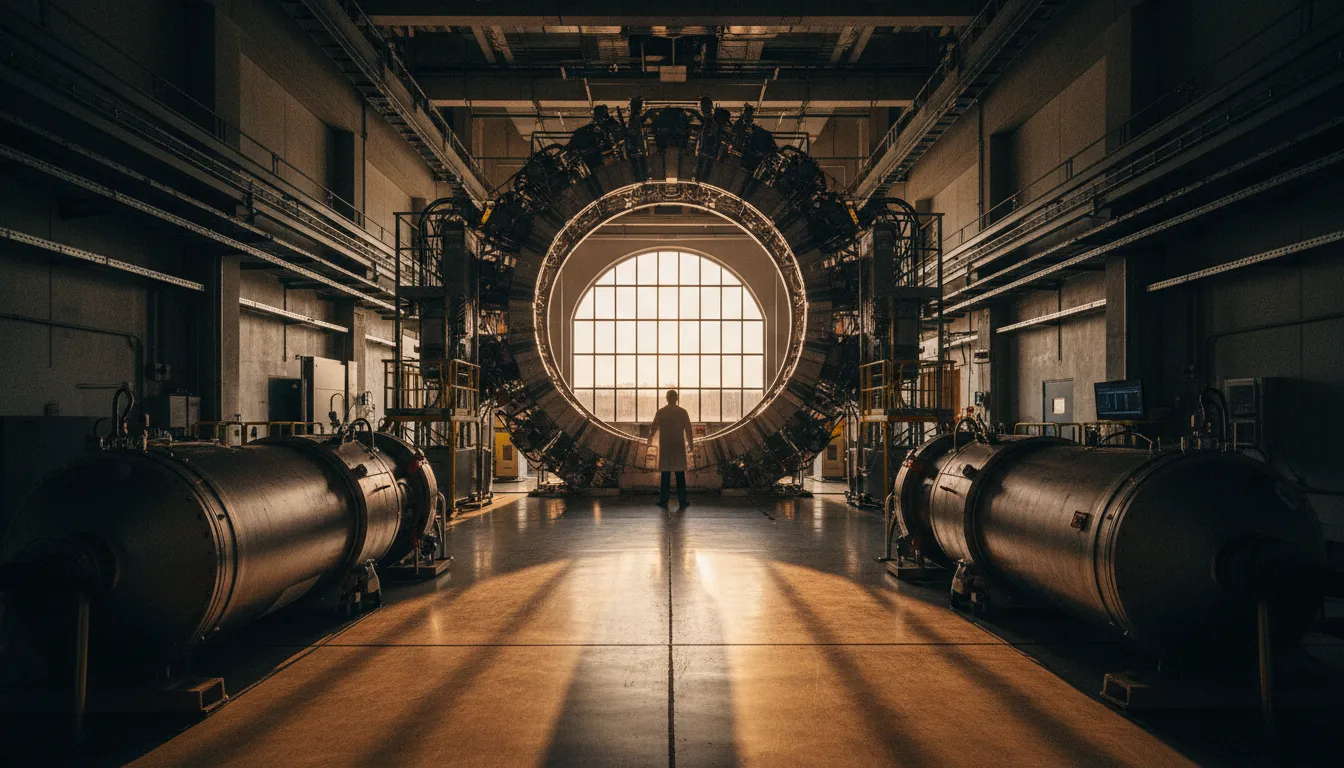
- Particle accelerators: CERN's Large Hadron Collider relies on over 1,200 superconducting magnets cooled to 1.9 K to bend particle beams around its 27-kilometer ring.
- Power cables: Pilot projects like the Long Island superconducting cable have demonstrated that high-temperature superconductor wire, chilled with liquid nitrogen, can deliver power through dense urban areas with virtually no transmission loss.
The Temperature Problem
When Dutch physicist Heike Kamerlingh Onnes discovered superconductivity in mercury in 1911, the critical temperature was just 4.2 Kelvin. For decades, progress was glacial. A major leap came in 1986 when IBM researchers Georg Bednorz and Karl Alex Müller found ceramic copper-oxide compounds that superconduct at around 35 K—earning them a Nobel Prize and launching the era of high-temperature superconductors.
Within a year, scientists pushed the record above 90 K using yttrium barium copper oxide (YBCO), crossing the crucial liquid-nitrogen threshold of 77 K. That made cooling far cheaper and more practical. Under extreme pressures, hydrogen-rich compounds have since shown superconductivity above 250 K, but those conditions are impossible to maintain outside a laboratory.
The latest milestone came in March 2026, when University of Houston physicists achieved 151 Kelvin (−122°C) at ambient pressure using a "pressure quenching" technique on a mercury-based ceramic. It is the highest critical temperature ever recorded without maintaining high pressure—yet still roughly 140 degrees below room temperature.
Why Room Temperature Matters
A room-temperature superconductor would be transformative. Power grids could transmit electricity across continents with zero loss. MRI machines could shrink in size and cost, making advanced medical imaging accessible worldwide. Quantum computers could operate without elaborate cooling systems. Electric motors and generators would become radically more efficient.
As researchers at the U.S. National Academy of Sciences recently outlined, two key challenges remain: improving computational models that predict which materials might superconduct, and engineering those materials so they can actually be manufactured. No fundamental law of physics forbids room-temperature superconductivity—the barrier is finding the right material and understanding why it works.
After more than a century of incremental progress, the quest continues. Each record broken narrows the gap between laboratory curiosity and world-changing technology.