How Tidal Energy Works—and Why It Matters
Tidal energy harnesses the gravitational pull of the moon to generate reliable, carbon-free electricity—but high costs and limited sites have kept it on the fringes of the clean energy transition. Here's how the technology works and why it could still matter.
Power From the Pull of the Moon
Every day, without fail, the ocean rises and falls. These tides are driven by the gravitational tug of the moon and, to a lesser extent, the sun—a force so precise that scientists can predict tidal patterns centuries in advance. That predictability is what makes tidal energy one of the most intriguing yet underused sources of renewable power on the planet.
Unlike solar panels that go dark at night or wind turbines that idle on calm days, tidal generators produce electricity on a near-clockwork schedule. The question is why, despite this remarkable advantage, tidal power still contributes less than one percent of the world's electricity supply.
The Three Ways to Capture Tidal Power
Engineers have developed three main approaches to converting ocean tides into usable electricity, each with distinct trade-offs.
Tidal Stream Generators
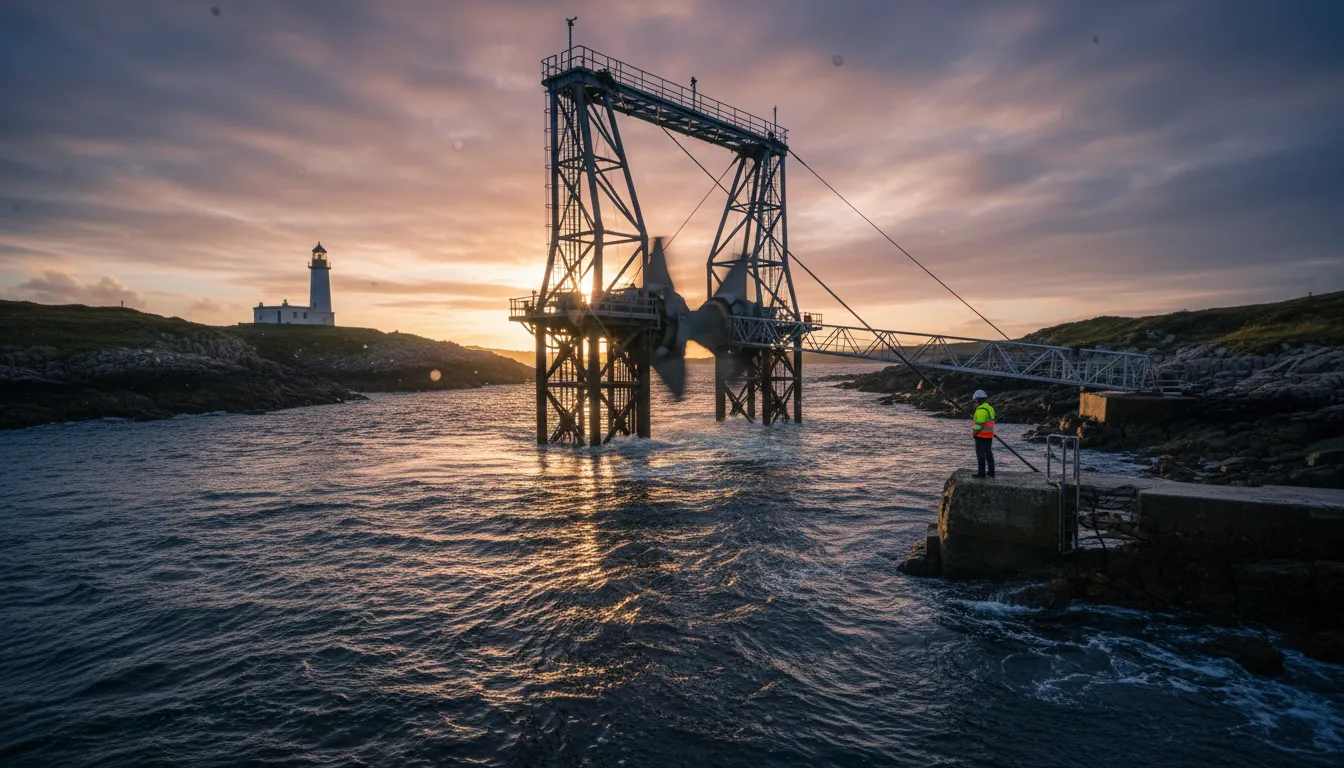
The most common modern approach, tidal stream generators work much like submerged wind turbines. Placed on the seafloor in channels where tidal currents run fast, their blades spin as water flows past—first on the incoming tide, then again on the outgoing one. Because water is roughly 800 times denser than air, a relatively small turbine can capture enormous amounts of energy compared with its wind counterpart, according to the U.S. Energy Information Administration.
The drawback is engineering: saltwater is corrosive, currents are powerful, and servicing equipment on the seafloor is expensive. Scotland's MeyGen project in the Pentland Firth—the world's largest operational tidal stream array—has demonstrated the technology works at scale, but its full 400 MW build-out has moved slowly due to financing challenges.
Tidal Barrages
A tidal barrage is essentially a dam built across a river estuary or bay. Sluice gates allow water to fill the basin at high tide, then close. As the sea level outside drops, the trapped water is released through turbines to generate power. France's La Rance station, opened in 1966 with a 240 MW capacity, remains the most famous example—and still operates today, more than 60 years after construction, according to Earth.org.
Barrages are reliable and long-lived (concrete structures can last over a century), but they alter estuarine ecosystems, affecting sediment flow, salinity, and the habitats of fish and birds. These environmental concerns have blocked many proposed barrage projects in the UK and elsewhere.
Tidal Lagoons
A newer concept, tidal lagoons create an artificial enclosed area in the sea rather than damming an existing estuary. Water is pumped in and out through turbines as tides change. Proponents argue lagoons can generate power with fewer ecological disruptions than barrages, though no commercial-scale lagoon has been built yet.
Why Tidal Power Hasn't Gone Mainstream
The fundamental problem is economics. The MIT Climate Portal notes that commercial tidal energy currently costs between $130 and $280 per megawatt-hour—compared with around $20 per MWh for onshore wind. High upfront construction costs, expensive undersea maintenance, and a limited number of sites with sufficiently strong tidal currents all constrain the industry.
Geography matters enormously. Strong tidal energy sites require a tidal range (the difference between high and low tide) of at least five meters, or exceptionally fast tidal currents. The world's best locations—the Bay of Fundy in Canada, the Pentland Firth in Scotland, France's Brittany coast, and Australia's Kimberley region—are few and often far from population centers.
The Environmental Calculus
Tidal power produces near-zero greenhouse gas emissions during operation, and each kilowatt-hour generates an estimated 23 grams of CO₂ equivalent over its lifecycle—far less than any fossil fuel. But barrages can disrupt coastal ecosystems, and even submerged turbines pose risks to marine mammals and fish from blade strikes and electromagnetic emissions, the Pacific Northwest National Laboratory notes. Modern designs increasingly use slower-spinning blades and shrouded rotors to reduce wildlife impacts.
A Niche Role in the Energy Transition
Tidal energy is unlikely to power whole nations—but it doesn't need to. Its true value lies in complementing intermittent renewables like wind and solar. Because tidal cycles are offset from peak electricity demand, a grid that blends solar, wind, and tidal generation can reduce its reliance on battery storage or gas peakers. France's Normandie Hydro project, planning seven 2.5 MW turbines off the coast of Brittany due to open in 2026, is the latest bet that tidal power can carve out a reliable niche. In an era when every clean gigawatt counts, the ocean's clockwork rhythm may yet prove its worth.