What Is the Durand Line—and Why It Still Sparks Wars
Drawn by a British colonial officer in 1893, the Durand Line divides Afghanistan and Pakistan along a 2,640-kilometer border that no Afghan government has ever recognized—fueling a century of conflict, terrorism, and geopolitical tension.
A Line Drawn in 1893 That the World Still Cannot Erase
Few borders on Earth carry as much unresolved tension as the Durand Line—the 2,640-kilometer frontier separating Afghanistan from Pakistan. Negotiated hastily in 1893 by a British colonial officer, the line split ethnic Pashtun homelands in two and embedded a dispute that has fueled insurgencies, wars, and diplomatic crises for over a century. Understanding why this border remains so volatile is essential to understanding South Asia's most persistent conflicts.
The Great Game and Its Bloody Paperwork
In the nineteenth century, the British Empire and Tsarist Russia competed for dominance over Central Asia in what historians call the Great Game. Britain needed a stable buffer zone between Russian-controlled territories and its crown jewel, India. Afghanistan was that buffer.
In November 1893, British Indian Foreign Secretary Sir Mortimer Durand traveled to Kabul and presented Afghan Emir Abdur Rahman Khan with a proposed border agreement. The emir, economically dependent on British subsidies and militarily outmatched, signed the one-page document. A joint survey team then physically demarcated the line between 1894 and 1896—often cutting straight through Pashtun villages, valleys, and tribal territories with little regard for the communities living there.
The result was a boundary drawn not to reflect ethnic, geographic, or cultural reality, but purely to serve British imperial strategy. As Encyclopædia Britannica notes, the line was designed to define spheres of British and Afghan influence—not to create a lasting, legitimate international frontier.
The Pashtun Divide
The Durand Line runs directly through the ancestral homeland of the Pashtuns, an ethnic group with roots in the region dating back at least 2,500 years. Overnight, the agreement split more than 30 million Pashtuns between two political entities—those living on the eastern side became subjects of British India (and, after 1947, Pakistani citizens), while those on the western side remained Afghans.
Families were divided. Trade routes were severed. Tribal governance structures that ignored colonial maps were suddenly treated as criminal cross-border activity. According to National Geographic Education, the line created a population whose primary loyalties were to tribe and clan—not to the states that claimed them.
This fracture gave birth to the concept of Pashtunistan—the idea of a unified Pashtun homeland straddling both countries. While the movement has never achieved statehood, it has driven Afghan foreign policy and fueled anti-Pakistan sentiment in Kabul for generations.
Why Afghanistan Has Never Accepted the Border
When Pakistan gained independence in 1947, Afghanistan was the only United Nations member to vote against its admission—partly over the border dispute. Kabul argued that the Durand Agreement had been extracted under colonial coercion and was therefore invalid under international law.
In 1949, Afghanistan's parliament formally declared all agreements related to the Durand Line void. No Afghan government since—not the monarchy, not the Soviet-backed republics, not the U.S.-backed administrations, and not the Taliban—has officially recognized the line as an international border. As the Middle East Institute documents, this near-universal Afghan rejection is one of the most durable diplomatic positions in modern history.
Pakistan, by contrast, considers the matter settled. Islamabad points to international recognition of the border, existing treaties, and the legal doctrine that colonial-era boundaries—however arbitrary—become binding upon independence.
The Fence, the Taliban, and Modern Militancy
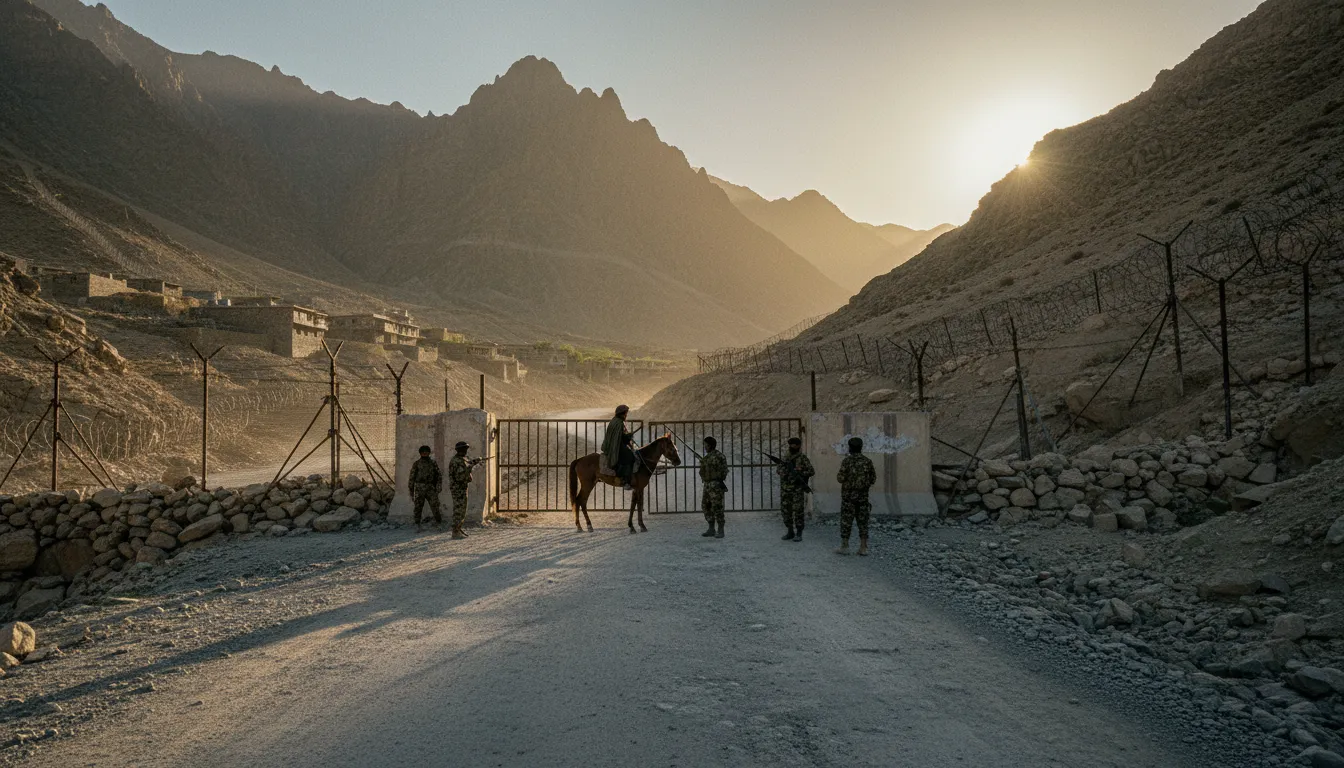
The dispute is not merely symbolic. It has direct consequences for regional security. Starting in 2017, Pakistan began constructing a physical fence along the Durand Line, erecting hundreds of kilometers of fencing and watchtowers in an effort to curb cross-border militant movement. Afghanistan condemned the fence as an illegal encroachment.
At the center of modern tensions is the Tehrik-i-Taliban Pakistan (TTP)—the Pakistani Taliban—which operates from Afghan territory and regularly attacks targets inside Pakistan. Islamabad accuses Kabul of providing safe haven to TTP fighters; the Afghan Taliban denies this while maintaining longstanding ideological ties to the group.
The porous, disputed border makes enforcement nearly impossible. The same mountain passes that allow Pashtun traders, shepherds, and families to move freely have long been used by insurgents and smugglers. According to the European Foundation for South Asian Studies, the Durand Line has become a zone of permanent low-level conflict—punctuated by periodic military escalations that risk spiraling into open war.
Why the Dispute Cannot Be Easily Resolved
For Pakistan, accepting Afghan demands would mean ceding territorial sovereignty and legitimizing secessionist movements among its own Pashtun population. For Afghanistan, recognizing the Durand Line would mean abandoning a foundational national grievance and potentially alienating powerful Pashtun political factions at home.
No third-party mediation has succeeded. International law offers no clear remedy—colonial-era borders are generally upheld under the principle of uti possidetis, but Afghanistan's unbroken rejection complicates that argument.
The result is a border that is simultaneously legally recognized and politically illegitimate—a colonial relic that continues to shape the destinies of millions of people who had no say in drawing it.