How Water-in-Diesel Emulsion Works—and Why It Matters
Adding tiny water droplets to diesel fuel triggers micro-explosions that slash nitrogen oxide and soot emissions by up to 60–67%, all without redesigning existing engines.
A Counterintuitive Idea: Water Inside Fuel
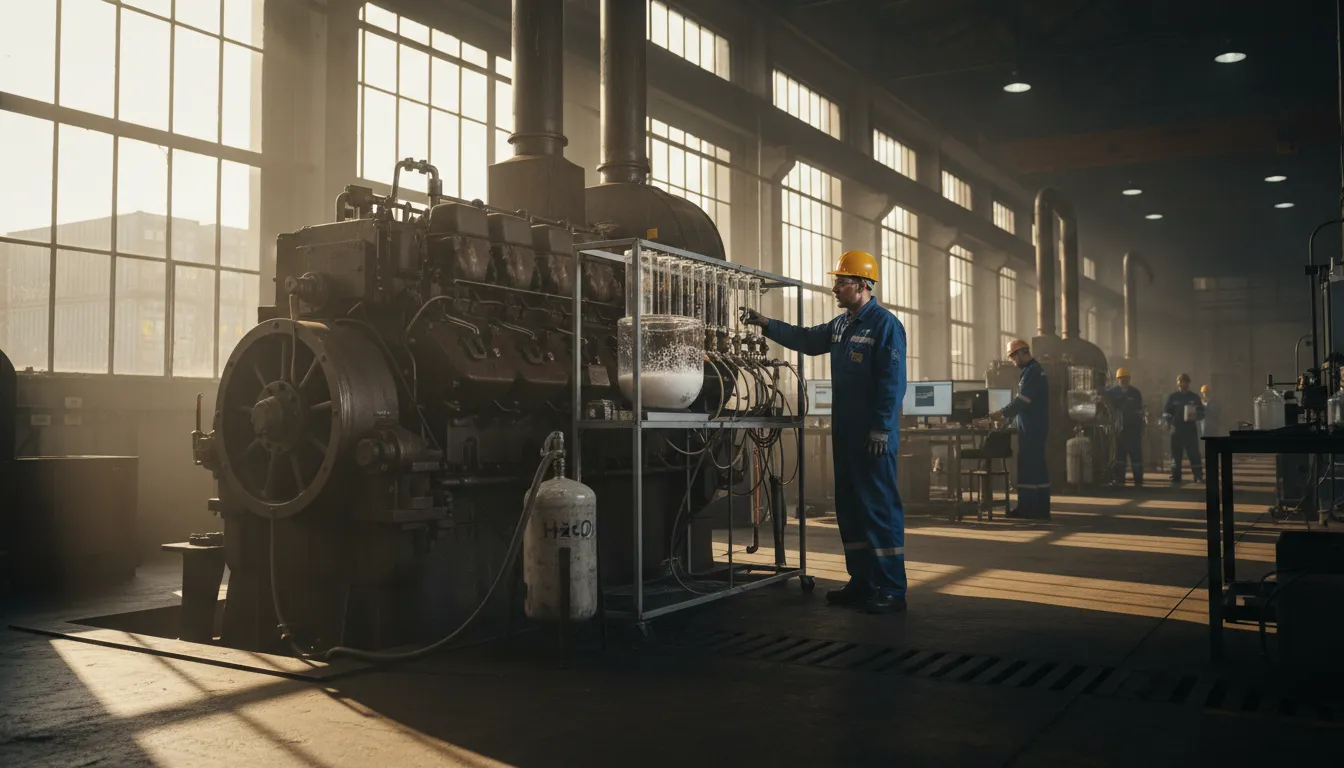
Water and engines do not usually mix. Moisture in a fuel tank can corrode parts and stall machinery. Yet scientists have spent decades proving that deliberately blending microscopic water droplets into diesel fuel can dramatically cut harmful exhaust emissions—sometimes by more than 60%—while requiring zero engine modifications.
The technology is called Water-in-Diesel Emulsion (WiDE). It works in trucks, ships, generators, and any compression-ignition engine already on the road or at sea. As regulators worldwide tighten air-quality rules, WiDE is drawing fresh attention as a fast, cheap bridge toward cleaner transport.
What Is a Water-in-Diesel Emulsion?
An emulsion is a stable mixture of two liquids that normally do not blend—think of milk, where fat droplets are suspended in water. In WiDE, the roles reverse: tiny water droplets, typically 5–20% of the fuel volume, are dispersed throughout a continuous diesel phase.
Chemicals called surfactants keep the mixture from separating. A surfactant molecule has a water-loving (hydrophilic) head and an oil-loving (hydrophobic) tail. Positioned at the boundary between each water droplet and the surrounding diesel, surfactants lower the interfacial tension and lock the emulsion in place—sometimes for up to 60 days without separation.
The Micro-Explosion Effect
The magic happens inside the combustion chamber. Water boils at 100 °C, far below diesel's ignition temperature of roughly 250 °C. When an emulsified fuel droplet enters the hot cylinder, the embedded water superheats and vaporizes explosively—a phenomenon engineers call a micro-explosion.
Each micro-explosion shatters the surrounding diesel droplet into a cloud of much finer particles. This secondary atomization achieves two things at once:
- Better air-fuel mixing — finer droplets burn more completely, leaving less unburned soot and particulate matter.
- Lower peak temperatures — the energy absorbed during water vaporization cools the combustion zone, which suppresses the formation of nitrogen oxides (NOx), the pollutants responsible for smog and acid rain.
According to a review published in The Scientific World Journal, WiDE can reduce NOx by up to 45% and particulate matter by 80–90% compared with neat diesel, depending on the water fraction and engine conditions. A March 2026 study from the Federal University of Technology Owerri reported NOx reductions of 67% and soot cuts of 68% with an optimized emulsion.
Where It Is Already in Use
The shipping industry has been the earliest large-scale adopter. Marine diesel engines burn heavy fuel oil, one of the dirtiest fossil fuels on the planet. Since 2006, companies like Nonox Ltd. have offered onboard emulsification units that blend water into fuel in real time. These systems have demonstrated soot reductions of up to 90% and NOx cuts of roughly 40%, helping vessels meet International Maritime Organization (IMO) Tier II and even Tier III emission standards without expensive exhaust aftertreatment.
On land, pilot programs have tested WiDE in city bus fleets, construction equipment, and backup generators—anywhere retrofitting with catalytic converters or particulate filters is costly or impractical.
Limitations and Trade-Offs
WiDE is not a silver bullet. Adding water displaces some fuel, which can reduce energy content per liter and slightly increase fuel consumption—though the improved combustion efficiency often offsets this penalty. Surfactant quality matters: a poorly formulated emulsion can destabilize and send free water into injectors, risking corrosion. Cold climates pose challenges too, since water in the emulsion can freeze and clog fuel lines.
Long-term engine wear studies remain limited, and the technology does not eliminate carbon dioxide emissions—it primarily targets the local pollutants (NOx and particulates) that cause respiratory disease and urban smog.
Why It Matters Now
The world still relies on roughly 1.5 billion diesel engines in trucks, ships, trains, and generators. Replacing all of them with electric or hydrogen alternatives will take decades. WiDE offers an immediate, low-cost intervention: no new engines, no exotic fuels, just water, a surfactant, and a mixing unit. For developing nations where fleet modernization is slow, and for the shipping industry facing tightening IMO sulfur and NOx caps, water-in-diesel emulsion represents a pragmatic path to cleaner air while the energy transition unfolds.