Measles Surges Across US, Threatening Elimination Status
The United States has recorded over 1,136 measles cases in just two months of 2026 — already nearing half of last year's 30-year record — as unvaccination rates rise and public health infrastructure weakens under federal leadership hostile to vaccines.
A Disease Declared Eliminated Is Back With a Vengeance
Measles, a disease the United States declared eliminated in 2000, is roaring back at a pace that alarmed public health officials had not seen in a generation. As of late February 2026, the CDC had confirmed 1,136 cases across 28 states — and the outbreak shows no signs of slowing. In just two months, the country has already recorded nearly half of last year's total of 2,281 cases, itself the highest annual count since 1991.
The numbers are stark: the 2026 outbreak is running four times faster than 2025 at the same point in the year, and 25 times faster than 2024. If the trajectory holds, the US could surpass its entire 2025 total by spring — and potentially lose its measles-elimination status, a designation awarded by the Pan American Health Organization (PAHO) that certifies continuous interruption of the virus for at least 12 months.
South Carolina and Florida Drive the Surge
The epicenter of the 2026 outbreak is South Carolina, where hundreds of cases have been confirmed since an outbreak began in October 2025. Florida is now the fastest-growing hotspot, with over 100 cases including a cluster at Ave Maria University. Utah has recorded more than 319 infections, with 62 new cases in just three weeks. In Texas, 13 cases were identified at an ICE detention facility in El Paso.
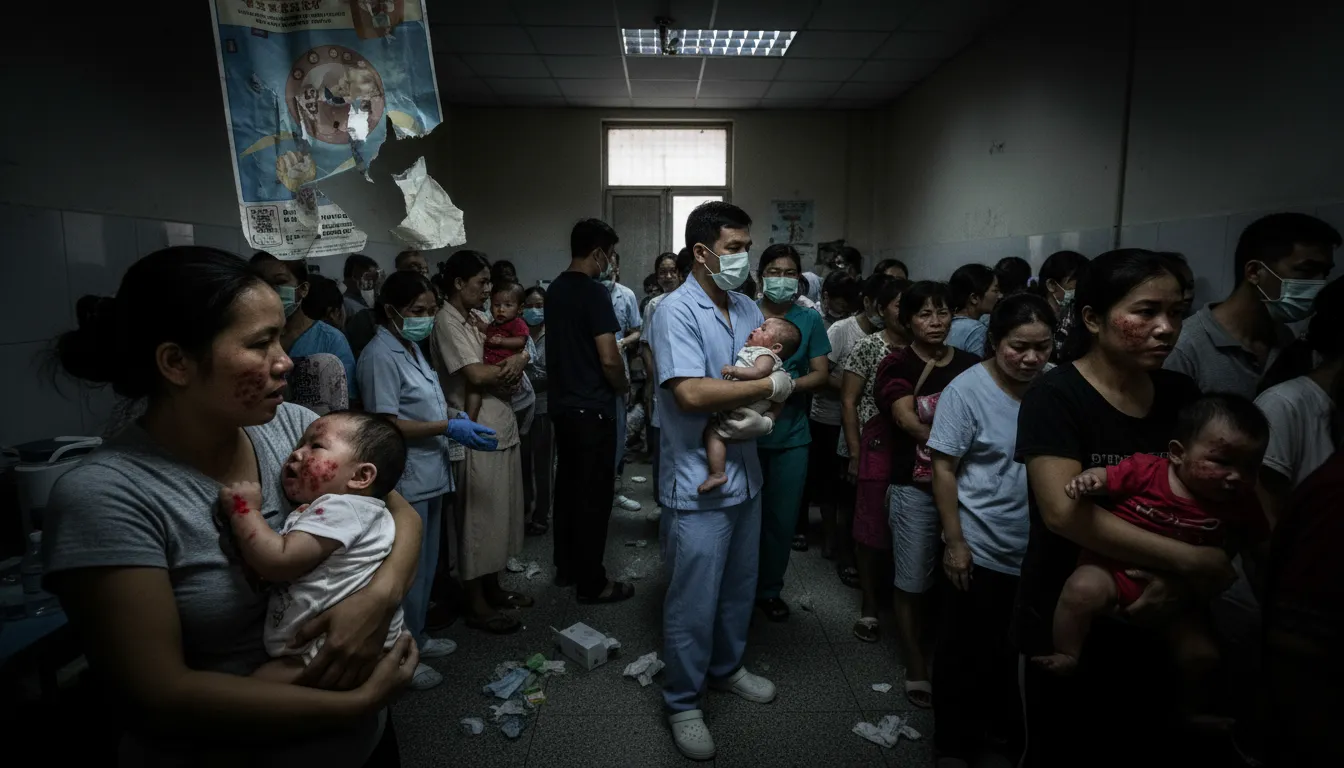
The demographic profile is alarming: 81% of cases involve people aged 19 or younger, and 24% are children under five — the group most vulnerable to measles complications including pneumonia, encephalitis, and death. Just 5% of cases required hospitalization this year, though experts warn that death is likely to follow as case numbers climb. Three people died of measles in the US last year.
Vaccination Gaps Fuel the Fire
The overwhelming driver of the outbreak is vaccine avoidance. About 96% of 2026 measles cases occurred in people who were unvaccinated or whose vaccination status was unknown, according to CDC data. Two doses of the MMR (measles-mumps-rubella) vaccine are 97% effective at preventing infection — yet vaccination rates have fallen below the 95% herd-immunity threshold in many communities following the COVID-19 pandemic.
Measles is extraordinarily contagious — roughly six times more contagious than COVID-19. In an unvaccinated population, a single infected individual can pass the virus to up to 18 others, and the virus can linger in the air for two hours after an infected person has left a room, according to Dr. Sanchi Malhotra, medical director of pediatric infection prevention at UCLA Mattel Children's Hospital.
"It can be really hard to control from an infection-prevention and public health standpoint, given how contagious it is," Dr. Malhotra said.
Political Headwinds Complicate Response
The outbreak is unfolding at a fraught political moment for US public health. Health Secretary Robert F. Kennedy Jr., a longtime vaccine skeptic, has repeatedly downplayed the risks of measles and spread unsubstantiated claims about the MMR vaccine. Kennedy also dismissed the significance of the US potentially losing its measles-elimination status — a view echoed by his newly appointed CDC deputy.
According to reporting by KFF Health News, the Trump administration's layoffs and communication freezes at the CDC slowed the agency's response to early outbreaks and impeded coordination with state health officials. Federal emergency funds for outbreak response were also delayed.
A Hard-Won Status Now at Stake
The US achieved measles elimination in 2000, an historic milestone that required decades of mass vaccination campaigns. That status is now in jeopardy: PAHO will assess whether continuous transmission has occurred across a 12-month window and could formally strip the US of its elimination designation within months. Such a ruling would carry serious public health, diplomatic, and economic consequences — from travel advisories issued by other nations to the long-term erosion of trust in the US vaccination infrastructure.
Before the measles vaccine was introduced in 1963, roughly 3–4 million Americans contracted the disease each year, causing 48,000 hospitalizations and 400–500 deaths annually. Public health experts warn that without urgent action to reverse falling vaccination rates, the US risks returning toward that grim baseline.