Japan Plans Missiles Near Taiwan as China Hits Back
Japan has announced plans to deploy surface-to-air missile systems on Yonaguni Island, just 70 miles from Taiwan, by fiscal 2030. China has responded with sweeping export controls targeting 40 Japanese defence and industrial firms, marking a sharp escalation in one of Asia's most volatile rivalries.
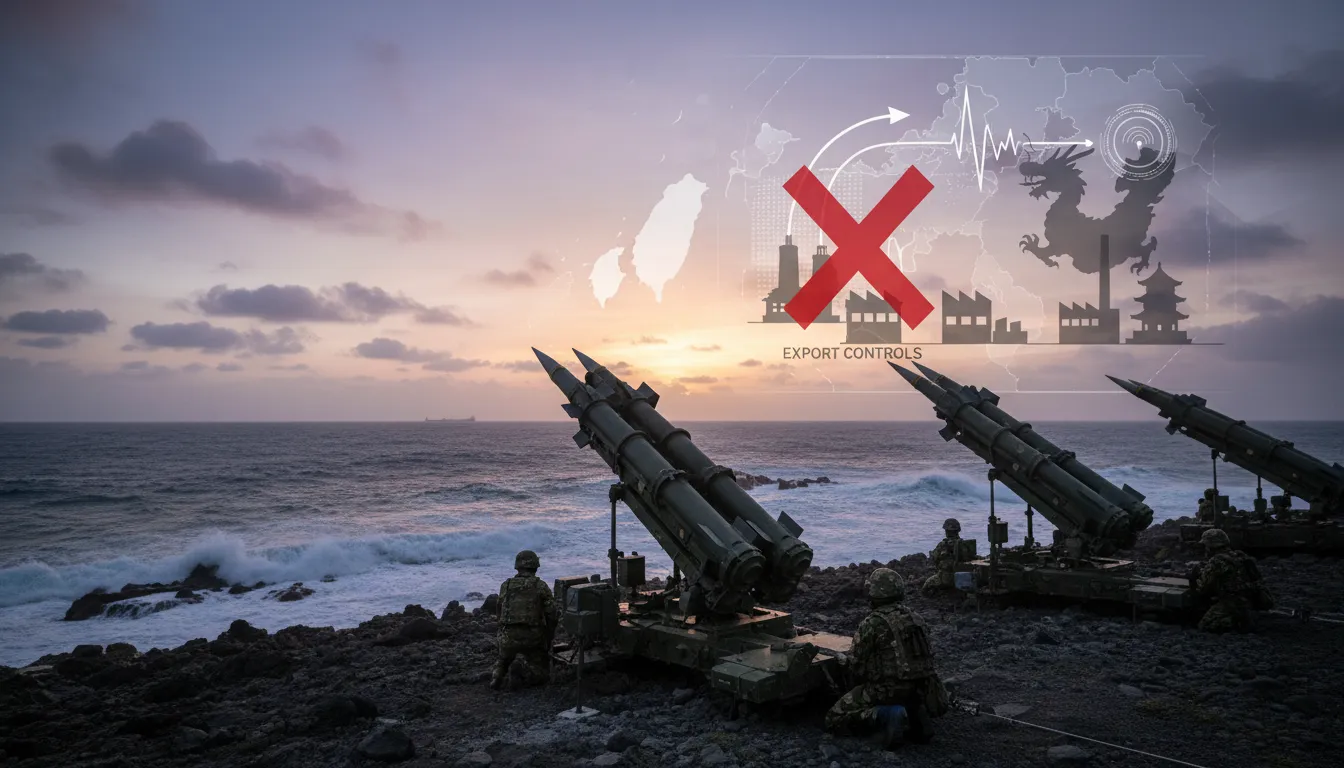
Japan's Island on the Front Line
In a move that has set nerves on edge across East Asia, Japan's Defence Minister Shinjiro Koizumi announced on February 24 that Tokyo will station upgraded Type-03 medium-range surface-to-air missiles at Camp Yonaguni by fiscal year 2030. Yonaguni is Japan's westernmost island — a speck of land roughly 110 kilometres east of Taiwan, close enough that the island's coastline is visible on a clear day.
The deployment, which will add roughly 100 additional personnel to the camp's existing garrison of about 230, represents the first time Japan has committed to a concrete deadline for arming the strategically critical outpost. The Type-03 systems are specifically enhanced to counter hypersonic glide vehicles, reflecting Japan's acute concern about Chinese military technology. "This deployment will reduce the possibility of armed attacks on Japan," the Japanese defence ministry stated.
China's Economic Counter-Strike
Beijing wasted no time in responding. On the same day, China's Ministry of Commerce imposed export controls on 40 Japanese companies and institutions, effective immediately. The measures are split into two tiers: 20 entities placed on a direct export control list — meaning they cannot receive dual-use goods from China — and a further 20 placed on a watch list requiring strict screening.
The affected organisations read like a who's who of Japan's industrial base. On the control list: Mitsubishi Shipbuilding, Kawasaki Heavy Industries Aerospace Systems, and Japan's own National Defense Academy. On the watch list: Subaru, TDK, Eneos, and affiliates of trading giants Itochu, Sumitomo, and Mitsui.
Restricted goods include rare metals — tungsten, tellurium, and bismuth — critical for semiconductors and industrial manufacturing, as well as precision sensors and aerospace materials. Beijing framed the measures as necessary to curb Japan's "remilitarization and nuclear ambitions," describing them as "legitimate, reasonable, and legal."
Markets delivered an immediate verdict. Fujitsu shares fell 9 percent, NEC dropped over 6 percent, while Kawasaki, IHI, and Mitsubishi Heavy Industries also declined sharply.
A Crisis With Deep Roots
The deterioration in Japan-China relations traces back to November 2025, when Prime Minister Sanae Takaichi told Japanese legislators that a Chinese attack on Taiwan would constitute a "survival-threatening situation" for Japan — implying possible military intervention. Beijing responded with fury. China's defence ministry warned that Japan "would suffer a crushing defeat" if it intervened in a Taiwan conflict.
Since then, Beijing has steadily tightened the screws: reinstating a ban on Japanese seafood imports, issuing travel warnings, dispatching naval vessels near Japanese waters, and now escalating economic pressure through export controls. Chinese visitors to Japan plummeted 60.7 percent year-on-year in January 2026.
Meanwhile, Tokyo has pressed ahead with the largest military build-up in its postwar history. Japan's draft defence budget for fiscal 2026 allocates roughly 9.04 trillion yen ($58 billion) — a record — as the country moves toward spending 2 percent of GDP on defence, the NATO benchmark, despite its pacifist constitution.
A Structural Shift, Not a Spat
Analysts warn the crisis is no longer a manageable diplomatic dispute. "What began as a row over Taiwan is spiralling into something structural," one expert told Al Jazeera, describing the two Asian powers as moving away from managed coexistence toward "strategic competition punctuated by periodic crises."
China's dominance in rare earth production gives Beijing significant economic leverage — but Japan's deepening security alliance with the United States and its missile build-up along the Ryukyu island chain signal that Tokyo has calculated the risks and chosen to proceed. With Yonaguni set to become an armed outpost facing China's coast, the Taiwan Strait flashpoint now has a new and uncomfortably close frontier.