Modi's Historic Knesset Address Cements India-Israel Axis
Indian Prime Minister Narendra Modi has arrived in Israel for a landmark two-day state visit, becoming the first Indian leader to address the Knesset as both nations upgrade their ties to a 'special strategic partnership' backed by billions in defence deals.
A First for India on the World Stage
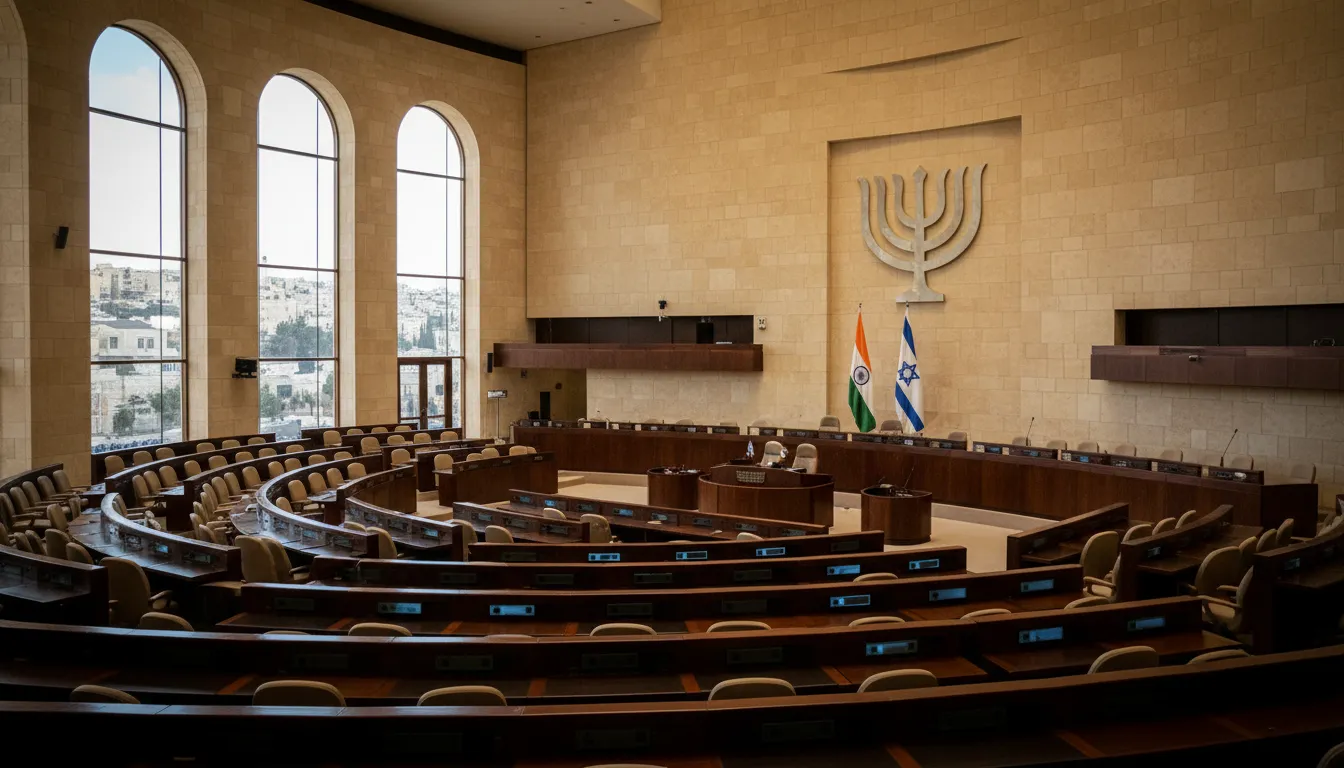
Indian Prime Minister Narendra Modi touched down in Israel on Wednesday for a two-day state visit that marks a watershed in the two countries' diplomatic history. Modi addressed the Israeli parliament, the Knesset, making him the first Indian prime minister ever to do so — a rare honour that Israel typically reserves for its closest allies, such as the United States and Germany.
The visit, only Modi's second to Israel following his pioneering 2017 trip, was met with an extraordinary reception. Israel's Jerusalem Post ran a front-page "Welcome Modi" headline, while Israeli President Isaac Herzog personally welcomed the Indian leader on the tarmac.
A 'Special Strategic Partnership' Takes Shape
The centrepiece of the two-day agenda is a formal upgrade of bilateral relations to a "special strategic partnership" — a designation that Jerusalem reserves for a handful of global powers. Israeli Prime Minister Benjamin Netanyahu described the relationship as a "powerful alliance between two global leaders," united by shared interests in innovation, security, and regional stability.
The defence dimension is substantial. Israel has agreed to arms deals worth an estimated $8.6 billion with India in 2026, making it India's second-largest weapons supplier after France. Discussions reportedly include cooperation on advanced air-defence systems and India's potential integration into Israel's cutting-edge laser-based air defence programme, known as Iron Beam.
Beyond guns and missiles, the two sides are expected to sign agreements on artificial intelligence, quantum computing, and cybersecurity, including the establishment of a joint cybersecurity centre of excellence. India's ambassador underscored the breadth of the agenda: "Israel is really good at innovation and science. There will be a lot of discussion on AI, cybersecurity, and quantum."
The 'Hexagon' Strategy and Regional Stakes
Netanyahu used the visit to advance his vision of a "hexagon of alliances" — a coalition involving Israel, India, Greece, Cyprus, and select Arab and African nations designed to counter both radical Shia and Sunni regional axes. While India has not formally endorsed the concept, Modi's presence in Jerusalem signals a deepening strategic alignment that would have been unthinkable under earlier Indian governments.
The visit's timing adds a layer of geopolitical tension. It comes amid mounting fears of a U.S. military strike on Iran, and just weeks after India's government signed — albeit a day later than most — a 107-nation UN statement condemning Israeli settlement expansion in the West Bank. That nuanced balancing act reflects India's longstanding strategic doctrine of maintaining ties across conflicting blocs.
A Relationship Three Decades in the Making
The economic trajectory of the India-Israel relationship underscores how far both countries have come. Bilateral trade stood at just $200 million in 1992 when diplomatic relations were established; by 2024, it had grown to $6.5 billion, with both sides targeting further growth through a free trade agreement currently under negotiation.
India's shift also reflects its post-2025 security calculus. Following its brief but sharp military confrontation with Pakistan — in which Chinese-supplied weapons featured prominently — New Delhi has redoubled its search for advanced Western-aligned defence technology. Israel, with its battle-tested systems and innovation ecosystem, fits that bill precisely.
What Comes Next
Modi's itinerary includes a visit to the Yad Vashem Holocaust memorial and a meeting with President Herzog before departing Thursday. Analysts say the concrete outcomes — partnership upgrades, defence contracts, AI accords — will reverberate far beyond the two-day summit, reshaping the strategic architecture of the Middle East and South Asia for years to come.