"No Kings": Millions March in Potentially Largest US Protest
Over 3,000 rallies across every US congressional district mark the third wave of No Kings protests on March 28, with organizers forecasting the largest single day of protest in American history.
A Nation Takes to the Streets
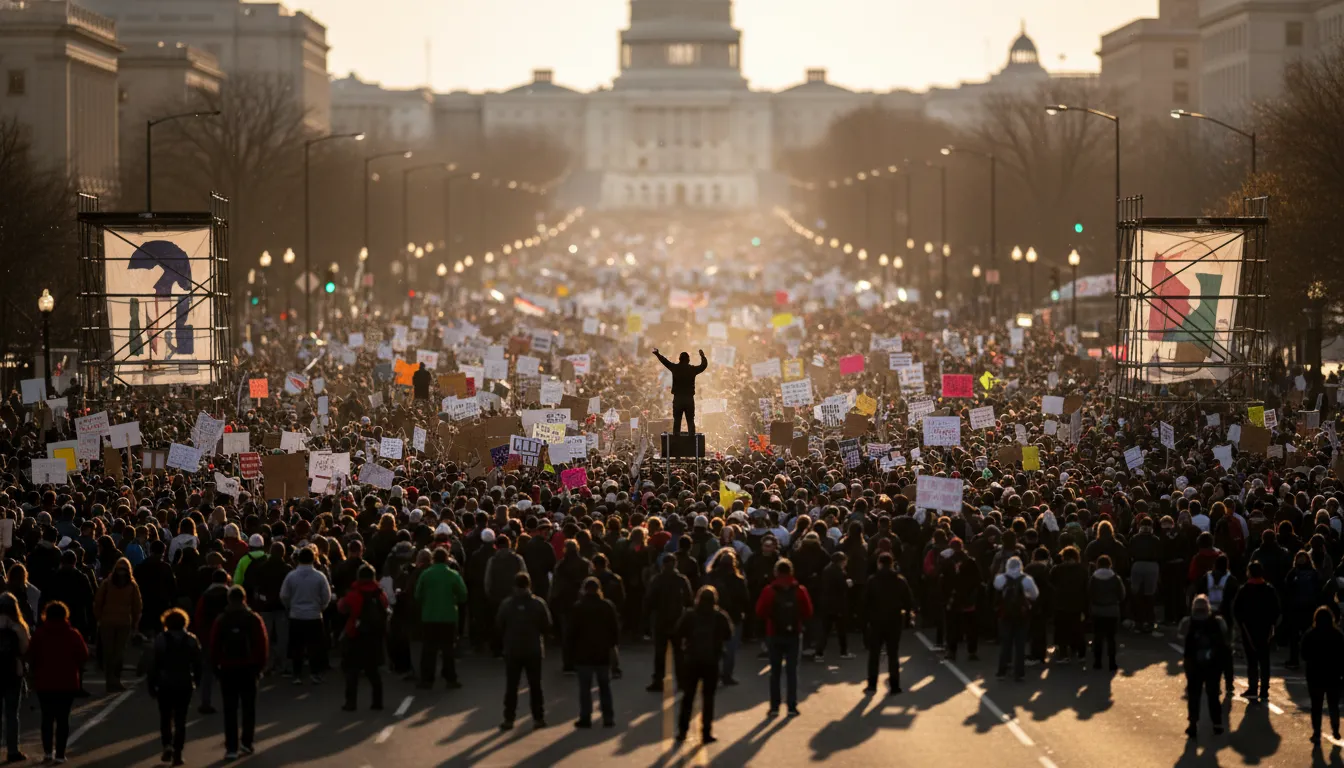
On Saturday, March 28, millions of Americans are expected to pour into streets, parks, and capitol grounds in what organizers and historians say could be the largest single day of domestic protest in United States history. The third wave of the "No Kings" movement — organized primarily by the grassroots coalition Indivisible — has registered more than 3,200 events spanning every congressional district in the country and six continents worldwide.
If projections hold, the demonstrations will dwarf both the June 2025 protests, which drew an estimated five million participants across 2,100 events, and the October 2025 wave, when roughly seven million people rallied during a government shutdown. The scale signals a protest movement that is not merely persisting but accelerating.
St. Paul: The Flagship Rally
The movement's centerpiece is a massive rally at the Minnesota State Capitol in St. Paul, where organizers told state officials to expect 100,000 to 150,000 attendees — up from an estimated 80,000 at the same venue last June. The lineup reads like a who's who of American activism and culture: Senator Bernie Sanders, rock legend Bruce Springsteen, actress Jane Fonda, folk icon Joan Baez, and singer Maggie Rogers.
Springsteen is set to perform "Streets of Minneapolis," a protest song he wrote after the fatal shootings of civilians by federal immigration agents earlier this year. Marchers will converge from three starting points — Saint Paul College, Harriet Island, and Western Sculpture Park — before uniting at the Capitol at 2 p.m.
Other major rallies feature their own notable figures: Bill Nye and journalist Mehdi Hasan in Washington, D.C., and the Dropkick Murphys in Boston.
Why They March
The protests are fueled by a constellation of grievances against the Trump administration's second term. Chief among them are Immigration and Customs Enforcement (ICE) operations, including "Operation Metro Surge," which have resulted in the fatal shootings of civilians Renée Good, Keith Porter Jr., and Alex Pretti in Minnesota. Organizers also cite 40 deaths inside detention centers since the administration took office.
"With every ICE raid, every escalation abroad, and every abuse of power at home, Americans are rising up in opposition to Trump's attempt to rule through fear and force," said Ezra Levin, Indivisible's co-executive director.
The movement has also broadened its focus to include opposition to the U.S.-Israeli war on Iran, healthcare concerns, and what organizers characterize as a systematic erosion of democratic norms.
Beyond the Cities
Perhaps the most striking development is the movement's geographic spread. According to Indivisible, two-thirds of people who RSVPed for March 28 events live outside major urban centers — a nearly 40 percent increase from the first No Kings action. This rural and suburban participation suggests the protests are building a broader coalition that reaches well beyond traditional liberal strongholds.
"People are coming out in every state, in every county, collectively, and saying, 'Enough,'" said Leah Greenberg, Indivisible co-founder.
Historical Echoes, Uncertain Future
If the projected turnout materializes, March 28 would surpass not only previous No Kings events but also the 1963 March on Washington and the 2017 Women's March as the largest coordinated protest in American history. The movement's rapid growth — from a first rally to a potential record-breaker in under a year — reflects the depth of political polarization gripping the country.
Yet the question looming over every protest sign and megaphone remains the one posed by analysts at Stateline: what comes next? Whether this extraordinary mobilization translates into lasting political change — at the ballot box, in the courts, or in the halls of Congress — will determine whether the No Kings movement becomes a turning point or a moment.