Nuclear Arms Race Looms as New START Treaty Expires
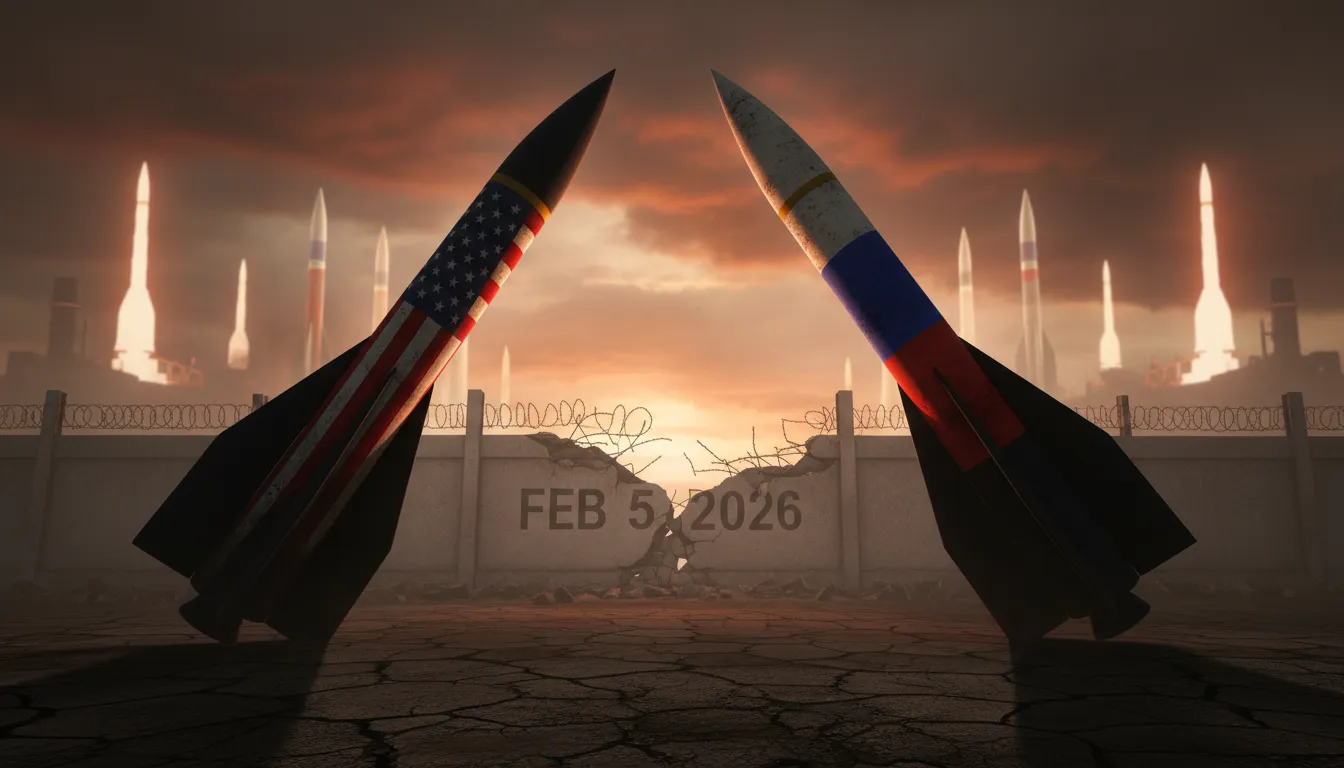
The last nuclear arms control treaty between the US and Russia expired on February 5, 2026, leaving both nations without legally binding warhead limits for the first time since the early 1970s — and no successor agreement in sight.
The End of an Era in Nuclear Diplomacy
For the first time since the early 1970s, the United States and Russia are operating without any legally binding limits on their strategic nuclear arsenals. The New Strategic Arms Reduction Treaty — New START — expired on February 5, 2026, closing a chapter in nuclear diplomacy that helped prevent catastrophic escalation for over half a century. No successor agreement is on the horizon.
What New START Actually Did
Signed in 2010 by President Barack Obama and Russian President Dmitry Medvedev, New START imposed strict caps on both nations' nuclear capabilities: no more than 1,550 deployed strategic nuclear warheads, 700 deployed missiles and bombers, and 800 total launchers. Crucially, it also mandated transparency — up to 18 on-site inspections per year and continuous data exchanges. Those verification mechanisms, experts argue, were as valuable as the warhead ceilings themselves: they removed the guesswork that historically fuels arms races.
A Breakdown Years in the Making
The treaty could only be extended once. President Biden exercised that option in 2021, buying five more years. But diplomacy toward a successor stalled as relations deteriorated. Russia suspended its compliance protocols in 2023, freezing inspections following its full-scale invasion of Ukraine, while remaining nominally bound by the numerical limits.
In September 2025, President Putin offered to voluntarily maintain the treaty's caps for one year past expiration. President Trump publicly called the idea "good" but issued no formal response. He ultimately shrugged off the deadline: "If it expires, it expires," he reportedly said, promising a "better agreement" — one that would also include China, a nation that has never accepted arms control limits and has rapidly expanded its arsenal in recent years.
What Happens Without It
The consequences could be severe. According to analysts at the Federation of American Scientists, unconstrained by treaty limits, the US ICBM force could theoretically double from roughly 400 to 800 warheads; Russia could add several hundred more to its submarine and land-based forces. Both nations are simultaneously modernizing their delivery systems, reducing political incentives to constrain numbers.
Beyond raw arsenals, the loss of transparency may prove equally destabilizing. For over 50 years, regular inspections and data exchanges prevented dangerous miscalculations. Without them, military planners on both sides must default to worst-case assumptions — a dynamic historically associated with accelerating arms races and heightened accident risk.
International Alarm
UN Secretary-General António Guterres warned of a "grave moment" as the treaty lapsed, calling urgently on both governments to return to the negotiating table. France's Foreign Ministry issued a formal statement of concern and urged new multilateral frameworks. The NPT Review Conference, scheduled for April 2026, faces immediate pressure to address the growing vacuum in global nuclear governance.
Arms control experts at the Vienna Center for Disarmament advocate a pragmatic short-term path: rather than sweeping comprehensive treaties, risk-reduction measures — secure communication hotlines, mutual launch notifications, and confidence-building dialogue that draws in China, France, and the United Kingdom — could help contain the damage while longer-term negotiations develop.
A More Dangerous World?
National security specialist Stephen Flynn put it simply: the treaty "helped to provide a sense of stability between the two powers for decades." That stability is now gone. Whether Washington and Moscow can construct a replacement framework — and whether Beijing can be persuaded to join — may define the global security landscape of the late 2020s. For now, the world's two largest nuclear powers are legally unconstrained for the first time in a generation.