What Are the Magellanic Clouds and Why They Matter
The Magellanic Clouds are two dwarf galaxies orbiting the Milky Way that serve as vital laboratories for astronomy, dark matter research, and understanding galaxy evolution — and they are on a collision course with our galaxy.
Two Galaxies Visible to the Naked Eye
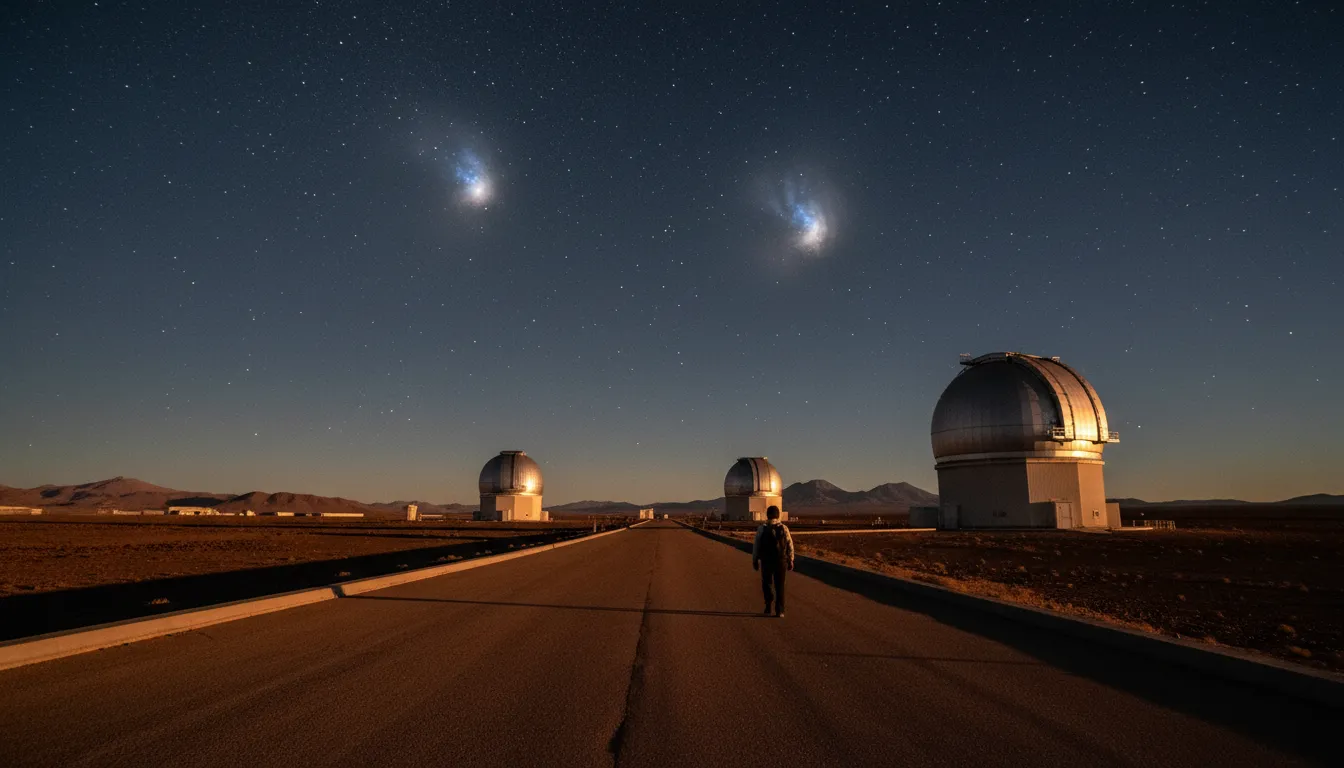
Look up from anywhere in the Southern Hemisphere on a clear night and two faint, glowing patches hover near the horizon like detached pieces of the Milky Way. These are the Magellanic Clouds — the Large Magellanic Cloud (LMC) and the Small Magellanic Cloud (SMC) — a pair of dwarf galaxies that orbit our own. Despite their modest appearance, they rank among the most scientifically important objects in the sky.
The LMC sits roughly 163,000 light-years from Earth, making it the second- or third-closest galaxy to the Milky Way. The SMC trails slightly farther at about 200,000 light-years. Together, they are gravitationally bound companions — satellite galaxies slowly circling a host hundreds of times more massive than themselves.
Anatomy of Two Dwarf Galaxies
The LMC spans about 32,200 light-years across and contains roughly 30 billion stars. The SMC is smaller, around 18,900 light-years in diameter, with approximately 3 billion stars. Both are classified as irregular or disrupted barred spiral galaxies, meaning they lack the elegant pinwheel structure of classic spirals like the Milky Way.
What makes them stand out is their gas. Both clouds are extraordinarily gas-rich, with a far higher proportion of hydrogen and helium relative to their total mass than the Milky Way. They are also "metal-poor" — astronomer shorthand meaning they contain fewer heavy elements forged in previous generations of stars. This combination makes them prolific stellar nurseries. The LMC's Tarantula Nebula is the most active star-forming region in the entire Local Group of galaxies.
A Cosmic Laboratory
Astronomers treasure the Magellanic Clouds because their proximity allows detailed study impossible with more distant galaxies. In 1912, Henrietta Leavitt measured Cepheid variable stars in the SMC and discovered the period-luminosity relationship — a breakthrough that gave humanity its first reliable cosmic yardstick for measuring distances across the universe.
In February 1987, the LMC delivered another landmark: Supernova 1987A, the closest observed supernova in nearly four centuries. Hours before its light reached Earth, neutrino detectors in Japan, the United States, and Russia captured a burst of particles — the first direct detection of neutrinos from a stellar explosion. That single event launched the field of neutrino astronomy and confirmed theoretical models predicting that 99% of a collapsing star's energy escapes as neutrinos.
Probing Dark Matter
The Magellanic Clouds have become crucial tools in the search for dark matter, the invisible substance thought to make up about 27% of the universe. Recent research shows the LMC contains nearly twice as much dark matter as previously estimated, which significantly perturbs the local dark matter distribution around the Milky Way. Scientists have found that the tilt of the LMC's bar structure correlates with the dark matter content of the SMC — offering a novel, indirect method to measure a substance that has never been directly detected.
Meanwhile, new simulations show the SMC's chaotic stellar motions result from a direct collision with the LMC a few hundred million years ago. That discovery has forced astronomers to rethink the SMC's status as a "textbook" reference galaxy for studying galactic evolution.
A Collision Course With the Milky Way
The Magellanic Clouds are not merely passive neighbors. The LMC is losing energy and spiraling inward. According to models published in the Monthly Notices of the Royal Astronomical Society, the LMC will merge with the Milky Way in roughly 2.4 billion years — well before the famous Milky Way-Andromeda encounter. That collision could awaken our galaxy's dormant supermassive black hole and expand the stellar halo fivefold, though it is unlikely to destroy the galactic disc.
Signs of this impending merger are already visible: gravitational interactions between the clouds and the Milky Way are triggering new star formation in regions of our galaxy where none was expected. Streams of neutral hydrogen trail behind the clouds like a cosmic breadcrumb trail, mapping their orbital path.
Why They Still Matter
From calibrating cosmic distances to catching neutrinos, from probing dark matter to previewing galactic mergers, the Magellanic Clouds punch far above their weight. As telescopes grow more powerful and simulations more precise, these two small galaxies continue to reshape our understanding of how the universe assembles itself — one collision at a time.