What Is a Shadow Fleet and How It Evades Oil Sanctions
Shadow fleets are networks of aging tankers that use deceptive tactics to transport sanctioned oil, generating billions in revenue while posing serious environmental and maritime risks worldwide.
Hidden Tankers, Hidden Oil
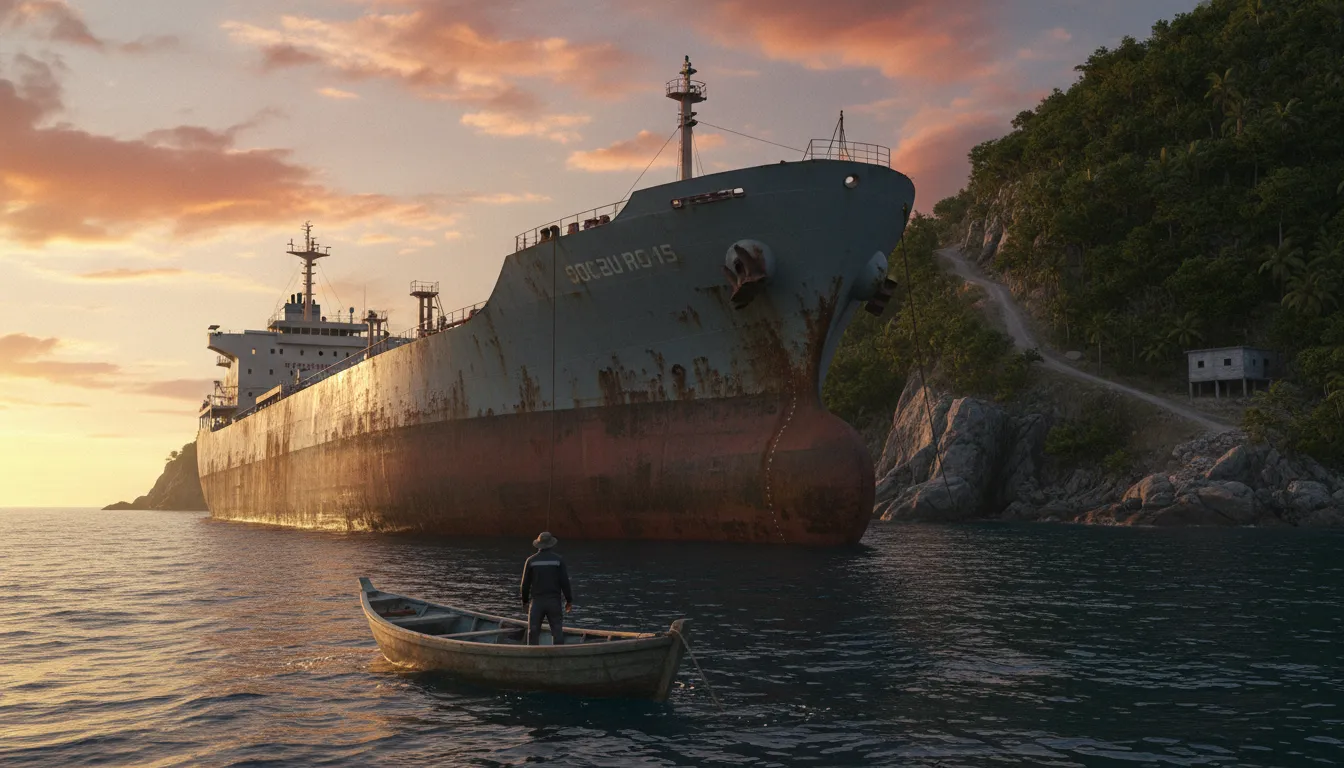
Somewhere in the open ocean, two tankers drift side by side in calm waters. A heavy hose connects them as millions of barrels of crude oil flow from one hull to the other. Neither vessel broadcasts its location. Neither carries adequate insurance. When the transfer is complete, the receiving ship sails on—its cargo's true origin effectively erased.
This is the world of the shadow fleet, a sprawling network of aging vessels that enables sanctioned nations to sell oil on the global market despite international restrictions. What began as a niche smuggling tactic has grown into an industry involving an estimated 600 to 1,900 ships, depending on the definition used, and now accounts for roughly 17% of the global tanker fleet.
How the Shadow Fleet Works
The concept is straightforward: when Western sanctions restrict a country from selling oil through normal channels, that country acquires its own tankers and operates them outside the regulated shipping system. Russia dramatically scaled this approach after the G7 and European Union imposed a $60-per-barrel price cap on Russian crude in late 2022.
Moscow and its intermediaries began snapping up old, often obsolete tankers through shell companies in jurisdictions with minimal oversight. These vessels are registered under flags of convenience—countries like Gabon, the Cook Islands, Panama, and Eswatini that offer ship registration with few questions asked. Gabon alone more than doubled its ship registry in 2023, with an estimated 98% of its tankers classified as high-risk with no identifiable owner.
Ship-to-Ship Transfers
The most critical evasion technique is the ship-to-ship (STS) transfer. Oil is pumped between vessels in open waters—sometimes multiple times—before reaching its final destination. Each transfer further obscures where the cargo originated. Hotspots for these exchanges include waters off Malaysia, West Africa, and the Mediterranean.
Going Dark
Shadow tankers routinely disable their Automatic Identification System (AIS), the transponder that broadcasts a ship's position, speed, and identity. Without AIS signals, maritime authorities cannot easily track the vessel. Some ships also engage in flag hopping, changing their registered nation repeatedly, or GPS spoofing, broadcasting false location data to appear far from their actual position.
The Scale of the Problem
According to Brookings Institution and European Parliament analyses, Russia's shadow fleet alone transports an estimated 3.7 million barrels per day—roughly 65% of Russia's seaborne oil trade—generating between $87 billion and $100 billion annually. The shadow fleet effectively allowed Russia to bypass the price cap, earning an estimated $9.4 billion in additional revenue in 2024 alone, according to analysts.
Russia is not the only user. Iran and Venezuela have long operated smaller shadow fleets. Combined, an estimated 10% of the world's tankers are now involved in sanctioned or illicit oil trades.
Why It's Dangerous
Shadow fleet vessels are overwhelmingly old. More than 75% of tankers without standard international insurance are over 15 years old, and about a quarter exceed 20 years. These aging hulls carry enormous environmental risk.
In December 2024, two Russian shadow tankers broke apart during a storm in the Kerch Strait, spilling up to 8,500 metric tons of heavy fuel oil into the Black Sea. Because the vessels carried insurance from Russian providers operating outside the international Protection & Indemnity (P&I) framework, cleanup liability fell largely on affected coastal states. Analysts at the Kyiv School of Economics estimate that a major shadow fleet spill could cost up to $1.6 billion—a bill likely paid by taxpayers rather than shipowners.
Can Anything Stop It?
Western governments have sanctioned over 636 shadow fleet tankers, and the EU banned refueling of non-compliant vessels at its ports starting in January 2026. The United States has had the most success: only 15% of US-sanctioned vessels continued loading at Russian ports in late 2025.
Yet enforcement remains patchy. The ocean is vast, shell companies are cheap, and the financial incentives are enormous. As long as sanctioned oil finds willing buyers—primarily in China, India, and Turkey—the shadow fleet will adapt, rename, reflag, and sail on.