What Is Earth's Albedo and Why It Keeps Dropping
Earth's albedo — the fraction of sunlight our planet reflects back to space — is declining to record lows, accelerating global warming through powerful feedback loops involving clouds, ice, and ocean surfaces.
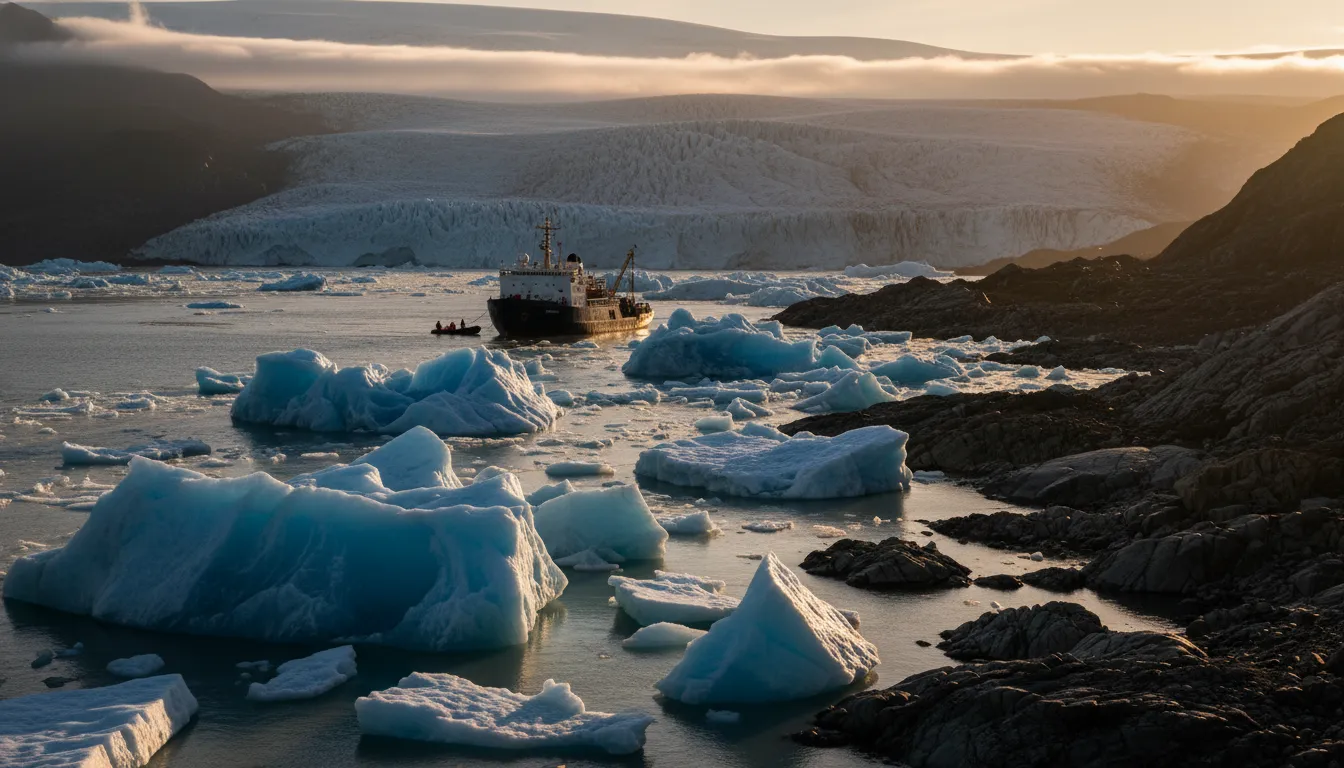
The Mirror That Cools the Planet
Every second, the Sun bathes Earth in roughly 340 watts of energy per square meter. Not all of it stays. About 30 percent bounces straight back into space, reflected by clouds, ice sheets, deserts, and other bright surfaces. Scientists call this reflectivity albedo, from the Latin word for "white." It is one of the most important numbers in climate science — and it is shrinking.
How Albedo Works
Albedo is expressed on a scale from 0 to 1. A perfectly black surface that absorbs all incoming light scores 0; a perfectly white one that reflects everything scores 1. Fresh snow reflects up to 90 percent of sunlight (albedo ~0.9). Open ocean, by contrast, absorbs more than 90 percent (albedo ~0.06). Forests sit around 0.15, while deserts range from 0.3 to 0.4.
Earth's planetary albedo — the average across every surface, ocean, and cloud layer — hovers around 0.30, meaning roughly 30 percent of incoming solar radiation is reflected. The remaining 70 percent is absorbed, warming the atmosphere, land, and seas. Even a tiny shift in that balance delivers enormous energy changes across the entire planet.
How Scientists Measure It
Two complementary methods track Earth's reflectivity. NASA's CERES (Clouds and the Earth's Radiant Energy System) instruments, flying aboard satellites like Terra, Aqua, and Suomi-NPP, use scanning radiometers to measure reflected shortwave energy twice a day across small patches of the globe. Meanwhile, ground-based earthshine observations — pioneered at Big Bear Solar Observatory in California — gauge the faint glow on the dark side of the Moon, which is sunlight bounced off Earth and back again. Because earthshine is a relative measurement, it avoids calibration drifts that can plague satellite sensors over decades.
The Ice-Albedo Feedback Loop
Albedo's importance to climate hinges on a powerful positive feedback loop. When temperatures rise, snow and ice melt, exposing darker land or ocean beneath. Those dark surfaces absorb more heat, which melts more ice, which lowers albedo further — and so on. This ice-albedo feedback is one of the reasons the Arctic is warming roughly two to four times faster than the global average.
The reverse also applies: during ice ages, expanding glaciers raised Earth's albedo, reflected more sunlight, and reinforced cooling. The mechanism works both ways, amplifying whatever temperature trend is already under way.
Clouds: The Bigger Factor
While melting polar ice captures headlines, research published in Science in late 2024 revealed a surprise: low-level cloud cover, not ice, drives most of the recent albedo decline. The study found that 85 percent of the drop in planetary albedo since 2020 came from fewer low-altitude clouds, especially over the North Atlantic and tropical oceans. The year 2023 saw roughly 1.5 percent fewer low clouds than the historical average — enough to let significantly more solar energy reach the surface.
Without the albedo decline that began around December 2020, researchers estimate the global mean temperature in 2023 would have been approximately 0.23 °C cooler. That single factor explains a large portion of what climate scientists had called "unexplained warming."
Why a Dimming Earth Matters
A 2021 Geophysical Research Letters study showed that Earth dimmed by about 0.5 percent between 1998 and 2017 — a seemingly small number with outsized consequences. Less reflectivity means more absorbed heat, which raises ocean temperatures, intensifies storms, and accelerates ice loss in a compounding cycle.
Understanding albedo is essential for climate models that project future warming. If cloud cover continues to thin — a process still poorly understood — warming could accelerate beyond current projections. Conversely, some geoengineering proposals aim to increase albedo artificially, by brightening marine clouds or placing reflective particles in the stratosphere, though such interventions remain controversial and untested at scale.
Earth's albedo is, in effect, the planet's thermostat dial. Right now, something is turning it the wrong way.