What Is the Green Sahara—and Why Did It Vanish?
The world's largest hot desert was once a lush landscape of lakes, rivers, and grasslands. Scientists call this era the African Humid Period, and new cave research is revealing how and why the Sahara flipped between green and barren.
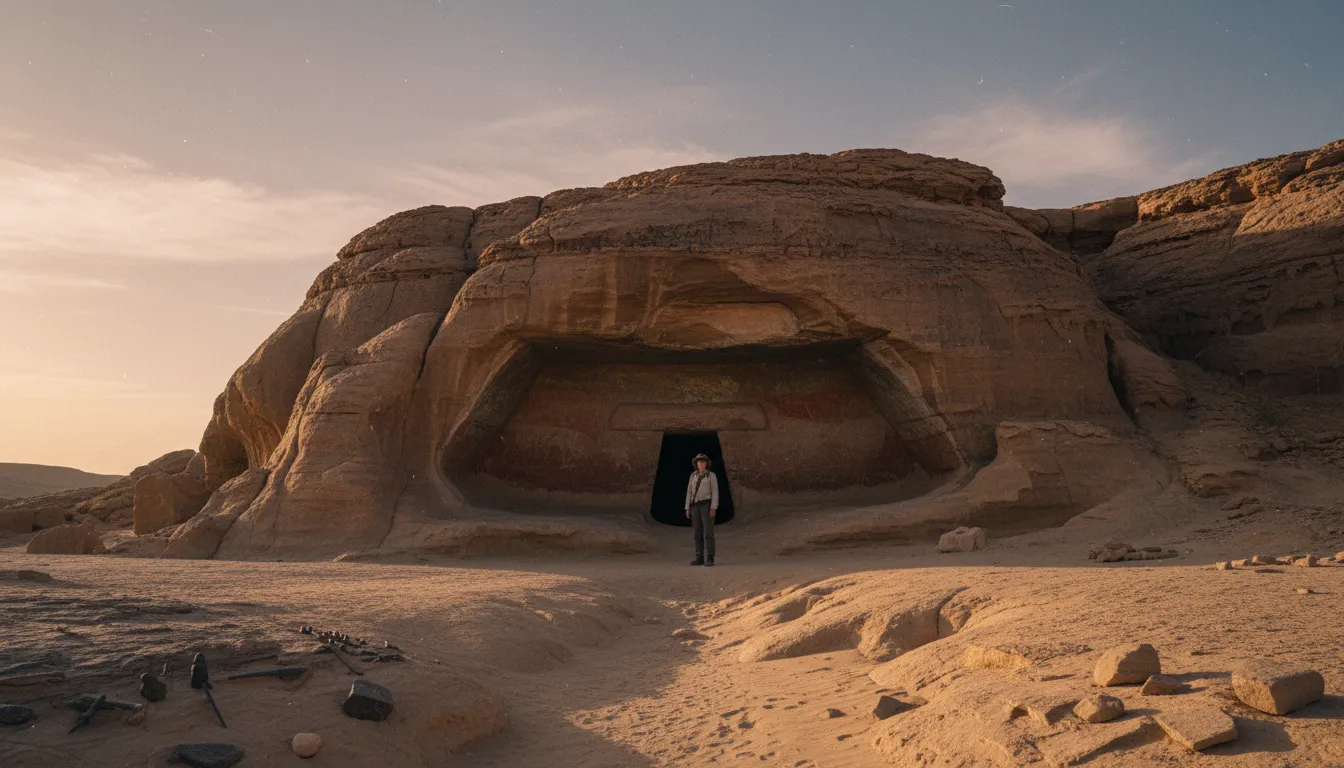
A Desert That Was Once Green
The Sahara Desert stretches across nearly nine million square kilometers of North Africa—an expanse of sand, rock, and extreme heat roughly the size of the United States. Yet as recently as 5,000 years ago, much of this landscape looked nothing like the barren wasteland visible on satellite imagery. Scientists call this vanished world the Green Sahara, and it represents one of the most dramatic climate transformations in Earth's recent history.
During a climate phase known as the African Humid Period, roughly 11,000 to 5,000 years ago, the Sahara was a patchwork of grasslands, shallow lakes, rivers, and wetlands. Hippos wallowed in its waterways. Crocodiles patrolled its rivers. Early human communities fished, herded cattle, and painted vivid scenes of their world on rock walls that still survive.
The Evidence Hidden in Stone and Bone
The proof comes from multiple scientific disciplines. At Tassili n'Ajjer, a mountain range in southeastern Algeria, more than 15,000 rock paintings and engravings depict elephants, giraffes, hippos, and people swimming—a stone library of an ecosystem that no longer exists. Sediment cores drilled from ancient lakebeds reveal layers of pollen from grasses and trees, while fossilized fish and crocodile remains confirm permanent water sources across what is now open desert.
More recently, researchers from the University of Oxford analyzed stalagmites from remote caves in southern Morocco. By measuring uranium and thorium isotopes in these mineral formations, they determined that between 8,700 and 4,300 years ago, massive weather systems called tropical plumes continuously drenched the region—the first evidence of their influence on rainfall in the northwestern Sahara.
What Made the Sahara Green
The primary driver is a slow wobble in Earth's rotational axis called precession. Over a cycle of roughly 21,000 years, this wobble changes the angle at which sunlight hits each hemisphere during different seasons. When the Northern Hemisphere tilts closer to the sun during summer, the land surface heats up more intensely, pulling the West African Monsoon further north and dragging heavy rains deep into what is now the Sahara.
But orbital mechanics alone did not create the Green Sahara. Vegetation amplified the effect through a powerful feedback loop: more rain meant more plants, darker surfaces absorbed more heat, which pulled in still more moisture. Dust levels dropped, further warming the surface. The system essentially tipped itself into a wet state.
Why It Vanished
Around 5,500 years ago, the orbital geometry began to reverse. Summer sunlight in the Northern Hemisphere weakened, and the monsoon retreated southward. What happened next remains debated. Some evidence suggests a gradual drying over roughly a thousand years. Other studies point to a far more abrupt collapse—possibly within one or two centuries.
The same feedback loop that created the Green Sahara now worked in reverse. As vegetation died, bare ground reflected more sunlight, cooling the surface and further weakening the monsoon. Less rain meant less vegetation, which meant even less rain. The system tipped into its current arid state.
Why It Matters Now
The Green Sahara is more than a curiosity from deep time. It demonstrates that Earth's climate can undergo rapid, dramatic shifts driven by feedback loops—a lesson directly relevant to understanding modern climate change. The drying also triggered one of the largest human migrations in prehistory, pushing populations toward the Nile Valley and potentially catalyzing the rise of ancient Egyptian civilization.
Recent DNA analysis of remains from the Takarkori rock shelter in Libya revealed that Green Sahara pastoralists belonged to a previously unknown North African genetic lineage that remained isolated for tens of thousands of years—a reminder that entire populations and ways of life vanished when the rains stopped.
As scientists continue probing caves, lakebeds, and ancient DNA, the Green Sahara keeps revealing new secrets about how quickly landscapes—and the civilizations that depend on them—can transform.