How Coral Bleaching Works—and Why Reefs Are Dying
Coral bleaching occurs when rising ocean temperatures break the symbiotic bond between corals and the algae that feed them, turning reefs white and threatening ecosystems that support a billion people worldwide.
A Partnership Under Stress
Coral reefs are among the most biodiverse ecosystems on Earth, yet they depend on a microscopic relationship most people never see. Inside the tissue of every healthy coral lives a population of tiny algae called zooxanthellae. These single-celled organisms photosynthesize sunlight into nutrients, supplying up to 90 percent of a coral's energy. In return, corals provide shelter and the carbon dioxide the algae need. This mutualism also gives reefs their vivid colours.
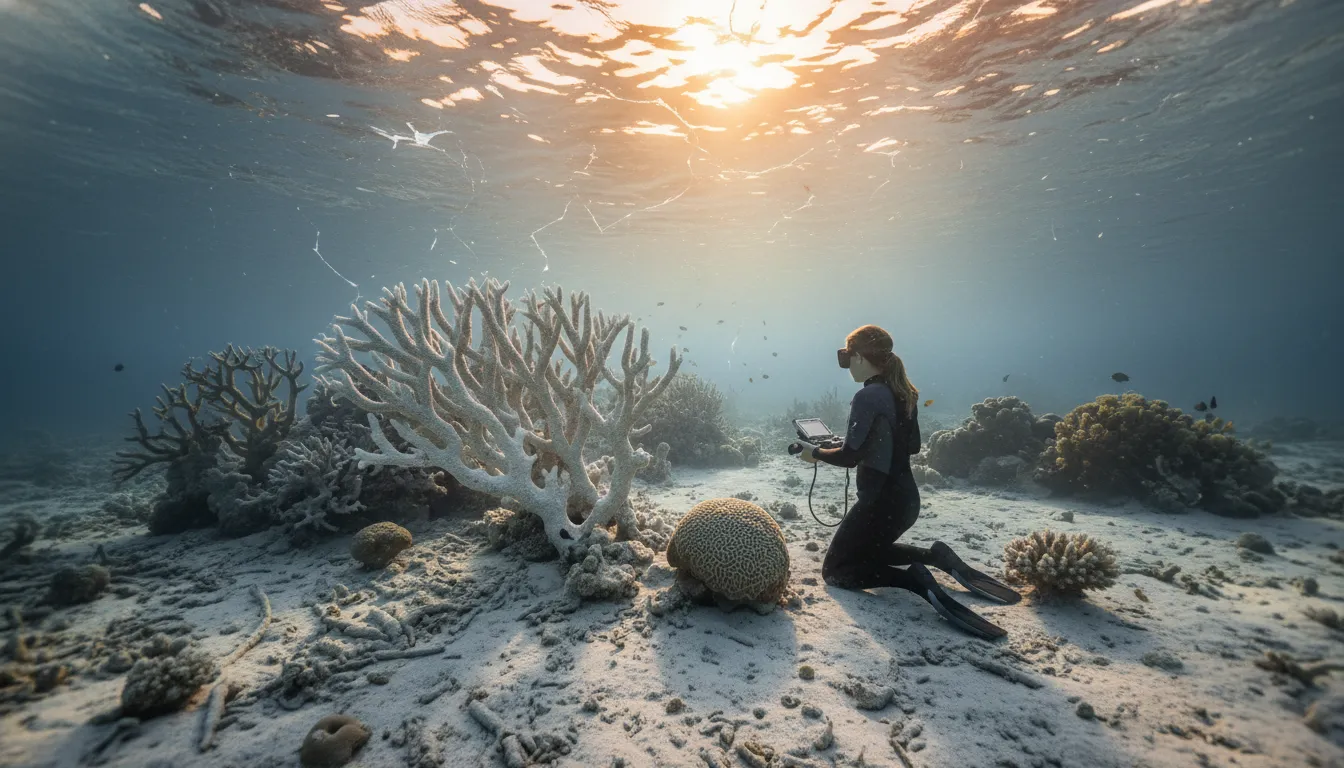
When ocean temperatures rise just 1–2 °C above the normal summer maximum for a sustained period, the relationship breaks down. Heat disrupts the algae's photosynthesis, causing them to produce reactive oxygen species—molecules that become toxic to the coral host. Faced with a partner turned harmful, the coral expels the algae from its tissue. Without them, the coral's white calcium-carbonate skeleton shows through. The reef has bleached.
Not Dead Yet—but Starving
Bleaching does not kill coral instantly. A bleached colony can survive for weeks by catching plankton and absorbing dissolved nutrients. If water temperatures drop in time, zooxanthellae can recolonise the tissue and the coral recovers. Research published by NOAA Fisheries shows that remote, well-protected reefs such as Palmyra Atoll have bounced back within two years of a bleaching event.
But recovery demands time that reefs increasingly do not have. According to James Cook University, full recovery typically takes 9 to 12 years—and that assumes no cyclone, disease outbreak, or repeat heat wave intervenes. On the Great Barrier Reef, the average gap between mass bleaching events has been cut in half since 1980, leaving less and less room for reefs to rebuild.
A Crisis at Global Scale
The planet has now experienced four global coral bleaching events—in 1998, 2010, 2014–2017, and a fourth that began in 2023 and became the most intense on record. Data from the International Coral Reef Initiative shows that 84 percent of the world's reefs were affected during the latest event, and more than 50 percent sustained measurable damage.
Over the past three decades, roughly half of the world's living coral cover has been lost. Even under the most optimistic Paris Agreement scenario—limiting warming to 1.5 °C—the UN Environment Programme projects that 70 to 90 percent of reef-building corals will die. At 2 °C of warming, that figure rises to 99 percent.
Why It Matters Beyond the Ocean
Coral reefs occupy less than one percent of the ocean floor, yet they support roughly 25 percent of all marine species. An estimated one billion people depend on them for food, income, and coastal protection. According to NOAA, reefs generate billions of dollars in annual economic value through fisheries, tourism, and shoreline defence—healthy reefs absorb up to 97 percent of a wave's energy, shielding coastal communities from storms and flooding.
In Australia alone, the Great Barrier Reef supports 77,000 full-time jobs and contributes an estimated $9 billion per year to the national economy. Globally, reef tourism brings in roughly $36 billion annually.
Can Anything Be Done?
Scientists are exploring several strategies: selective breeding of heat-tolerant coral strains, transplanting resilient species onto degraded reefs, and even experimenting with probiotics that help corals cope with thermal stress. Marine protected areas that limit overfishing and pollution have also been shown to improve reef resilience and speed recovery.
Yet researchers stress that no intervention can substitute for the most critical factor: reducing greenhouse gas emissions. As long as ocean temperatures keep climbing, bleaching events will grow more frequent and more severe, outpacing any restoration effort. The window for preserving the world's reefs is narrowing fast.