What Is the Strait of Hormuz and Why It Controls Global Oil
A narrow waterway between Iran and Oman, the Strait of Hormuz funnels roughly 20% of the world's oil supply — making it the single most consequential chokepoint in global energy markets.
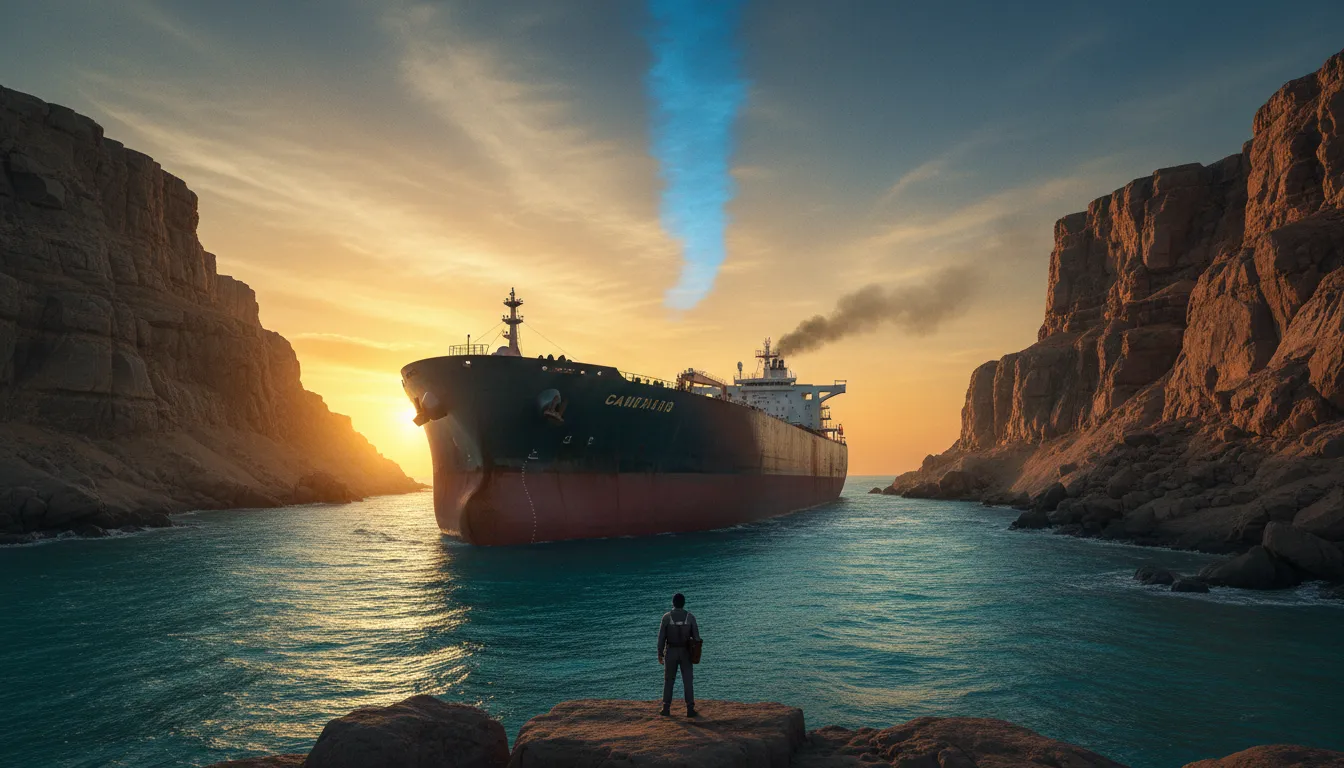
A Bottleneck the Size of a City
Squeeze a fifth of the world's entire oil supply through a passage barely 33 kilometres wide at its narrowest point, and you begin to understand why the Strait of Hormuz commands so much geopolitical attention. This sliver of water between Iran to the north and Oman to the south is not merely a shipping lane — it is the single most consequential energy chokepoint on Earth.
According to the U.S. Energy Information Administration (EIA), roughly 20 million barrels of oil per day flowed through the strait in 2024, equal to approximately 20% of global petroleum liquids consumption and more than one-quarter of all seaborne oil trade. A disruption here does not merely inconvenience a few refiners — it shocks prices worldwide within hours.
Geography: Why It Is So Hard to Replace
The strait connects the Persian Gulf — home to the world's largest proven oil reserves — to the Gulf of Oman and, from there, the open Indian Ocean. The Strauss Center at the University of Texas notes that the UN's International Maritime Organization designates just two two-mile-wide shipping lanes inside the strait: one inbound, one outbound, with a buffer zone between them. Supertankers must thread through these corridors one at a time.
Iran controls the northern shore; Oman controls the southern shore via its Musandam Peninsula, a small exclave that juts into the water. Both countries' territorial waters technically overlap the strait, meaning no vessel can legally transit without entering the jurisdiction of at least one of them — a geographic reality that gives Iran enormous leverage.
Who Depends on It?
The overwhelming majority of oil leaving the Persian Gulf has no practical alternative route. The EIA reports that 84% of crude oil passing through Hormuz in 2024 went to Asian markets. China, India, Japan, and South Korea together absorbed 69% of all Hormuz crude flows, making Asia's economic engine almost entirely reliant on this single passage. Saudi Arabia alone accounted for 38% of those flows — around 5.5 million barrels per day.
The strait also carries roughly one-fifth of the world's liquefied natural gas (LNG) trade, primarily from Qatar, which has no overland export route and depends entirely on maritime shipping.
The United States, by contrast, imports very little directly through Hormuz today — thanks to domestic shale production, just 7% of US crude imports transited the strait in 2024, according to the EIA. Yet a Hormuz closure would still devastate American consumers indirectly, because global oil is priced on a single interconnected market: when supply tightens anywhere, prices rise everywhere.
Why Closing It Is Harder Than It Sounds
Iran has threatened to close the strait repeatedly over the past four decades. In practice, a full closure is extraordinarily difficult to sustain. The strait is wide enough that tankers can navigate outside the designated shipping lanes, and the depth — between 60 and 100 metres across much of its width — means laying effective minefields takes time and resources. The Encyclopædia Britannica notes that the depth and breadth of the waterway make prolonged disruption challenging even for a well-armed regional power.
The United States Navy's Fifth Fleet, headquartered in Bahrain, exists in large part to guarantee freedom of navigation through the strait. Multiple allied navies conduct escort and surveillance operations in the region.
Alternative Routes: Too Little, Too Late
Only two pipeline bypasses exist. Saudi Arabia's East-West pipeline can carry up to 7 million barrels per day to the Red Sea port of Yanbu — well short of the 20 million barrels that normally pass through Hormuz. The UAE operates a 1.5-million-barrel-per-day pipeline to Fujairah on the Gulf of Oman. Together, these alternatives cover at most 40% of normal Hormuz throughput, leaving a massive gap that no existing infrastructure can fill quickly.
A History of Tension
The most serious historical episode was the Tanker War of the 1980s, when Iran and Iraq both attacked oil tankers in the Persian Gulf during their decade-long conflict, prompting the United States to escort Kuwaiti tankers under American flags. Iran has since seized foreign vessels, harassed commercial ships with armed speedboats, and threatened to mine the strait — typically as leverage during diplomatic standoffs over its nuclear programme or US sanctions.
Each episode sends a reminder that the modern global economy rests, in part, on the safe passage of tankers through a corridor barely wider than a mid-sized city's commute.
Why It Will Keep Mattering
Even as renewable energy expands, global oil demand is not expected to peak until the late 2020s or early 2030s. For the foreseeable future, the Strait of Hormuz remains what analysts call a single point of failure for world energy markets — a place where geography, geopolitics, and economics converge in a strip of water that most people could not find on a map, yet whose stability affects the price they pay at the pump.