How China's National People's Congress Works
China's National People's Congress is the world's largest legislative body, yet few outside China understand how it actually functions, who sits in it, and what role it plays in a one-party state.
The World's Biggest Legislature You've Never Heard Of
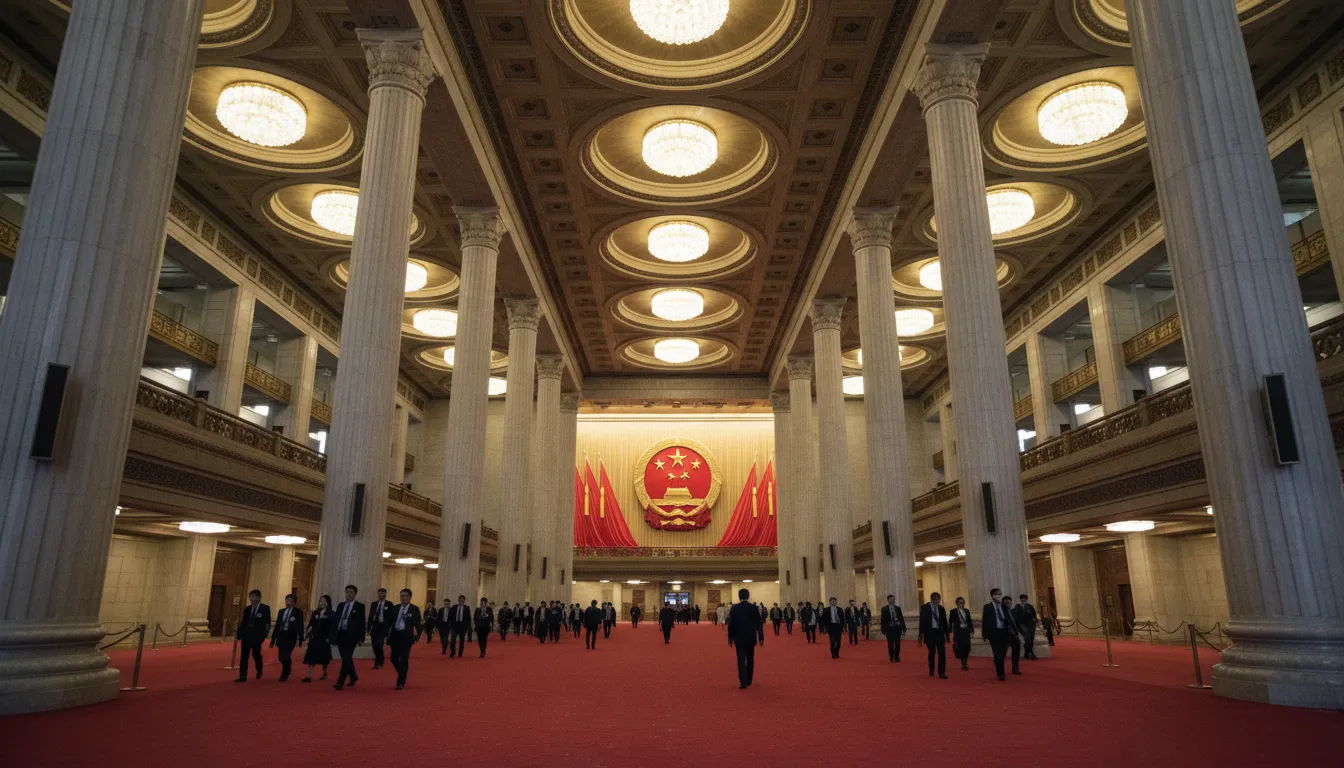
Every spring, nearly 3,000 delegates converge on Beijing's Great Hall of the People — a colossal building flanking Tiananmen Square — for one of the most consequential political gatherings on the planet. The National People's Congress (NPC) is formally China's supreme organ of state power, the apex of its legislative system, and the largest parliamentary body in the world. Yet for most outsiders, it remains opaque, often dismissed as a formality. The reality is more nuanced.
What Is the NPC?
Established in 1954 under China's first constitution, the NPC is enshrined as the highest authority of the People's Republic of China. On paper, it outranks every other institution — the president, the State Council (cabinet), the military commission, and the courts all formally answer to it. In practice, it operates within a political framework where the Chinese Communist Party (CCP) holds a constitutionally guaranteed leading role.
The NPC's roughly 2,977 deputies (as of the 14th NPC, elected in 2023) are drawn from 35 electoral units: China's 31 provinces, autonomous regions, and municipalities directly under central government; the People's Liberation Army; and special bodies representing Hong Kong and Taiwanese compatriots. Delegates serve five-year terms and are chosen through a tiered indirect election system — local congresses elect provincial ones, which in turn elect NPC delegates. Around 70 percent of delegates are CCP members, according to research from Harvard's Ash Center.
What Powers Does the NPC Hold?
The NPC's formal powers are sweeping. According to China's constitution and analysis by the Congressional-Executive Commission on China, the body can:
- Amend the national constitution
- Enact and repeal basic laws (criminal, civil, and state organ legislation)
- Elect and remove the president and vice president
- Approve the premier nominated by the president
- Ratify the national budget and economic development plans
- Authorize declarations of war and states of emergency
In short, it holds all the powers a parliament anywhere might hold — at least on paper.
The Standing Committee: Where Real Work Happens
Because the full NPC convenes for only 10 to 14 days per year, the bulk of legislative work falls to its permanent body: the Standing Committee of the NPC (NPCSC). With roughly 170 members, the NPCSC meets every two months and enacts the majority of China's laws between full NPC sessions. As NPC Observer, a specialist research platform, explains, the Standing Committee also interprets the constitution and supervises government ministries.
Is the NPC Really Just a Rubber Stamp?
The "rubber stamp" label is common in Western commentary — and it has real basis. Votes on major legislation routinely pass with approval rates above 90 percent. The CCP controls the nomination process at every level, meaning no genuine opposition exists within the chamber. Laws are not debated between rival parties as in Westminster or US-style systems.
But scholars caution against treating the NPC as purely ceremonial. As Harvard's Tony Saich notes, major legislation can take years to draft and may be shelved if significant disagreement emerges among delegates or state bodies. The process involves extensive consultation across ministries, local governments, and expert committees before a vote is ever held. Occasionally, bills have been amended or delayed in response to NPC feedback — a form of constrained deliberation within a one-party framework.
The East Asia Forum describes the NPC's role as part of China's "party-state constitutionalism" — a system where constitutional forms lend legitimacy to CCP rule, while the party retains ultimate authority over outcomes.
The Two Sessions: A Broader Political Moment
The NPC annual gathering is always held alongside the Chinese People's Political Consultative Conference (CPPCC), an advisory body representing various social groups and political parties outside the CCP. Together, the two meetings are known as the Lianghui, or "Two Sessions." This joint event, typically held in early March, is China's primary annual political showcase — the moment when economic growth targets, budget priorities, and major policy directions are announced to the nation and the world.
Why It Matters Globally
When the NPC approves China's GDP growth target or endorses a new five-year economic plan, markets from Tokyo to Frankfurt react. When it passes national security legislation — as it did for Hong Kong in 2020 — international consequences follow swiftly. Understanding the NPC's mechanics is not an academic exercise; it is essential context for anyone tracking global trade, geopolitics, or technology policy in the twenty-first century.