China Hits Japan With Export Curbs Over Military Buildup
Beijing has restricted exports of rare earth elements and dual-use goods to 40 Japanese entities, citing Tokyo's accelerating military expansion and Prime Minister Sanae Takaichi's remarks on Taiwan — the latest flashpoint in a deepening bilateral rift.
A New Front in the China-Japan Rivalry
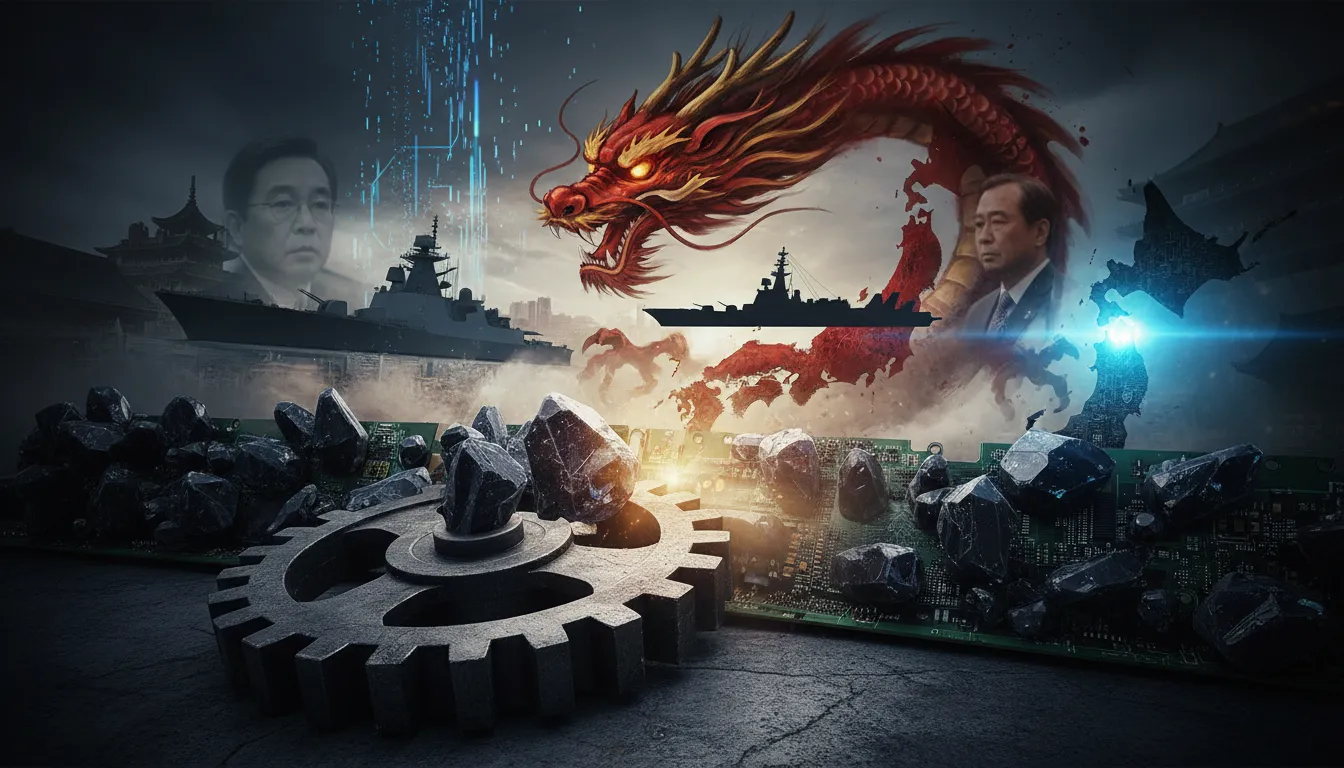
China has imposed sweeping export controls on 40 Japanese companies and institutions, cutting off access to rare earth elements and dual-use materials it says are fueling Japan's military resurgence. The move, announced by China's Ministry of Commerce on February 25, marks a significant escalation in one of Asia's most consequential geopolitical rivalries.
The restrictions target items applicable to both civilian and military manufacturing — including rare metals such as tungsten, tellurium, bismuth, dysprosium, yttrium, and samarium, which are critical inputs for aircraft, weapons systems, semiconductors, and electric vehicles. China controls a dominant share of global rare earth supply, giving it outsized leverage over trading partners.
Who Is Affected — and How
Beijing divided the 40 affected entities into two tiers. Twenty companies — including divisions of Mitsubishi Heavy Industries, Kawasaki Heavy Industries' aerospace arm, Fujitsu, and the National Defense Academy of Japan — were placed on a strict export prohibition list, barred outright from receiving dual-use goods from China.
A further 20 entities, among them Subaru, Eneos, TDK, and affiliates of major trading houses Itochu, Sumitomo, and Mitsui, were added to a watchlist requiring enhanced export license scrutiny before any shipments can proceed.
Markets reacted sharply. In Tokyo, Fujitsu shares fell 9%, NEC dropped 6%, and several defense contractors slid between 3% and 6%. Analysts noted, however, that many affected companies hold substantial rare earth stockpiles, which could buffer short-term disruptions.
The Political Trigger
The restrictions are explicitly political. China's commerce ministry stated the measures aim to curb Japan's "remilitarization and nuclear ambitions," calling them "entirely legitimate, reasonable, and legal."
The flashpoint traces to November 2025, when Prime Minister Sanae Takaichi suggested Japan could intervene militarily if China used force against Taiwan — a statement that infuriated Beijing. Takaichi has since won a landslide election mandate, deepening China's alarm. Under her leadership, Japan is accelerating plans to double defense spending to 2% of GDP, a historic shift for a country bound by a pacifist postwar constitution.
According to Ryo Sahashi, a professor at the University of Tokyo, the export curbs represent "a check against the Japan–U.S. relationship and at Japan's additional defense efforts," reflecting China's determination to apply economic pressure as a deterrent against Tokyo's strategic pivot.
Tokyo Pushes Back — But Has Little Leverage
Japan's response was swift and firm. Deputy Chief Cabinet Secretary Masaaki Kanai called the measures "completely unacceptable and extremely regrettable," adding that they "deviate from international practices" and demanding their immediate withdrawal. Tokyo formally protested through diplomatic channels, summoning China's Deputy Chief of Mission.
Yet Japan's options are constrained. China remains Japan's largest trading partner, and the two economies are deeply intertwined. The restrictions expose a structural vulnerability Tokyo has long sought to reduce but struggled to address: its dependence on Chinese critical minerals.
A Warning Signal for the Region
The move follows a pattern Beijing has used before — restricting exports of gallium and germanium to pressure the United States and Europe over semiconductor policy. Applying the same playbook to Japan suggests China is growing more willing to weaponize its supply chain dominance in pursuit of strategic goals.
With the U.S.-Japan alliance deepening, Taiwan tensions unresolved, and Japan's rearmament accelerating, analysts warn the bilateral relationship is entering a more confrontational phase — one where economics and security are increasingly inseparable.