Czech Republic Sees Growth, But 40% of Households Struggle to Afford Basic Expenses
A new survey reveals that forty percent of Czech households are struggling to cover basic monthly expenses, despite the Czech economy being among the healthiest in the EU. President Pavel has warned against isolation following the examples of Hungary and Slovakia.
Economic Paradox: Rising Wages, Rising Worries
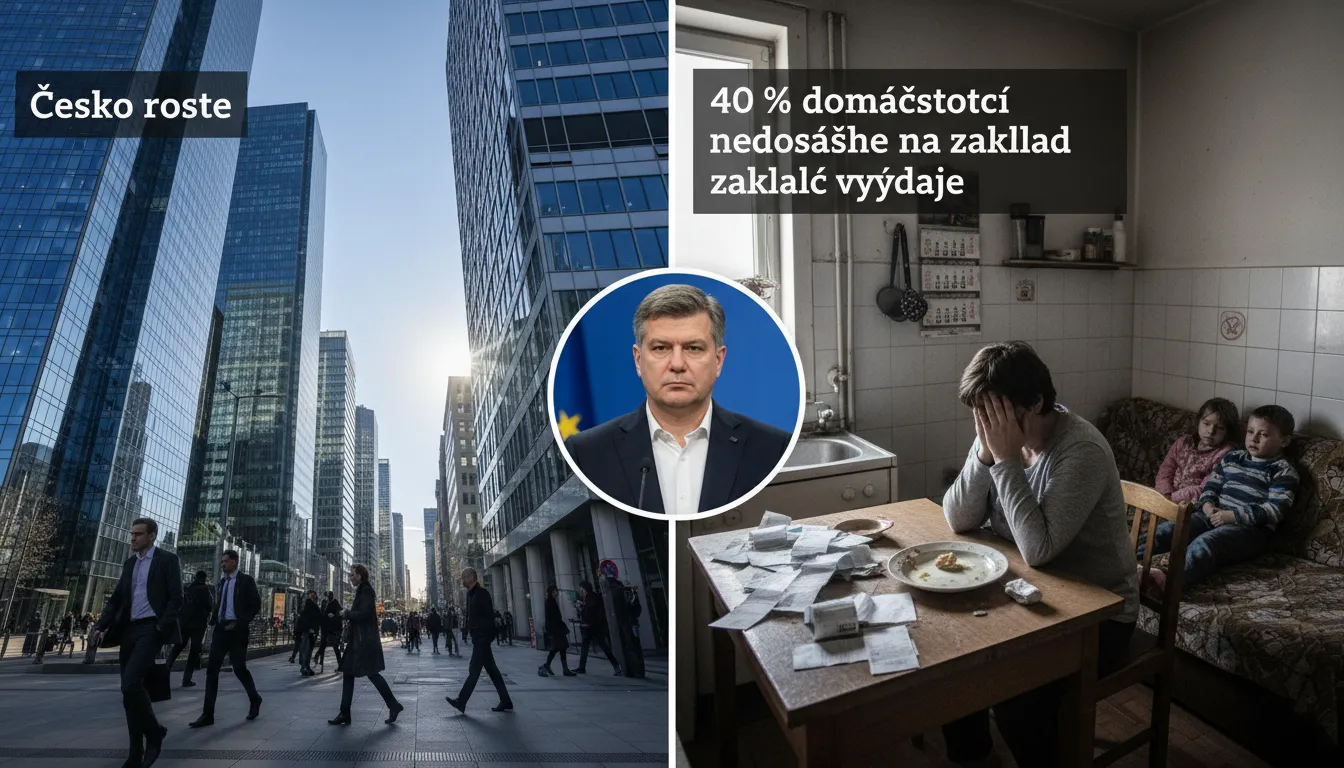
The Czech economy is showing healthy figures. Gross domestic product grew by 2.5 percent in 2025, and real wages are projected to grow at a rate of 2.7 percent in 2026 — one of the fastest in the entire European Union. Yet, a new survey paints a worrying picture: forty percent of Czech households are struggling to cover basic monthly expenses. This paradox is becoming a key topic in the pre-election debate.
Who is Struggling the Most?
Single parents and seniors living alone are the worst off. According to data from PAQ Research and Czech Radio, as many as 62 percent of seniors living alone live below the European income poverty line — compared to the EU average of 28 percent. For single parents, the proportion of households in poverty ranges from around 36 to 43 percent. Approximately a quarter of all Czech households can only afford to buy basic foodstuffs.
The main causes are rising housing and energy costs. Housing costs have risen by 6.7 percent year-on-year, with households in rented apartments spending an average of a third of their income on housing. For the most vulnerable groups, the proportion of housing expenditure can exceed 40 percent of total income. Paradoxically, only six percent of eligible households receive housing benefits, even though a third of all households are entitled to them.
Healthy Economy, Uneven Benefits
The Czech Republic ranks among the healthiest economies in the European Union — in a recent assessment, it occupied approximately eighth place out of twenty-seven member states. The Ministry of Finance forecasts economic growth of around 2.2 percent in 2026. Real wages are expected to increase by 2.7 percent; only Hungary plans a higher rate in the entire EU.
Yet, the fruits of this growth are not being shared equally. The wealth gap is widening: while part of society is improving, vulnerable groups — renters, single-parent families, and even part of the middle class — are lagging behind. Economists warn that real wages have not yet made up for the losses caused by the inflationary wave of 2021 to 2023.
Pavel: A Path Like Hungary's Leads to a Dead End
Against the backdrop of these social tensions, President Petr Pavel issued a warning of a geopolitical nature. In a debate on the Czech Republic's foreign policy orientation, he stressed that the country faces a fundamental choice: either it remains an active and reliable partner within the European Union, or it slides into international isolation. He cited Hungary and Slovakia as cautionary examples, whose departure from pro-European policies has led to a loss of influence and diplomatic capital in Brussels.
At the Visegrad Group summit in Hungary, Pavel called for active involvement in EU affairs and warned against extreme positions on both sides. "We are willing to come up with constructive proposals on how to solve these problems more effectively," the President said at the time. Experts also point out that the Czech Republic cannot afford to be placed in the same category as Budapest and Bratislava — the risk of losing influence in EU negotiations is real.
Social Disparities as an Election Theme
The connection between economic inequality and the question of foreign policy orientation paints a complex field on which the Czech political debate will take place in the coming months. The frustration of households struggling with housing and energy costs creates fertile ground for populist promises and Eurosceptic sentiments — exactly the type of politics that Pavel warns against.
Managing this equation — sharing economic optimism with as many Czechs as possible while maintaining a pro-European course — remains arguably the biggest challenge for Czech politics in 2026.