"El Mencho" Killed: Mexico Paralyzed by 252 Roadblocks
The Mexican army killed Nemesio "El Mencho" Oseguera, leader of the CJNG cartel, on February 22, triggering 252 roadblocks in 20 states and more than 70 deaths in Mexico's biggest security crisis in decades.
The Operation That Shook Mexico
Sunday, February 22, 2026, will be etched in Mexico's recent history as one of its most violent days. Special Forces of the Mexican Army killed Nemesio Oseguera Cervantes, "El Mencho", founder and leader of the Jalisco New Generation Cartel (CJNG), during an operation in the mountains of Tapalpa, Jalisco, 130 kilometers south of Guadalajara. The 59-year-old kingpin died while being transported by helicopter to Mexico City. The operation, in which seven cartel members lost their lives, had intelligence support from the United States, which had offered up to $15 million for information leading to his capture.
Nationwide Retaliation: 252 Roadblocks in 20 States
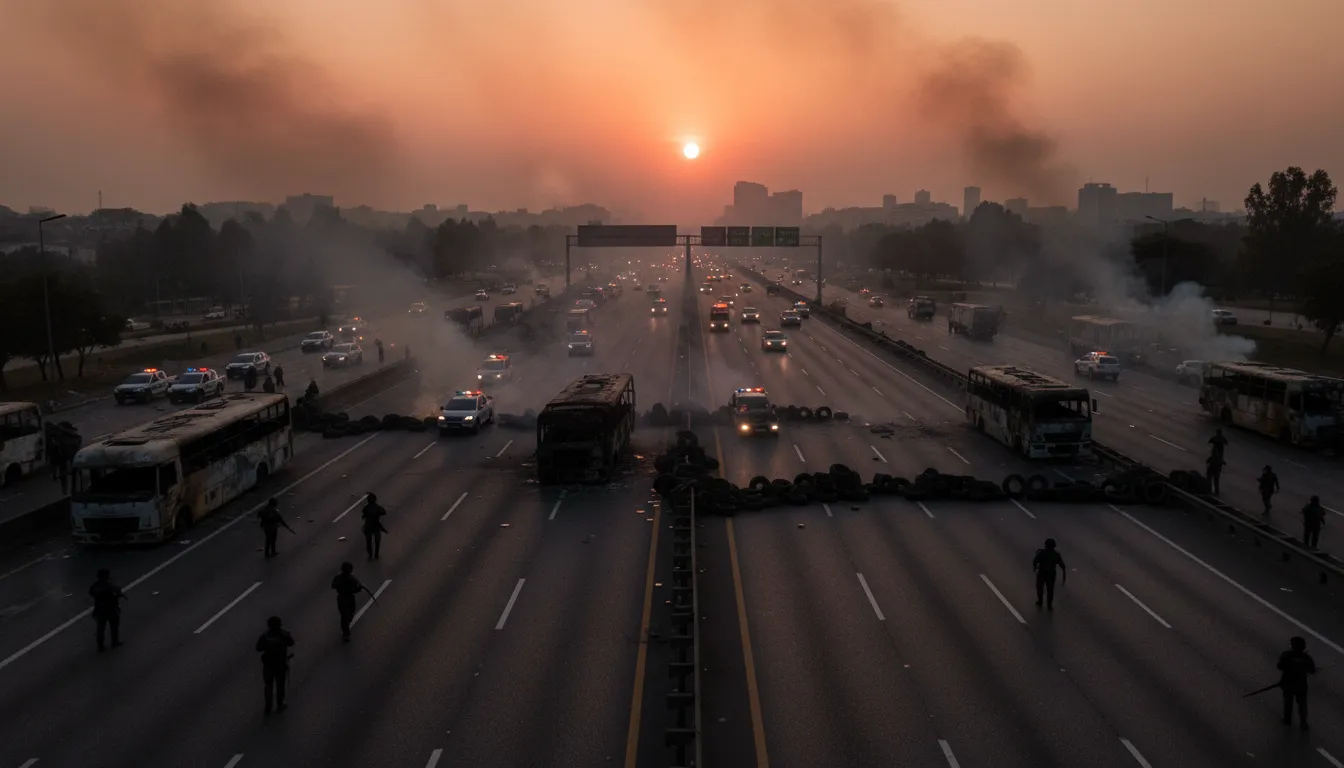
Within hours, the CJNG activated an unprecedented contingency plan. The Secretary of Public Security, Omar García Harfuch, confirmed 252 simultaneous narco-blockades in 20 states, with 65 road closures in Jalisco alone. Burning vehicles, shootings, explosions, and attacks on gas stations and businesses paralyzed the west of the country and spread to Michoacán, Guanajuato, Tamaulipas, Guerrero, Oaxaca, Zacatecas, Baja California, and Veracruz. Several states suspended classes on February 23; airlines such as Air Canada canceled flights, and the governments of the United States and Canada issued travel alerts.
The total death toll exceeded 70: at least 27 security agents, more than 40 alleged cartel members, and at least one civilian died between the operation and the subsequent riots. About 70 people linked to the CJNG were arrested. The number of casualties made the day the deadliest on record in clashes with security forces in Mexico.
The Power Vacuum and the Battle for Succession
Unlike other Mexican cartels, the CJNG had never faced a succession process: since its founding, "El Mencho" exercised centralized and vertical leadership. Analysts at Animal Político identify at least five internal candidates: Juan Carlos Valencia González ("El 03"), the kingpin's stepson and responsible for money laundering; Audias Flores Silva ("El Jardinero"), who controls the cartel's largest territory in six states; and Hugo Gonzalo Mendoza Gaytán ("El Sapo"), in charge of the production of drugs and chemical precursors.
The scenarios range from an orderly transition—considered unlikely—to total fragmentation into multiple rival groups, similar to what happened with the Sinaloa Cartel. Vanda Felbab-Brown, a researcher at the Brookings Institution, told Al Jazeera that the violence could last "for months and potentially years" as the criminal landscape is reorganized. Several experts recall that the strategy of "decapitating" cartels applied during the government of Felipe Calderón (2006-2012) led to more violent fragmentation without interrupting drug trafficking.
Regional Consequences: Latin America on Alert
The impact of the fall of "El Mencho" transcends Mexican borders. The CJNG operated extensive cocaine production and transit networks in Colombia and Ecuador; its destabilization could reconfigure routes and alliances throughout the region. In Ecuador, where the cartel maintained pacts with the Los Choneros gang, the dispute for control of the ports could intensify if the Sinaloa Cartel tries to take advantage of the vacuum, according to analysis by Al Jazeera. Spain, one of the CJNG's main entry points into Europe, and several Latin American governments are closely monitoring the evolution of the crisis.
A Historic Milestone with Open Uncertainty
The elimination of the world's most wanted drug trafficker represents a symbolic and operational blow of great magnitude for the Mexican State and for bilateral cooperation with Washington. However, history warns that dismantling the leadership of a cartel without destroying its financial and territorial infrastructure rarely leads to lasting peace. Mexico celebrates a historic achievement while holding its breath for what may come.