Who Are the Tuareg—and Why Do They Keep Rebelling?
The Tuareg, Sahara's nomadic 'blue people,' have launched at least five major rebellions since 1916. Their fight for autonomy in northern Mali reveals a cycle of marginalization, uprising, and broken peace deals that keeps repeating.
Nomads of the Sahara
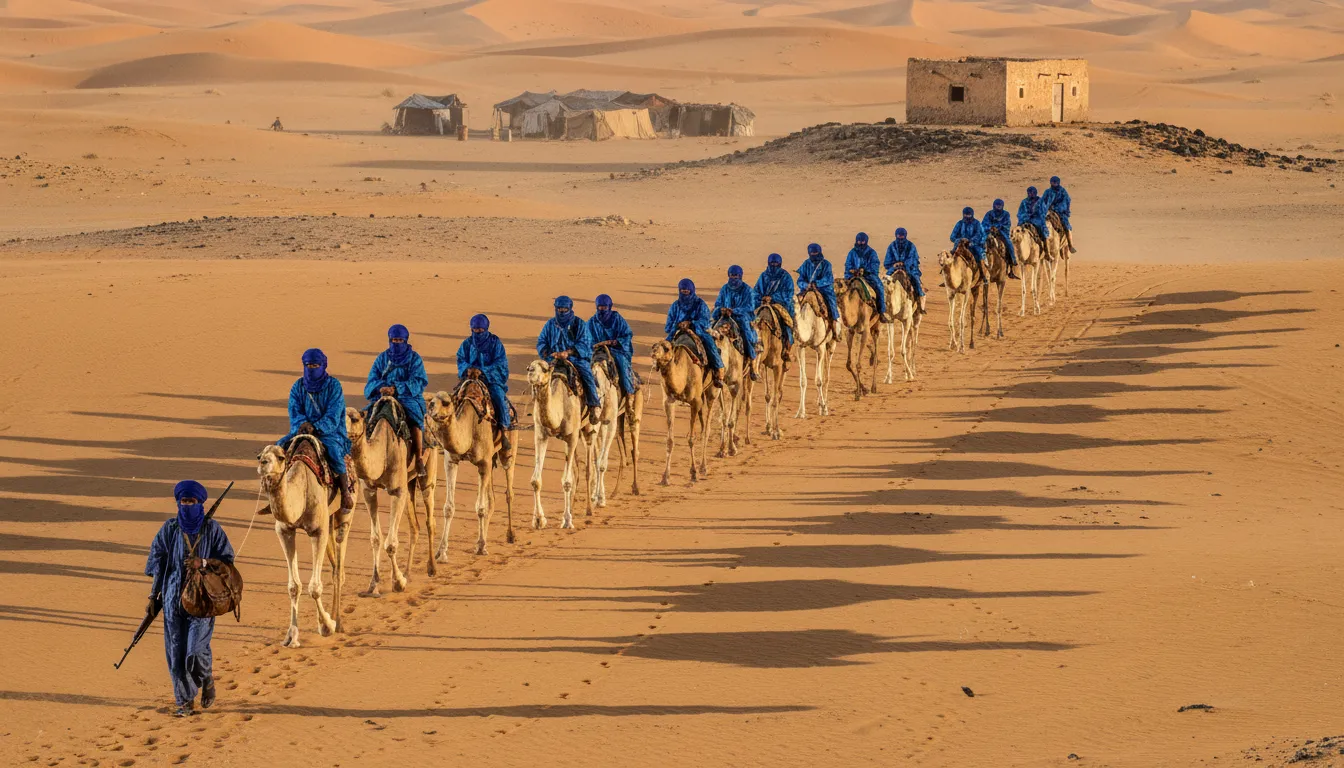
The Tuareg are a Berber-descended, predominantly Muslim people who have roamed the Sahara and Sahel for centuries. Numbering more than two million, they inhabit a vast territory that sprawls across five modern nations: Mali, Niger, Algeria, Libya, and Burkina Faso. They call themselves the Kel Tamasheq—"those who speak Tamasheq"—and their culture is strikingly distinct from that of their southern neighbors.
Tuareg society is largely matrilineal: lineage and inheritance pass through the mother's side, and women enjoy social freedoms unusual in the wider Sahel. Men, not women, wear veils—the iconic indigo-dyed tagelmust that stains the skin blue, earning them the nickname "blue people of the desert." For generations, Tuareg caravans controlled lucrative trans-Saharan trade routes linking sub-Saharan gold and salt to Mediterranean markets.
A Homeland Divided by Colonial Borders
When France carved up West Africa in the colonial era, the Tuareg's sprawling homeland was sliced among several territories. After Mali gained independence in 1960, the new government in Bamako—dominated by southern agricultural communities—had little interest in the aspirations of northern nomads. The Tuareg found themselves a marginalized minority within states they had never chosen to join.
The region the Tuareg claim as their own is called Azawad, a territory in northern Mali roughly the size of France. It is largely desert, sparsely populated, and has received minimal state investment in infrastructure, healthcare, or education. This neglect forms the core grievance behind every Tuareg uprising.
A Cycle That Keeps Repeating
The Tuareg have launched at least five major rebellions: in 1916–17 (the Kaocen revolt against French rule), 1962–64, 1990–95, 2006–09, and 2012. Each followed a remarkably similar pattern, described by researchers at the University of Florida's Sahel Research Group as a "cyclical loop."
The cycle works like this: grievances build over years of economic neglect and broken promises. An armed rebellion erupts. The Malian government, lacking the military strength to hold the north permanently, agrees to a peace deal that promises autonomy, development funds, and integration of Tuareg fighters into the national army. Then the government fails to implement most provisions—often citing a lack of resources. Frustration grows, a new generation of fighters organizes, and the cycle begins again.
The 2012 Turning Point
The most dramatic rebellion came in 2012, when the National Movement for the Liberation of Azawad (MNLA) launched a full-scale war. Many of its fighters were Tuareg veterans who had served in Muammar Gaddafi's Libyan army and returned home heavily armed after his fall in 2011. Within weeks, the MNLA overran the entire north and declared Azawad an independent state on April 6, 2012.
But the MNLA's victory was short-lived. Jihadist groups—including Ansar Dine and al-Qaeda in the Islamic Maghreb—hijacked the rebellion, imposing harsh sharia law and pushing the secular Tuareg aside. France intervened militarily in January 2013 to halt the jihadist advance toward Bamako. The MNLA eventually renounced its independence claim and entered negotiations.
Why the Grievances Never Fade
Several structural factors keep the Tuareg conflict alive. Climate change and desertification have devastated the pastoral economy that sustains northern communities. The Sahel droughts of the 1970s and 1980s drove thousands of young Tuareg men to seek work and military training in Libya, according to the Climate Diplomacy initiative—creating a generation of experienced fighters.
Meanwhile, jihadist organizations like Jama'at Nusrat al-Islam wal-Muslimin (JNIM), al-Qaeda's main Sahel affiliate formed in 2017, have exploited the same governance vacuum. JNIM now operates across Mali, Niger, and Burkina Faso, often competing and sometimes cooperating with Tuareg armed groups. The presence of Russian Africa Corps mercenaries, who replaced French forces, has added yet another layer of complexity.
The Algiers Accord of 2015, the most recent major peace deal, promised decentralization and development for the north. A decade later, most of its provisions remain unimplemented. For the Tuareg, this is a familiar story—and one that virtually guarantees the cycle will continue.