Hormuz Crisis Sends Oil Soaring, Markets Into Freefall
The near-shutdown of the Strait of Hormuz following US-Israeli strikes on Iran has sent Brent crude past $80 a barrel and triggered the worst Asian market crash since 2008, threatening to upend the global economy.
A Chokepoint Under Siege
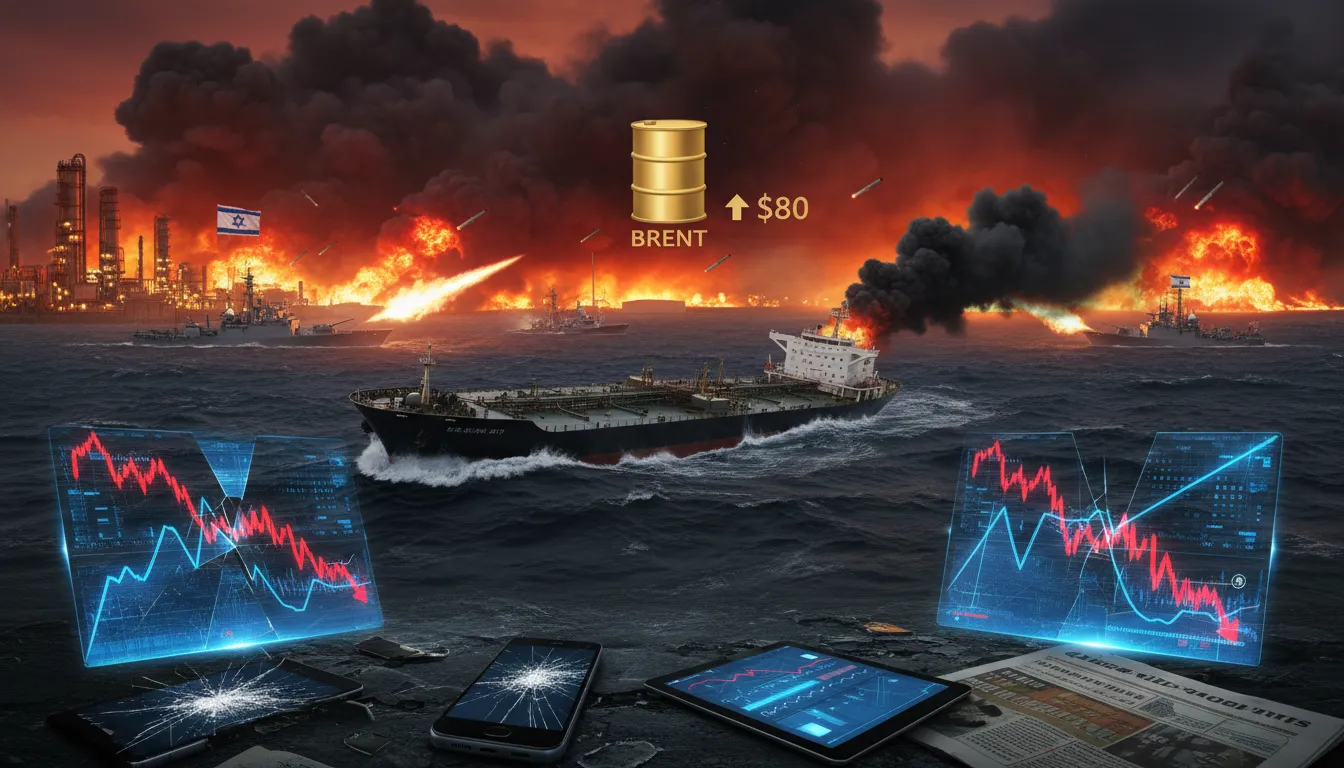
The world's most critical oil shipping lane is effectively closed for business. Since the United States and Israel launched coordinated strikes on Iran on February 28, 2026, Iran's Islamic Revolutionary Guard Corps has issued warnings prohibiting vessel passage through the Strait of Hormuz — and the threats are being taken seriously. Tanker traffic through the strait has dropped by as much as 80 to 100 percent, with more than 150 vessels anchored outside the waterway to avoid the risk of attack, according to maritime intelligence analysts.
The consequences are already reverberating across global energy and financial markets. The strait is the world's single most important oil chokepoint, carrying roughly one-fifth of all globally consumed oil as well as large volumes of liquefied natural gas (LNG). Insurance companies have begun withdrawing war-risk protection for vessels transiting the region, effectively enforcing a commercial blockade even before military orders do.
Oil Prices Surge Toward $100
Brent crude, the international benchmark, has surged more than 15 percent in just days, climbing above $80 per barrel — up from near $70 before the conflict began. West Texas Intermediate (WTI) climbed 6.76% to $71.55 per barrel. Analysts at Oxford Economics warn that prices could hit $100 per barrel or more if the disruption extends beyond weeks.
For American drivers, the impact is already visible at the pump. The price of gasoline recorded its largest one-day increase since 2005, with forecasters warning that the national average, expected to be $2.90 per gallon this year, could spike to $3.50 per gallon by summer. The Federal Reserve, which had been widely expected to cut interest rates in late March, is now seen as far less likely to act: market expectations for a cut have collapsed from 80 percent to near zero.
Asia Bears the Brunt
The region most exposed to a Hormuz shutdown is Asia. China, India, Japan, and South Korea together account for nearly 70 percent of all oil shipments through the strait. Qatar's LNG exports — critical to both European and Asian buyers — have also been severely disrupted, leaving major importers scrambling for alternative suppliers.
The panic was most visible in South Korea. The country's Kospi index plunged approximately 12 percent on Wednesday, triggering emergency circuit breakers on both the Kospi and the tech-heavy Kosdaq, in what Bloomberg described as the worst two-day crash since the 2008 global financial crisis. Broader Asian losses were severe: Japan's Nikkei 225 fell 3.9%, Hong Kong's Hang Seng lost 2.8%, and Taiwan's Taiex shed 3.4%. The MSCI Asia Pacific Index slumped more than 4 percent overall.
European markets were not spared. Germany's DAX fell 2.5%, France's CAC lost 2.2%, and the pan-European Stoxx 600 closed down 1.7%, according to ING Think.
No Exit in Sight
Iran's top national security official vowed that Tehran "will not negotiate with the United States," signaling that a diplomatic resolution is not imminent. The conflict has entered its fourth day with no ceasefire in sight, and President Trump has signaled the campaign could become an extended operation.
Economists are warning that a prolonged Hormuz shutdown could push inflation back above central bank targets in multiple countries, unraveling years of post-pandemic price stabilization. For the global economy, the message from markets is unambiguous: this is the biggest energy shock since Russia's invasion of Ukraine in 2022 — and it may be just beginning.