Slovakia Repatriates Citizens from the Middle East
More than five thousand Slovak citizens are stranded in the Middle East following the outbreak of war between the US, Israel, and Iran. The Slovak government is organizing evacuation flights from Jordan and Egypt in cooperation with the Czech Republic, while the closure of the Strait of Hormuz is driving up fuel prices in Slovakia.
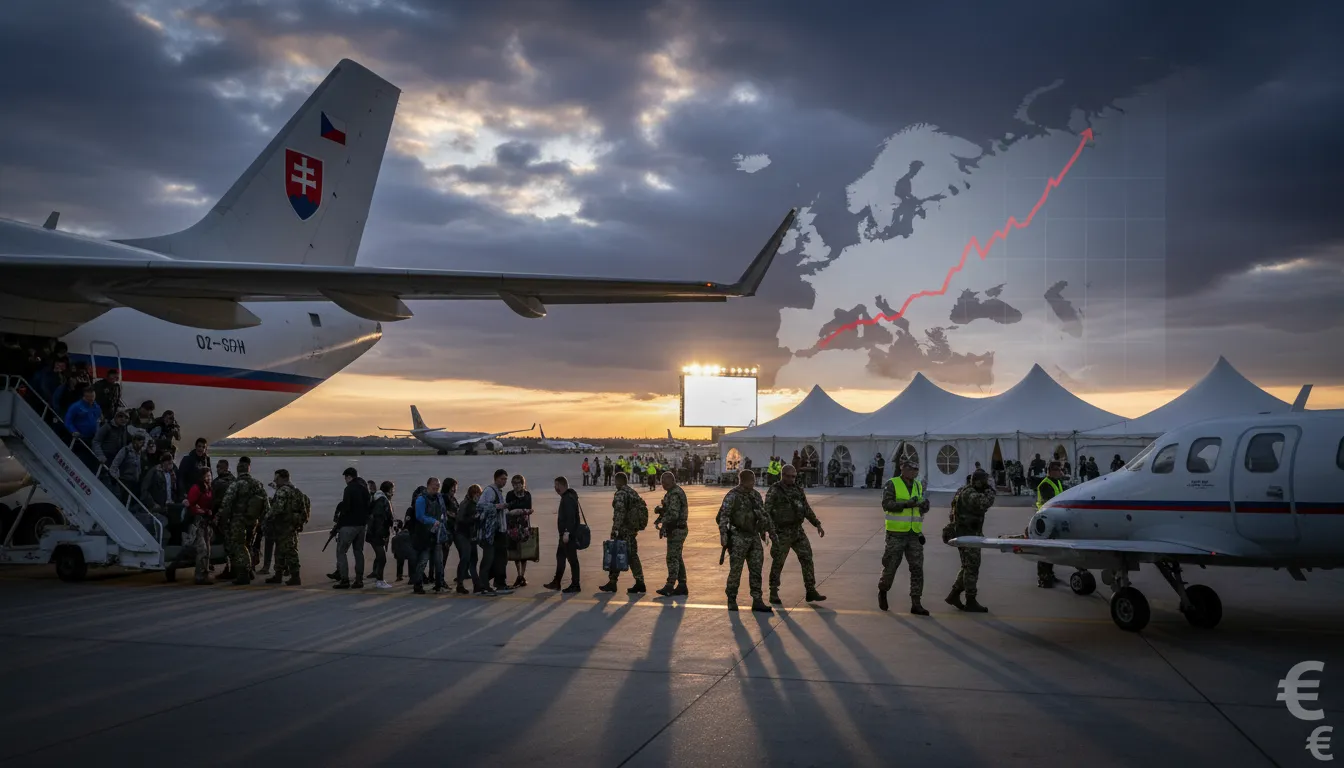
Thousands of Slovaks Stranded in Conflict Zone
More than five thousand Slovak citizens are stranded in Middle Eastern countries after an armed conflict erupted between the United States, Israel, and Iran on February 28, 2026. Coordinated US and Israeli air strikes on Iranian military targets – including the capital Tehran – triggered a massive Iranian retaliation with missiles and drones. The closure of large swathes of regional airspace immediately halted hundreds of commercial flights, stranding thousands of European tourists and workers in the region.
According to the records of the Slovak Ministry of Foreign and European Affairs, the largest number of registered Slovaks are in the United Arab Emirates – over three thousand people. Others are in Oman (488), Qatar (352), Jordan (219), and Israel. The Ministry strongly advises travelers not to move between countries individually, as the security situation in the region remains unstable.
Priority: Mothers with Children and the Sick
The Slovak Ministry of the Interior is arranging evacuation flights from Amman, Jordan, and Sharm El-Sheikh, Egypt. The first groups of Slovak citizens returned home on Tuesday, landing at Milan Rastislav Štefánik Airport in Bratislava. Foreign Minister Juraj Blanár emphasized that mothers with children and the seriously ill will be evacuated as a priority. "We are not able to evacuate everyone – the numbers are so high that it simply exceeds our capacity," Blanár admitted. Other citizens are urged to contact travel agencies and await further instructions.
The European Union is actively helping to finance repatriation operations. Brussels has confirmed that Slovakia, Italy, and Austria are the first countries to request coverage of rescue flight costs through the EU Civil Protection Mechanism.
Slovakia and Czech Republic Combine Resources
The Slovak and Czech governments are coordinating the use of evacuation aircraft capacity. The Czech Republic has sent military Airbus aircraft to the region – one to Egypt and the other to Jordan. Dozens of Slovaks are also returning on board Czech flights, and conversely, Slovak government planes are offering free seats to Czech and other European citizens. This cooperation reflects the long-standing Czech-Slovak partnership in consular assistance and crisis management.
Strait of Hormuz and Rising Fuel Prices
The closure of the Strait of Hormuz – a strategic sea route through which about a fifth of the world's oil supplies pass – has shaken global markets. The Iranian Revolutionary Guard has banned the passage of oil tankers, causing a sharp drop in crude oil shipping. The price of Brent crude rose by more than 13 percent to over $81 a barrel; analysts do not rule out exceeding the $100 mark if the conflict prolongs.
The consequences are also being felt at Slovak petrol stations. Experts estimate an increase in petrol and diesel prices of one to three cents per liter in the short term, but the increase could be more significant in the event of escalation. Trinity Bank economist Lukáš Kovanda warns that more expensive energy could weaken European industrial competitiveness and fuel a further wave of inflation, which will hit lower-income households the hardest.
What Next?
The Slovak Ministry of Foreign Affairs is constantly updating information and travel recommendations on its website. It urges Slovak citizens in the region to register if they need help returning and not to risk individual travel between countries. Further developments in the conflict, the fate of the Strait of Hormuz, and the extent of the international diplomatic response will be crucial for the safety of stranded Slovaks and for Slovakia's economic stability in the coming weeks.