How AI Data Centers Consume So Much Energy
Every AI query uses far more electricity than a standard web search. As data centers multiply globally, AI is becoming one of the fastest-growing drivers of electricity demand — with major consequences for power grids, energy costs, and the climate.
The Hidden Power Behind Every AI Response
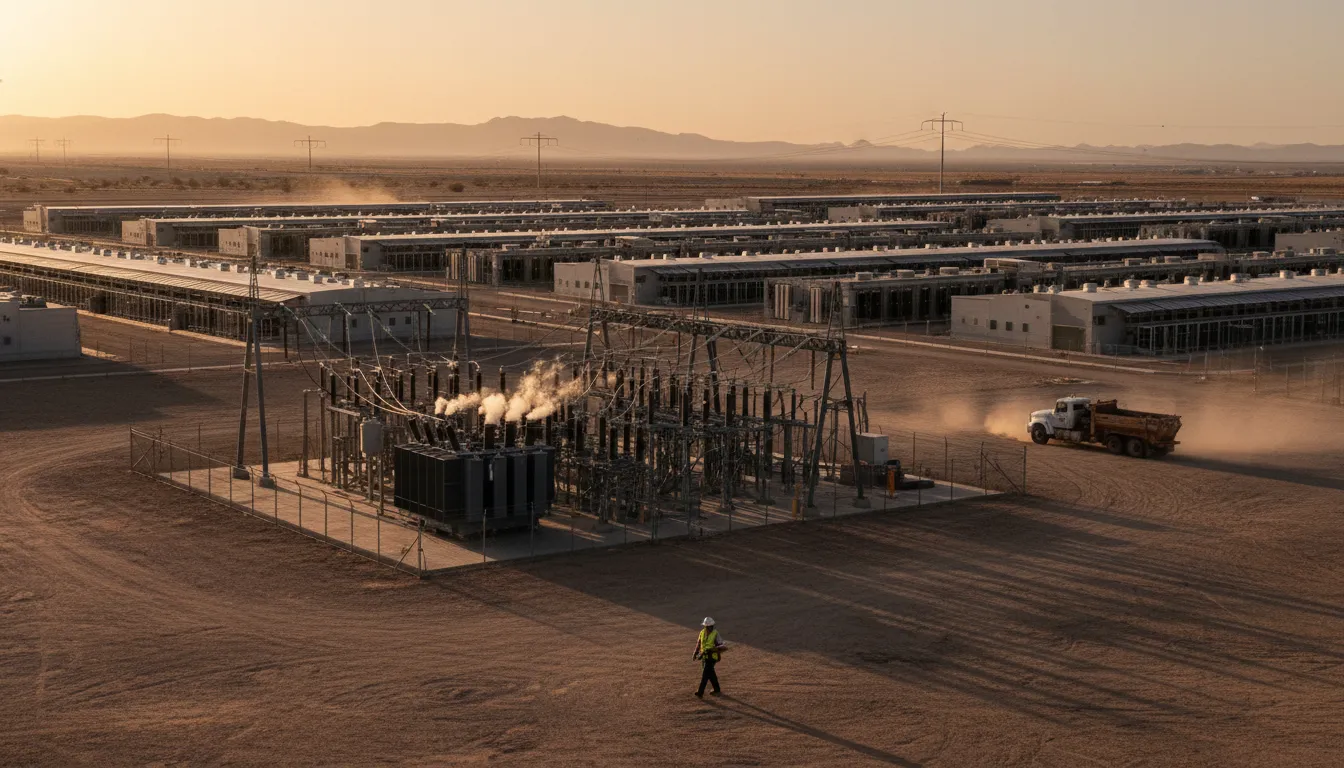
When you type a question into an AI chatbot, the answer feels instant and weightless. In reality, it draws on vast banks of specialized processors housed in warehouse-sized buildings that run around the clock — consuming enormous quantities of electricity and water just to keep their circuits cool.
According to the International Energy Agency (IEA), a single ChatGPT-style query uses roughly ten times more electricity than a conventional Google search. A standard web search consumes about 0.0003 kilowatt-hours; an AI prompt can consume around 0.0026 kWh. Individually those numbers are tiny — but multiplied across billions of daily requests, they add up to a staggering industrial-scale energy demand.
What Happens Inside a Data Center
A data center is essentially a factory for computation. Rows of servers — purpose-built chips called GPUs (graphics processing units) and newer AI accelerators — perform the mathematical operations that power large language models and image generators. Those chips generate intense heat, which must be continuously removed.
About 60% of a data center's electricity goes directly to running servers. The remainder feeds cooling systems — chillers, fans, and in newer facilities, liquid cooling loops that pipe water directly over processors. The Environmental and Energy Study Institute estimates that data centers consumed roughly 560 billion liters of water in 2023 for cooling purposes alone.
Efficiency is measured by a metric called Power Usage Effectiveness (PUE) — the ratio of total facility power to IT equipment power. A perfect score is 1.0; most hyperscale facilities (run by Google, Microsoft, Amazon) achieve 1.1–1.2, while older enterprise data centers can reach 1.5 or higher, wasting half as much energy again on cooling overhead.
Why AI Is Different From Earlier Computing
Traditional servers handle relatively light tasks — storing files, serving web pages, running databases. AI training and inference are computationally far more intensive. Training a large language model from scratch can consume as much electricity as hundreds of transatlantic flights. Even inference — generating a single response — requires a dense cascade of matrix multiplications across billions of parameters.
AI-dedicated accelerated servers are growing at 30% per year in power demand, according to the IEA, compared to just 9% for conventional servers. By 2030, AI's share of total data center electricity could rise from today's 5–15% to as much as 50%.
The Scale of the Problem
Global data center electricity use stood at roughly 415 terawatt-hours (TWh) in 2024 — about 1.5% of all electricity consumed on Earth. The IEA's base-case projection sees that figure more than doubling to 945 TWh by 2030, equivalent to Japan's entire annual electricity consumption.
The United States is the epicenter of the build-out. Pew Research reports that US data centers already account for about 4% of national electricity use, a figure projected to reach 7–12% by 2028. In Ireland, data centers could consume 32% of the country's total electricity by 2026, straining a grid that was never designed for such concentrated industrial loads.
The Carbon Brief notes that data centers and data transmission networks together account for roughly 1% of global CO₂ emissions — a share growing in step with demand.
Can Efficiency Keep Pace?
The tech industry argues that hardware and software improvements will blunt the worst impacts. Newer AI chips are significantly more efficient than their predecessors, and model compression techniques reduce inference costs. Google's internal data, published by MIT Technology Review, suggests that a typical Gemini AI prompt uses around 0.24 watt-hours — roughly the energy of running a microwave for one second — far less than earlier worst-case estimates.
The IEA's "high efficiency" scenario projects data center demand could be 20% lower in 2035 than in the baseline if hardware gains and smarter model architectures are broadly adopted. But demand is also growing faster than efficiency improvements, meaning absolute consumption will still rise substantially.
What It Means for the Grid — and Your Bills
Utilities and grid operators are scrambling to keep up. Data centers are being built faster than new power plants can be permitted and connected. The result is pressure on existing infrastructure, potential reliability risks during peak demand, and upward pressure on electricity prices for households and businesses nearby.
Renewable energy deals — direct power-purchase agreements between tech giants and wind or solar farms — have become the industry's preferred answer to both carbon concerns and grid constraints. But renewable intermittency means data centers often still draw from fossil fuels when the sun isn't shining or the wind isn't blowing.
The AI energy question is ultimately a public policy question: how societies choose to power the digital infrastructure that is rapidly becoming as essential as roads or water systems.